Quick Answer
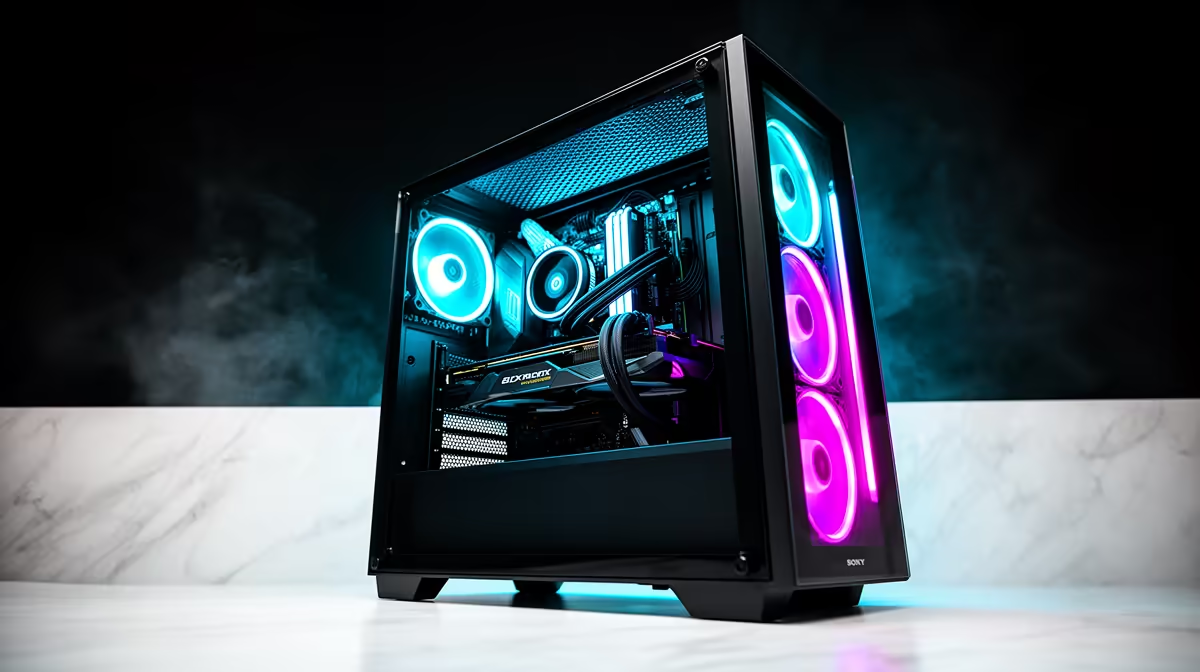
Yes, but only in purpose-designed large mid-towers that explicitly list 450mm or greater GPU clearance on the spec sheet. Most standard ATX mid-towers max out at 360mm to 380mm GPU clearance. A handful of larger mid-towers and most full-towers reach 400mm to 450mm or beyond.
Which Mid-Towers Actually Support 450mm GPU Clearance 🖥️
Cases that legitimately clear 450mm GPUs tend to be physically larger than typical mid-towers, sometimes called super-towers or XL mid-towers. Their internal volume is substantially greater, with case widths of 260mm to 310mm and heights above 500mm.
The key caveat is always front radiator conflict. A case with 450mm GPU clearance measured without a radiator may drop to 380mm to 400mm with a 360mm front-mounted AIO. Confirm the GPU clearance figure the manufacturer provides with a front radiator installed if you plan to run liquid cooling. A 450mm card in a front-radiator-fitted case is a tight fit even in the largest consumer cases.
Cable Management Implications at 450mm GPU Length ⚙️
Very long GPUs make cable management around the GPU power connectors more challenging. Current RTX 5090 and high-end RX 9070 XT cards use 16-pin (12VHPWR or 12V-2x6) connectors. The cable exit point on a 450mm card sits far into the case interior. Ensure your PSU's 16-pin cable reaches comfortably without sharp bends at the connector, which stress the connector pins over time.
A 300mm to 400mm 16-pin PCIe cable extension can help route the cable more cleanly if the standard PSU cable runs at a sharp angle. These are available locally for R100 to R250 and are a sensible addition for any build using very long GPU configurations.
GPU Sag at 450mm Length 🔧
At 450mm, GPU sag is not optional to address. A card this long creates substantial lever arm force at the PCIe slot. Any case designed to house 450mm cards should include an integrated GPU sag bracket or at minimum provide clear mounting points for aftermarket sag supports. Verify this on the product spec sheet before purchasing both the case and the GPU.
Vertical GPU mounting via a PCIe riser cable is an attractive option for 450mm builds. The card in vertical orientation hangs downward rather than cantilevering horizontally, eliminating sag physics entirely. Many large mid-towers include PCIe riser brackets or sell them as compatible accessories.
Measure Twice, Order Once ⚡
Before ordering a 450mm-class card, download the exact GPU length from the manufacturer's spec sheet (not the listed card length, which sometimes excludes the fan shroud overhang) and compare it to the case's stated GPU clearance with your planned AIO configuration. A 5mm discrepancy discovered after delivery means one component has to go back.
FAQ
Do I need a full tower for a 450mm GPU, or can a large mid-tower work?
A carefully selected large mid-tower can work, but the margin for error is small. Full towers are more forgiving at this length because their additional volume keeps cable routing and radiator placement conflicts manageable. For a first build with a 450mm card, a full tower is lower-risk.
What PSU wattage does a 450mm GPU typically require?
Cards long enough to reach 450mm are typically top-tier GPUs like the RTX 5090. These require a quality 1000W to 1200W PSU. The card length does not directly determine wattage, but GPU performance class does: RTX 5090-class hardware draws 450W to 600W under peak gaming load.
Are 450mm GPUs common in South Africa or is availability limited?
Very long partner-card variants of top-tier GPUs like the RTX 5090 are available through Evetech, though they are less common than the standard triple-fan versions that typically measure 310mm to 360mm. If your case maxes out at 380mm, a standard triple-fan variant of the same GPU will fit comfortably.
Building with a very long GPU and need a case that keeps up?
Browse full-tower and large mid-tower cases at Evetech, with GPU clearance specs listed so you can confirm fit before ordering.