Quick Answer
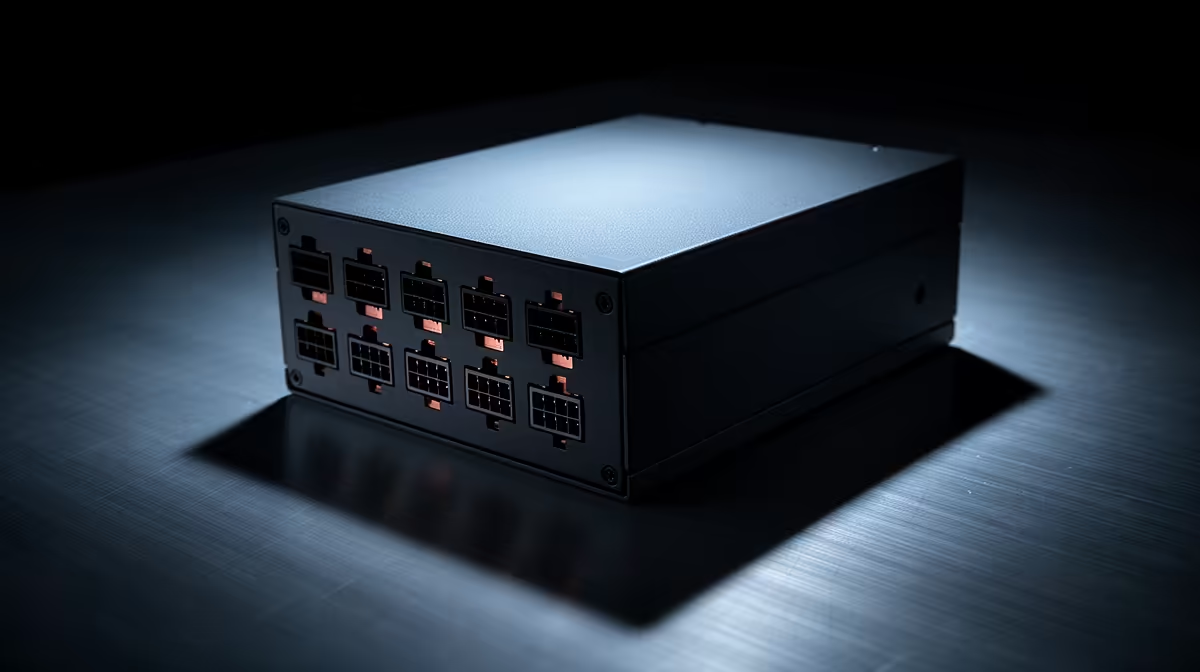
Yes. An underpowered PSU directly causes random crashes, thermal shutdowns, GPU driver failures, and corrupted frames. These symptoms appear under high load because the PSU cannot sustain the required wattage, causing the 12V rail to sag and protective circuits to intervene.
How an Undersized PSU Fails Under Load 🔋
When your system demands more power than the PSU can cleanly deliver, two failure modes occur. The first is rail sag: the 12V output voltage drops below its rated level, typically below 11.4V, at which point the GPU and CPU begin operating outside their specified input range. Modern GPUs throttle aggressively when this happens, causing dropped frames, artifacting, or driver timeouts that present as game crashes. The second failure mode is OPP triggering: the over-power protection circuit detects that delivered power exceeds the unit's rating and cuts power entirely. This is the sudden full shutdown during a heavy gaming session that looks like a power cut but lasts only until you press the power button again. Both symptoms look like GPU driver bugs or Windows instability rather than a power delivery problem.
Diagnosing PSU-Related Instability 🔍
The key diagnostic clue is that crashes occur specifically during load spikes, not at idle or during light use. If your system runs perfectly on the desktop but crashes during the most graphically demanding scenes or during CPU-plus-GPU combined stress, the PSU is the primary suspect. Software tools like HWiNFO64 read the motherboard's voltage rails. If the 12V reading sags below 11.8V under gaming load, the PSU is struggling. Note that motherboard-reported voltages are not perfectly accurate, but a reading below 11.5V is a reliable indicator of rail sag from an undersized or failing unit.
The Real Cost of Running an Inadequate PSU ⚠️
A chronically undersized PSU degrades component life. The GPU's VRMs experience stress when input voltage fluctuates outside spec. Extended operation in rail-sag conditions accelerates capacitor degradation on both the GPU and the motherboard. In South Africa, where RTX 50-series GPU prices range from R15,000 to R45,000-plus, losing a GPU to VRM stress from a R1,500 PSU shortcut is an expensive lesson. Replacing the PSU before a GPU upgrade costs a fraction of the component damage risk.
Test With HWiNFO64 During a Gaming Session ⚡
Download HWiNFO64 and enable the sensors overlay. Run your most GPU-intensive game for 20 minutes and monitor the 12V reading throughout. A healthy PSU holds between 11.8V and 12.2V under sustained load. Consistent readings below 11.7V during gameplay indicate you need a PSU upgrade.
FAQ
Can an underpowered PSU damage my GPU permanently?
Prolonged voltage sag stresses the GPU's VRMs and onboard capacitors. Brief incidents are unlikely to cause instant damage, but repeated crashes from power starvation over weeks or months can accelerate component ageing. Replace the PSU promptly rather than continuing to stress the hardware.
Could a PSU cause instability even if it has the right wattage on paper?
Yes. Cheap PSUs often cannot deliver their rated wattage under real-world conditions, particularly at higher temperatures. A unit rated at 850W may only cleanly deliver 700W at the 35°C ambient temperatures common in South African summers. Always buy from reputable brands with independent test data.
Is an RTX 5070 safe on an older 750W ATX 2.4 PSU?
The RTX 5070 has a roughly 250W TDP. On a system with a mid-range CPU, a quality 750W ATX 2.4 unit may cover the load on paper. However, the ATX 2.4 unit lacks ATX 3.1 transient handling, meaning GPU transient spikes could trigger shutdowns. An ATX 3.1 unit is the correct pairing for any current-gen GPU.
Experiencing crashes or shutdowns under load?
Upgrade to a correctly rated ATX 3.1 power supply from Evetech's local stock, with options from 650W to 1600W that cleanly handle current-gen GPU and CPU combinations.