Quick Answer
Shortened tubing can improve fitment in compact cases, but only within the limits of the specific AIO model's pre-filled closed loop. Most retail AIOs use fixed-length tubing you cannot shorten without voiding the warranty and risking coolant leaks. Purpose-built compact AIOs with shorter tube configurations, or custom loops, are the practical routes to better fitment in small form factor builds.
Why Tube Length Matters in Small Cases 🖥️
In a standard mid-tower, AIO tubing length rarely causes problems. A 360mm or 240mm radiator mounts to the top or front panel, and the 300mm to 400mm tubes common on retail AIOs reach the CPU socket comfortably.
A kinked tube adds resistance to the pump circuit. Asetek Gen 7 and Gen 8 pumps found in most mid-range AIOs are designed to overcome modest resistance, but a hard kink can reduce flow rate by 20 to 35 percent, raising CPU junction temperatures by 5 to 12 degrees Celsius under sustained load. For a Ryzen 7 9800X3D or Core Ultra 9 285K in a compact chassis, that margin matters.
What Manufacturers Actually Offer 🔧
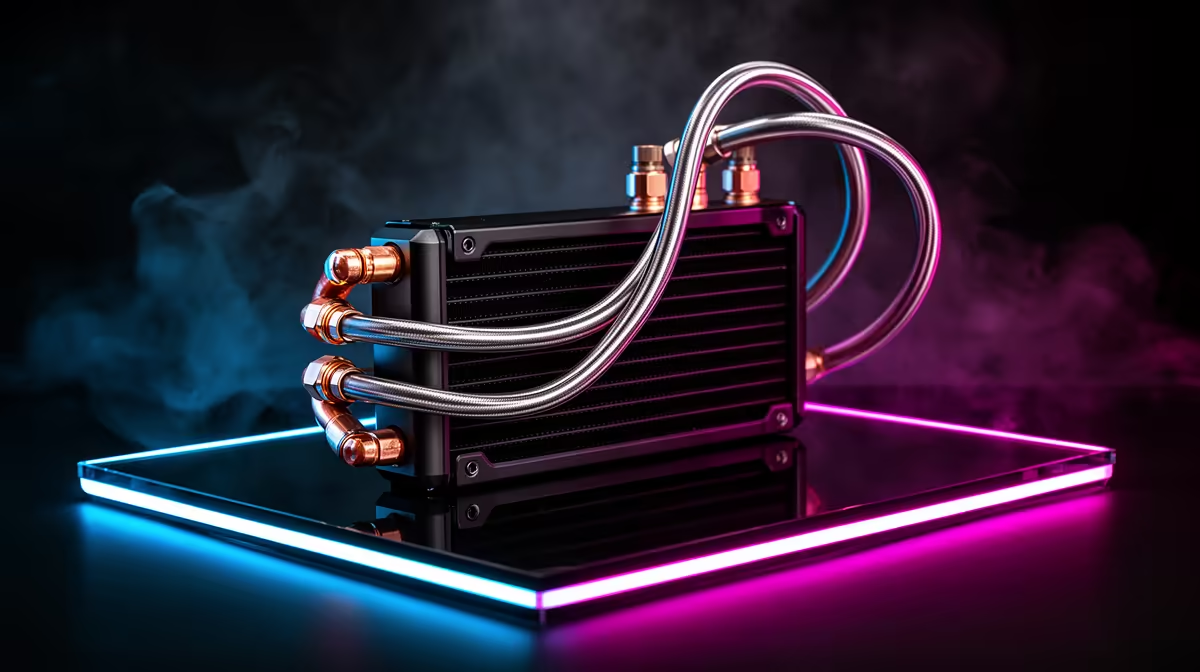
Several AIO manufacturers ship models designed for compact routing. Shorter tube variants (around 250mm to 300mm) are available from brands including Corsair, NZXT, and ASUS in their slim-line or SFF-targeted lineups.
For builders already owning an AIO with tubes that are marginally too long, the practical fix is to reroute the tubes in a gentle S-curve rather than cutting them. Routing over the top of the GPU rather than straight down, or looping behind the motherboard tray if the case has a through-slot, can absorb 40 to 80mm of excess length without restriction.
Custom Loop Considerations for SA Builders 🚀
A soft-tube custom loop using fittings, flexible PETG or silicone tubing, and a separate pump and reservoir gives full control over tube length and routing. This is the correct answer for builders who need precise fitment in cases like the Fractal Design Terra, Lian Li A4-H2O, or similar compact designs. However, custom loops start at around R4,500 to R8,000 for quality components at SA pricing, require more maintenance, and take considerably longer to build than a drop-in AIO.
For most SA compact builders prioritising simplicity, selecting a 120mm or 240mm AIO rated for SFF use and confirming the tube length specification against the case's radiator-to-socket measurement is the safest and most cost-effective approach.
Measure Before You Buy ⚡
Before ordering an AIO for a compact case, measure from the radiator mounting position to your CPU socket with a tape measure. Add 50mm for a gentle bend. If the AIO's listed tube length is shorter than that total, tubes will pull taut under load vibration and can stress the pump fittings over time.
FAQ
Can I cut and re-crimp the tubing on a retail AIO?
Technically possible but not recommended. Retail AIOs are filled and sealed at the factory under controlled conditions. Cutting tubes releases pre-mixed coolant and requires professional re-filling with a vacuum purge station to remove air bubbles. Doing this yourself voids the warranty and risks pump cavitation if air remains in the loop.
What is the shortest 240mm AIO tube length available?
Some compact-targeted AIO models list tube lengths of 270mm to 310mm. Check each product's specifications carefully, as tube length is not always prominently displayed on retailer pages. Looking at the product manual PDF often gives the most accurate measurement.
Do rubber vs braided tubes affect kink resistance in tight cases?
Yes. Braided reinforced tubing has a tighter bend radius before kinking compared to plain rubber tubing. If you are routing tubes through a tight corner in a compact case, choosing an AIO with sleeved or braided tubing reduces the risk of a flow-restricting kink.
Building compact but want proper cooling?
Check the AIO liquid cooler range at Evetech, including compact-friendly 120mm and 240mm options, and filter by tube length to match your case before you buy.