What looks like a bargain online can cost more once you factor in SA warranty access and real-world durability. For Medicine, the right pick is built around the coursework, not the brochure. Buying once and buying right saves a stressful mid-degree replacement at CPUT.
Quick Answer
For Medicine at CPUT, a practical laptop sits around a Core i5 or Ryzen 5 chip with 16GB RAM and a 512GB SSD. Budget roughly R13,000-R16,000 for a machine that lasts the full degree without a mid-course replacement. Watch the festive and back-to-school sales, when value picks swing the hardest.
Buying Smart on an SA Student Budget
Watch for a solid warranty, an SSD you can later swap, and enough USB-C for a docking setup in res. Long battery life matters on ward and clinic days. Confirm the model handles anatomy apps, PDF annotators and video playback before paying, since SA campus Wi-Fi and shared printers add their own load.
What Medicine Coursework Demands
Medicine students at CPUT mostly watch lecture recordings, annotate PDFs and run anatomy apps. That points to a Core i5 or Ryzen 5 chip as the floor, with 16GB RAM and a 512GB SSD so projects, browser tabs and reference PDFs stay open together. A bright, accurate 1080p screen helps with detailed diagrams.
Specs That Survive the Whole Degree
Aim for at least 512GB of storage and 16GB of RAM; both fill faster than first-years expect once recordings and datasets pile up. A bright 1080p panel reduces eye strain across long library sessions, and a 9-hour battery target keeps you working between lecture halls. Spending around R13,000-R16,000 now beats a cheap replacement in second year.
FAQ
Is a gaming laptop overkill for Medicine at CPUT?
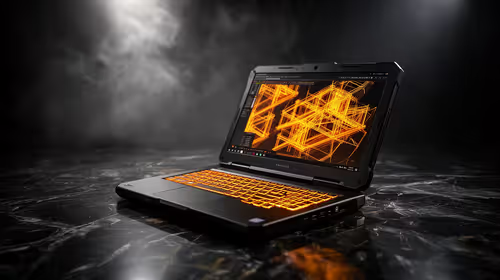
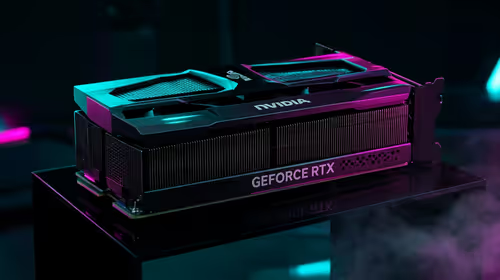
Not necessarily. A discrete GPU helps with 3D anatomy software and gives headroom for the full degree. The trade-off is weight and battery life, so confirm it still fits a daily campus commute.
How much RAM and storage do Medicine students really need?
Target 16GB RAM and a 512GB SSD. Recordings, datasets and project files fill an SSD faster than expected, so an upgrade slot is a real bonus at CPUT.
Should Medicine students prioritise weight or power?
Match it to your commute. If you carry the laptop daily, lean lighter; if it lives on a res desk, prioritise the power 3D anatomy software needs.
Shortlist a CPUT laptop built for Medicine coursework.
Compare models around R13,000-R16,000 with 16GB RAM and a 512GB SSD, check the warranty, then pick the one that lasts the full degree.