Quick Answer
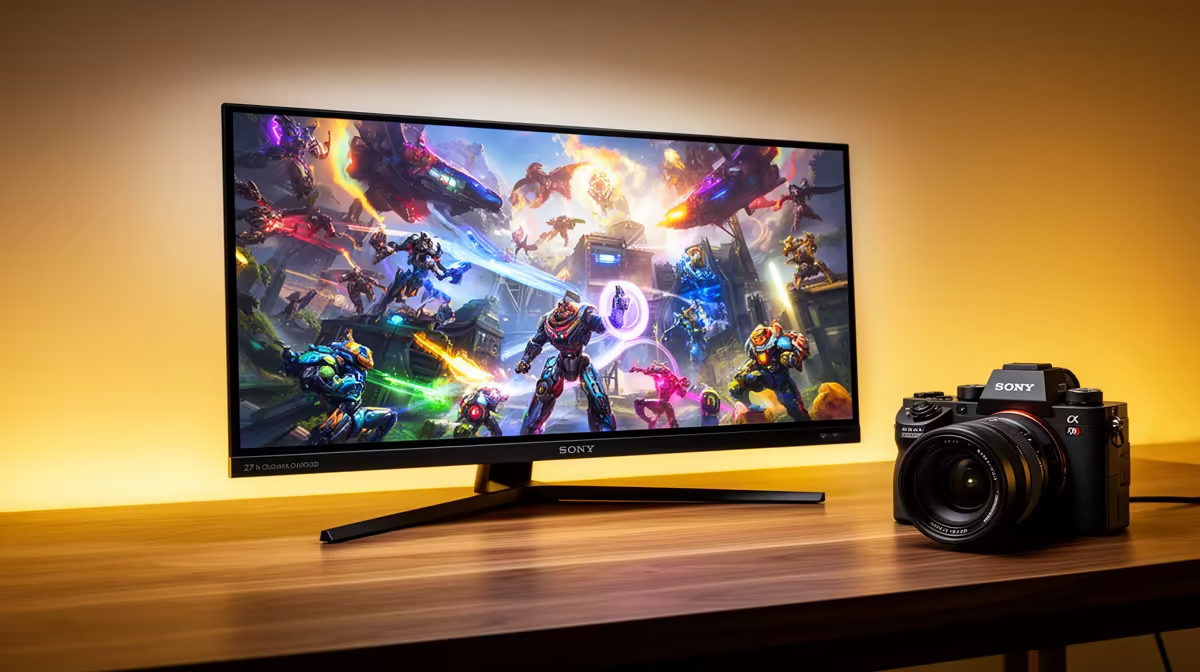
A 27-inch 4K OLED monitor delivers pixel-perfect sharpness at 163 PPI, true black levels, and sub-millisecond response times that no IPS or VA panel can match. For South African buyers, the investment typically sits between R18,000 and R30,000 depending on the model, making it the single biggest visual upgrade you can make to a gaming or WFH desk.
Why OLED Changes Everything at 27 Inches 🖥️
At 3,840 x 2,160 on a 27-inch screen, pixel density reaches 163 PPI. Text is razor-crisp without font smoothing tricks, which matters enormously for a WFH setup where you spend hours reading documents or spreadsheets. On the gaming side, OLED panels like those used in the LG 27GX790A achieve a 0.03ms GtG response, eliminating ghosting that even the fastest IPS panels still show at 1ms. The self-emissive pixel structure means black scenes in games like Cyberpunk 2077 show true black rather than the characteristic grey backlight bleed of LCD technology. Contrast ratios exceed 1,000,000:1, making HDR content genuinely impactful rather than cosmetic.
For WFH workflows, the wide colour coverage (most 4K OLEDs hit 99% DCI-P3) means colour-accurate design work, photo editing, or video review no longer requires a separate calibration display. You get one screen that excels after hours in-game and during working hours without compromise.
GPU Requirements for 4K OLED Gaming 🎮
Driving 4K at the high refresh rates OLED panels support demands serious GPU headroom. At 4K, an RTX 5080 or RTX 5090 is the realistic choice for hitting above 120 fps in demanding titles. An RTX 5070 Ti will manage 4K at 60 to 100 fps in most AAA games with DLSS 4 Quality mode enabled, which at 4K remains visually lossless. For WFH-only use with occasional lighter gaming, an RTX 5070 is workable. HDMI 2.1 handles 4K at 144Hz, while DisplayPort 2.1a UHBR20 is necessary for uncompressed 4K at 240Hz, so confirm your GPU supports the right output before purchasing.
South African buyers should note that GPU prices currently sit between R14,000 for the RTX 5070 range and R40,000-plus for the RTX 5090, so total system cost needs to be planned holistically alongside the monitor budget.
OLED Burn-In and WFH Use 💡
Burn-in is the most common concern when using an OLED display for productivity. Modern OLED monitors address this through pixel shift, logo luminance adjustment, and periodic pixel refresh cycles that run automatically.
Enable Pixel Refresh Before You Sleep ⚡
Run your OLED monitor's pixel refresh or pixel cleaning cycle at least once a week, ideally when you shut down for the night. Most 27-inch 4K OLEDs complete this in under 10 minutes and it extends panel longevity significantly, especially for mixed gaming and desk work use.
FAQ
Is 27 inches the right size for 4K productivity work?
Yes, 27 inches at 4K hits the sweet spot where text is sharp at normal desktop viewing distance (60 to 75 cm) without needing display scaling. Going larger, say 32 inches, reduces pixel density to around 138 PPI where slight softness becomes noticeable at close range.
Do I need to calibrate a 4K OLED monitor for design work?
Most 27-inch 4K OLEDs leave the factory within Delta E 2 for colour accuracy, which is print-production grade. For professional colour grading, a hardware calibration tool will tighten that further, but for general design, photography, and video review the factory profile is accurate enough.
What desk size do I need for a 27-inch monitor in a South African home office?
A desk with at least 120 cm of width and 60 cm of depth gives comfortable viewing distance and space for a keyboard and mouse. Paired with an ergonomic arm mount, you recover desk surface that the standard base would occupy.
Ready to upgrade your gaming and WFH setup with a 4K OLED display?
Browse Evetech's full range of 4K OLED and premium monitors, with local warranty support and knowledgeable staff who can match the right panel to your GPU and workspace.