Quick Answer
For South African gaming rooms and home offices that regularly reach 28 to 35 degrees Celsius in summer, prioritise a small PC case with a high-mesh front panel (60 percent or more open area), at least two front intake fan positions, and top exhaust venting. Compact cases with solid glass fronts are a poor choice in warm local conditions and will push GPU temperatures into thermal throttling territory.
Why SA Ambient Temperature Changes Your Case Choice 🌡️
South Africa's warm climate directly affects PC thermal management.
Front Panel Design: The Most Important Single Decision 🔧
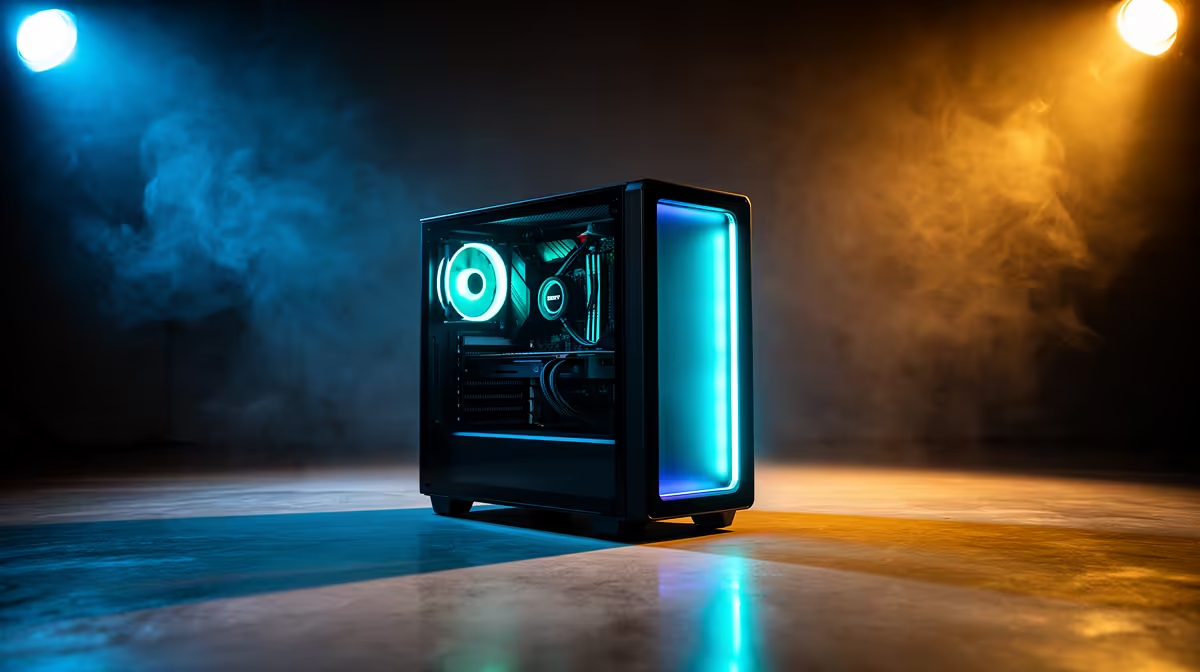
For warm SA gaming rooms, a mesh front panel is not a preference, it is a requirement. Mesh fronts with 60 to 80 percent open area allow two or three 120 mm fans to push fresh ambient air directly over the GPU intake. In thermal testing, a mesh-front compact case runs GPU temperatures five to twelve degrees Celsius cooler than a glass-front equivalent at identical fan speeds. Models like the Fractal Design Pop Mini Air and Cooler Master NR400 use mesh fronts and are locally available in the R1,200 to R1,700 range. If you prefer the look of glass, choose a case where glass is a removable panel over a mesh front, so you can run with mesh for daily gaming and glass for display or photos.
Fan Count, Top Exhaust, and Cable Layout for Warm Rooms 💨
For rooms above 28 degrees Celsius ambient, the minimum fan configuration in a small case is three fans: two 120 mm or 140 mm front intakes and one 120 mm rear exhaust. Adding a top exhaust fan drops GPU temperatures a further four to eight degrees Celsius and is worth the extra R150 to R300 for a 120 mm fan if the case has a top mount. Positive pressure (more intake CFM than exhaust) reduces dust accumulation, which matters in drier parts of SA like the Highveld where dust settles quickly on fan blades and reduces airflow. Keep cables routed tightly behind the motherboard tray to avoid blocking front fan intake paths, as a single fat cable bundle in the front bay can reduce airflow by 20 to 30 percent in compact cases.
Run Your PC in a Low-Ambient-Heat Spot First ⚡
Before assuming your compact case has a thermal problem, check where the PC sits. Placing a small PC in an enclosed desk cavity, in a corner with no airflow space behind the rear exhaust, or directly on carpet that blocks the bottom intake filter raises case temperatures by five to fifteen degrees Celsius without any hardware fault. In warm SA rooms, give the case at least 10 cm of open space on all sides.
FAQ
Do small PC cases get significantly hotter in SA summer compared to winter?
Yes, measurably so. GPU and CPU temperatures typically run five to fifteen degrees Celsius higher in summer in poorly ventilated rooms. This is enough to reduce sustained boost clock frequencies on current-gen GPUs and increase fan noise as the system compensates.
Should I use positive or negative pressure in a small case for a warm SA room?
Positive pressure, meaning more intake fans than exhaust, is recommended. It reduces dust ingestion through ungasketed gaps and provides a cleaner airflow path. In dusty SA conditions, dust on fan blades reduces airflow efficiency within a few months, so less dust entry means more sustained performance.
Is air cooling or an AIO better for small cases in warm SA conditions?
A quality AIO (240 mm or 280 mm) generally outperforms comparable air coolers in compact cases because it moves heat out of the CPU zone and dissipates it at the radiator where fresh air enters. In a warm room with good front intake, a 240 mm AIO on a Ryzen 7 9700X stays under 75 degrees Celsius even on hot days.
Building a PC for a warm SA gaming room or home office?
Browse Evetech's range of small PC cases including mesh-front and high-airflow options designed to handle South Africa's summer conditions.