



Marvel Rivals launch in South Africa
Marvel Rivals launch needs a balanced parts plan, not a random basket. Map the CPU, GPU, RAM, SSD, cooling, and monitor target to the budget so SA builders know where to spend first.
Read moreA multi-GPU or high core-count rig needs a wattage budget that covers transient spikes, not just steady-state draw. Specifications, real-world performance, and ZAR pricing all factor into the recommendation here.
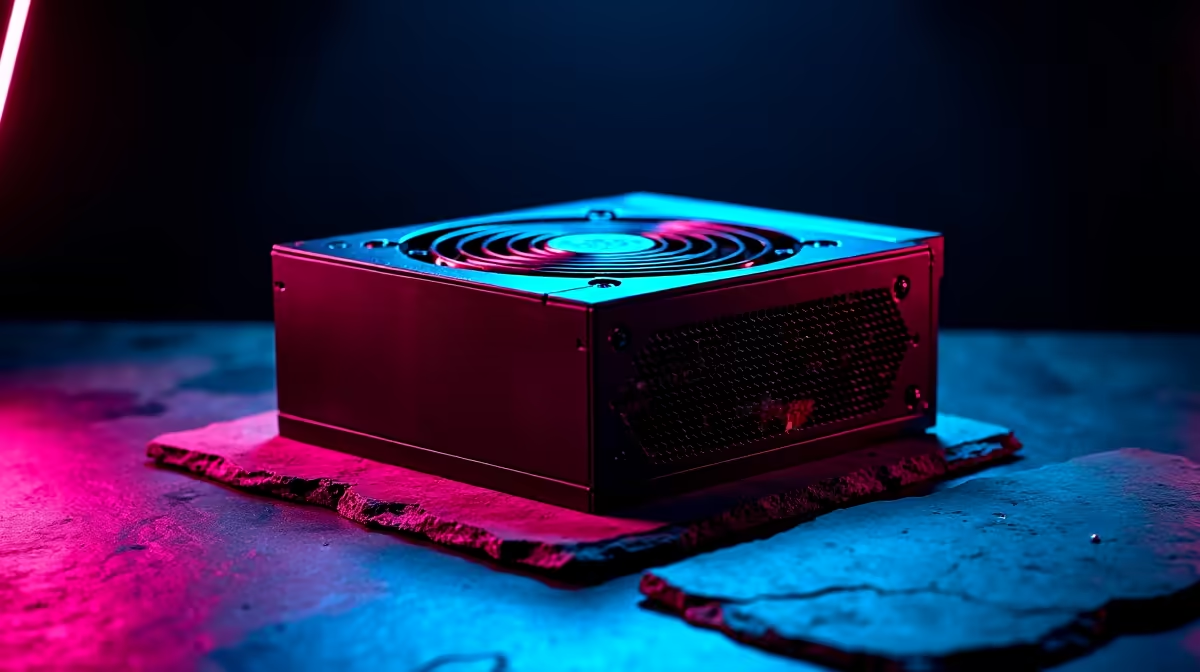
For a dual-GPU or high-core-count workstation, aim for a PSU rated at least 1,200W to 1,600W. Add up the TDP of every major component, then multiply by 1.25 to leave headroom for transient spikes. A 32-core Threadripper paired with two RTX 5090s sits comfortably over 1,400W under sustained load.
Start with GPU TDPs: a single RTX 5090 carries a 575W TDP, so two cards alone demand around 1,150W at stock clocks. A Ryzen Threadripper 7970X at full core load adds roughly 350W more. Factor in NVMe drives (around 7W each), DDR5 ECC RAM, and motherboard VRM draw, and a complete dual-GPU workstation can peak at 1,600W to 1,800W during shader compilation or Monte Carlo rendering. The safe rule is to size your PSU so the system runs between 50% and 80% load at typical workloads because that is where 80 Plus Titanium efficiency peaks and heat output is lowest.
PCIe Gen 5.1 graphics cards draw power through a single 16-pin 12V-2x6 connector rated for 600W continuous. Older PSUs with 8-pin cables can supply that via adapters, but sustained high-current draw through adapter harnesses causes localised heat buildup. ATX 3.1 units ship with native 12V-2x6 cables and are designed to handle the 150% transient power excursions that RTX 50-series cards produce during the first milliseconds of a spike without triggering overcurrent protection. For a South African build investing R80,000 or more, a native ATX 3.1 PSU is not optional.
Single-rail PSUs (one +12V rail) are preferred for multi-GPU setups because they eliminate current imbalance between rails. Multi-rail designs protect against shorts but can nuisance-trip when one GPU pulls hard. At 1,600W you also want a PSU with active power factor correction (PFC) rated for 220V to 240V South African mains so efficiency figures match rated values. The ROG Thor 1600W Titanium and Seasonic Prime TX-1600 are two units currently stocked at Evetech in this class, both carrying full 10-year warranties and 92%+ efficiency at full load.
Use an online PSU calculator with your exact component list, then add 25% on top of the result. In South Africa, Eskom voltage can fluctuate slightly between 218V and 242V, so a unit with a wide 90V to 264V input range protects efficiency ratings from being degraded by mains variation.
No. Two RTX 5090s at stock TDP alone need around 1,150W, and that leaves no headroom for the CPU, drives, or transient spikes. You need at least a 1,600W unit for a stable dual-5090 system.
No. A 1,600W Titanium PSU running at 50% load draws only as much from the wall as the system demands, typically around 900W to 1,000W, plus a small inefficiency tax of around 3% at that load point.
A 32-core CPU plus one RTX 5090 sits around 900W to 1,000W at peak. A 1,200W ATX 3.1 Platinum or Titanium PSU gives adequate headroom without over-spending.
Ready to spec the right PSU for your build? Browse high-wattage ATX 3.1 power supplies at Evetech, where the range covers everything from 850W Gold units to 1,600W Titanium flagships with full local warranty support.
Marvel Rivals launch needs a balanced parts plan, not a random basket. Map the CPU, GPU, RAM, SSD, cooling, and monitor target to the budget so SA builders know where to spend first.
Read more
Path of Exile 2 launch needs a balanced parts plan, not a random basket. Map the CPU, GPU, RAM, SSD, cooling, and monitor target to the budget so SA builders know where to spend first.
Read more
Black Myth Wukong launch needs a balanced parts plan, not a random basket. Map the CPU, GPU, RAM, SSD, cooling, and monitor target to the budget so SA builders know where to spend first.
Read more
Hollow Knight PC requirements should be mapped to resolution, settings and upgrade budget before choosing a tier. Verify current requirements, then balance GPU, CPU, RAM and SSD around SA pricing.
Read more
Hollow Knight build planning should focus on the target resolution, settings and total system balance. Treat launch wording as time-sensitive, then verify requirements before choosing SA PC parts.
Read more
Fallout 4 PC requirements should be mapped to resolution, settings and upgrade budget before choosing a tier. Verify current requirements, then balance GPU, CPU, RAM and SSD around SA pricing.
Read more
Wondering if a TKL wireless mechanical keyboard is worth it for everyday productivity? We break down latency, battery life, comfort, and workflow gains for real work. ⚡⌨️

Maximise battery life on a fanless 15-inch laptop using efficiency core architecture. Cut idle drain, tune power profiles, and improve thermals for longer runtime. 🔋⚙️
Learn how to reduce desk clutter with a TKL wireless keyboard using fewer cables, smart placement, and tidy essentials. Get a faster, calmer workspace with better ergonomics. ✅🧼
RGB keyboard lighting too distracting? Learn how to manage backlight modes, set brightness, and reduce distraction for focus and productivity 😌🖱️

Are themed gaming keyboards worth the extra cost? Compare build quality, switch options, features, and resale value to find the best fit for your setup 🎮⌨️
Full-Size vs Tenkeyless mechanical keyboards for gaming: find out if a smaller layout truly improves aim, speed, and comfort. We break down layout, desk space, latency-feel, and keybinds 🎮⌨️

Dedicated media rollers vs function key shortcuts: learn which setup gives you better workflow control, faster media access, and fewer mistakes. 🖱️🎧
Best Mechanical Switch Type for Gaming: Clicky vs Linear vs Tactile. Find your feel, speed, and noise balance with practical guidance for FPS, MOBA, and productivity 😄🎮

Direct mouse answer: Mouse not keeping up with your work? Everything that matters about dual-mode 2.4GHz + BT 5.0: DPI behaviour, channel switching, battery curves and per-app button mapping. Covers when 2.4GHz USB wins (low-latency desk) and when BT 5.0 wins (laptop, d

Plain wireless mouse guide: Mouse not keeping up with your work? Everything that matters about wireless productivity mouse: DPI behaviour, channel switching, battery curves and per-app button mapping. Includes DPI tuning tips, channel switch shortcuts, and ZAR-aware fea
Real productivity numbers: Set up your wireless mouse in this order: everything that matters about wireless productivity mouse: DPI behaviour, channel switching, battery curves and per-app button mapping. Includes DPI tuning tips, channel switch shortcuts, and ZAR-aware
Pen not feeling like paper? Stylus lag and skipping usually trace to old drivers, dirty nibs, or display refresh mismatches, not the pen itself. Covers pressure curve tuning, tilt thresholds, nib swap timing, and SA pricing brackets.