Quick Answer
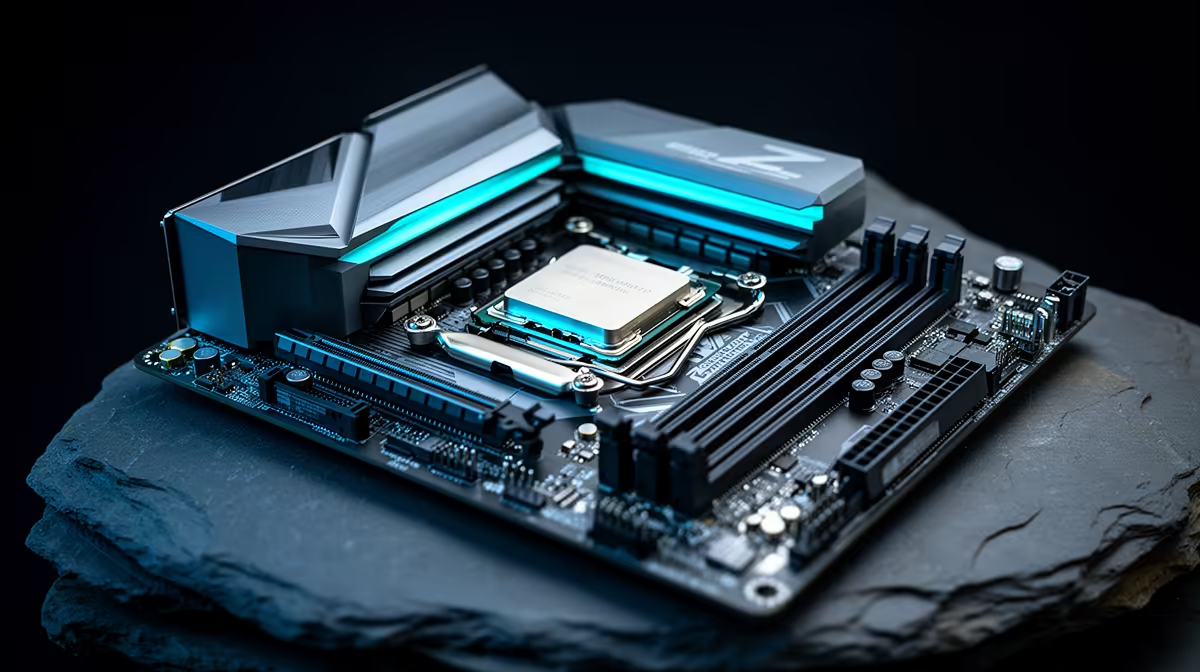
The best motherboard for overclocking the Core Ultra 7 265K is the ASUS ROG STRIX Z890-F GAMING WIFI (R7,000 at Evetech) — an 18-phase 90 A DrMOS VRM sustains 5.7 GHz P-core OC without thermal stress, Wi-Fi 7 and 2.5GbE are included, and ASUS's Extreme Tweaker BIOS provides the precision voltage controls needed for Arrow Lake OC. For maximum OC headroom, the MSI MEG Z890 Ace (R9,500) with a 24-phase VRM is the top pick for 5.8+ GHz attempts.
Core Ultra 7 265K Overclock Roadmap on Z890
| OC target |
VRM requirement |
Board |
AIO needed |
Est. power |
| 5.4 GHz P-core |
12-phase |
Gigabyte Z890M Aorus Elite |
240 mm |
~145 W |
| 5.5–5.6 GHz |
14-phase |
MSI Z890M Mortar / Z890 Tomahawk |
240 mm |
~170 W |
| 5.7 GHz |
18-phase |
ASUS ROG STRIX Z890-F |
360 mm |
~200 W |
| 5.8+ GHz |
24-phase |
MSI MEG Z890 Ace |
360 mm / custom |
~240+ W |
Arrow Lake OC Characteristics vs. Raptor Lake
The Core Ultra 7 265K's Arrow Lake architecture shows different OC behaviour from Raptor Lake:
- E-core OC provides less proportional gaming benefit than P-core OC — focus OC on P-cores first
- DDR5 memory speed has stronger gaming impact on Arrow Lake than Raptor Lake — DDR5-7200 tight timings add 5–8% FPS on top of CPU OC
- Ring (cache) ratio is critical — maintain Ring at P-core minus 2–3× for best latency
- Per-volt frequency ceiling is slightly lower than Raptor Lake's best chips — 5.8 GHz all-core typically requires 1.35–1.38 V vs. i7-14700K's 1.30–1.35 V at the same frequency
BIOS OC Starting Points
ASUS ROG STRIX Z890-F: Use AI Overclocking (AIOC) as initial profile → reduce Vcore by 0.02 V → retest → fine-tune per-core ratio if needed.
MSI MEG Z890 Ace: OC Genie auto profile → export to Extreme Tuner → manually set Ring Ratio and E-core frequencies independently.
FAQ
What is a safe daily Vcore for the Core Ultra 7 265K at 5.7 GHz?
Arrow Lake voltage guidance places the practical 24/7 limit at 1.35 V Vcore. Most 265K chips reach 5.7 GHz P-core at 1.30–1.35 V. Use a negative offset approach: find the minimum stable Vcore at 5.7 GHz using 20-minute Prime95 AVX-512 runs. Minimum stable Vcore reduces heat, extends CPU life, and provides thermal headroom in an mATX or ITX case. Keep CPU temperature under 85°C during gaming loads at whatever OC is chosen.
How does Arrow Lake OC compare to Raptor Lake for SA competitive gamers?
In CS2 and Valorant at 1080p (CPU-sensitive scenarios): a Core Ultra 7 265K at 5.7 GHz with DDR5-7200 CL32 matches or slightly exceeds an i7-14700K at 5.5 GHz with DDR4-3800 in raw 1% low FPS. Arrow Lake's advantage is DDR5 bandwidth — the memory scaling provides a larger FPS headroom for SA gamers running very high framerates (300+ fps in CS2). At 1440p in AAA titles, both platforms are GPU-limited and OC differences are minimal.
Does the Core Ultra 7 265K OC well across all chips (silicon lottery)?
Arrow Lake OC is newer and community data is less mature than Raptor Lake. Based on available reports: most Core Ultra 7 265K chips hit 5.5 GHz stable on 18-phase boards; around 60% reach 5.7 GHz with adequate VRM and cooling. The 5.8 GHz all-core ceiling requires a top-bin chip and custom cooling. SA buyers should treat 5.5–5.6 GHz as the realistic daily target and treat 5.7+ GHz as aspirational depending on their specific chip's quality.
the Core Ultra 7 265K, test with Cinebench R24 nT (10 minutes) first to establish thermal stability, then move to gaming stress testing with CS2 custom deathmatch servers for 30 minutes — CS2's engine is one of the most CPU-intensive gaming workloads at high framerates and will surface instability that a synthetic bench misses at the same temperature.