Quick Answer
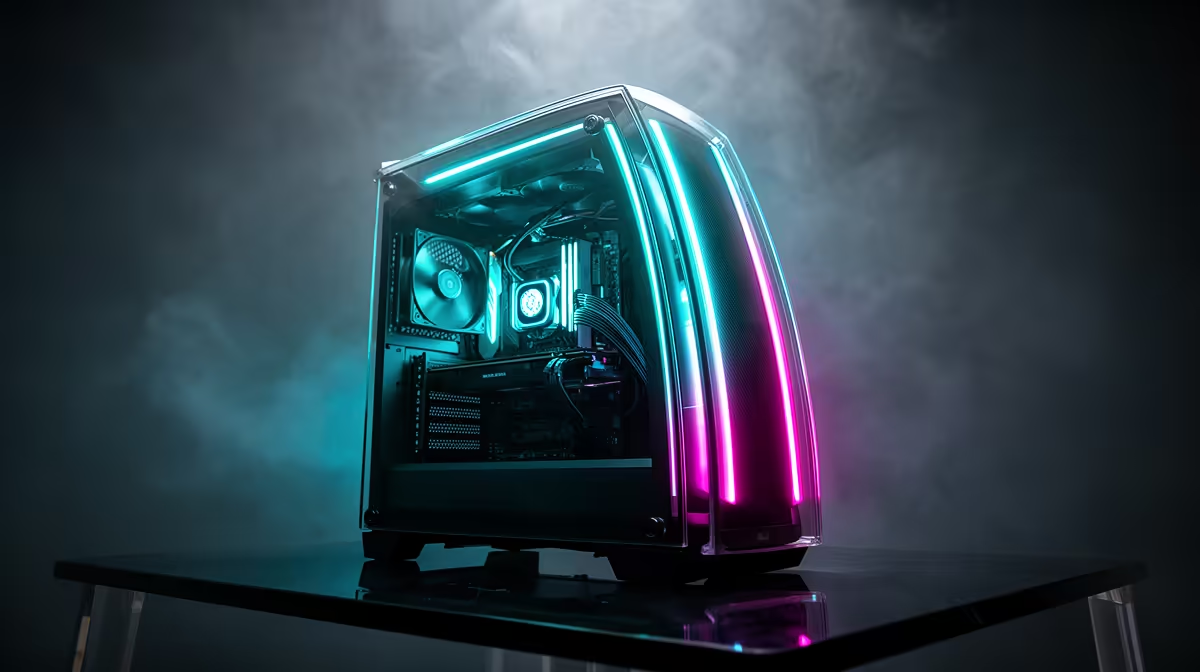
Curved tempered glass side panels look more premium in showcase builds and photographs, but are heavier, more fragile during transport, and more expensive to replace if cracked. Standard flat tempered glass is cheaper, easier to produce in higher thickness for rigidity, and offers the same internal visibility. For a desk-display rig that never moves, curved glass wins on aesthetics; for a PC you carry to LAN events, flat glass is the practical choice.
How Curved Glass Changes the Visual Impact ✨
Curved tempered glass creates a convex or concave profile that reflects ambient room light differently than flat glass. In a dark room with RGB components inside, the curvature creates a lens-like effect that makes internal lighting appear to wrap around the panel, intensifying colour saturation from different viewing angles. This effect is particularly visible with ARGB fans set to a slow colour fade cycle. Cases featuring curved glass typically cost R500 to R1,500 more than an otherwise identical flat-glass equivalent locally, a premium that is purely aesthetic.
Practical Differences in Daily Use 🔧
Flat tempered glass panels are typically 3mm to 4mm thick and remove via thumb screws or a hinge mechanism. Curved glass panels are usually 3mm to 5mm thick at the centre, but the curve introduces a stress concentration at the edges where glass meets the metal frame. Impacts at that join point are more likely to crack a curved panel than a flat one under identical conditions. Replacement cost matters: a flat side panel for most popular cases runs R300 to R800 locally, while a curved replacement for a specific model may need importing if the manufacturer has no local stock, adding weeks and additional cost.
What This Means for Showcase Build Photography 📸
Curved glass introduces reflective distortion that shows up in certain camera angles, while flat glass photographs more accurately to what the eye sees. Professional PC build photographers often prefer flat-glass cases for this reason. The curved panel's advantage is primarily in-person viewing rather than static photography. For a desk display piece in a South African home gaming setup viewed at one to two metres, the curved panel's premium look is genuinely attractive.
Handle Curved Glass with Both Hands ⚡
Curved tempered glass panels are heavier than they appear because the curve requires a thicker slab before shaping. When removing or installing the panel, grip at two points (top and bottom edge) rather than one side. One-handed gripping torques the panel against the hinge or magnetic retention and can chip the edge where glass meets metal.
FAQ
Does curved glass affect cooling compared to flat glass?
Negligible difference. Both types seal the same panel opening, and neither allows meaningful airflow through the side. All relevant cooling intake and exhaust happens through front mesh, top vents, and rear fan mount regardless of panel style.
Are curved glass panels standardised or case-specific?
Curved glass panels are case-specific because curvature radius, frame profile, and mounting mechanism vary by manufacturer and model. You cannot swap a curved panel from one brand onto another brand's frame.
Which panel type is better for dusty environments?
Both types seal similarly against side-panel dust ingress. Dust management depends on front and top filter quality rather than side panel style. Clean filters every four to six weeks regardless of which panel your case uses.
Building a showcase rig you want to be proud of?
Browse Evetech's range of premium gaming cases including models with curved and flat tempered glass panels.