Quick Answer
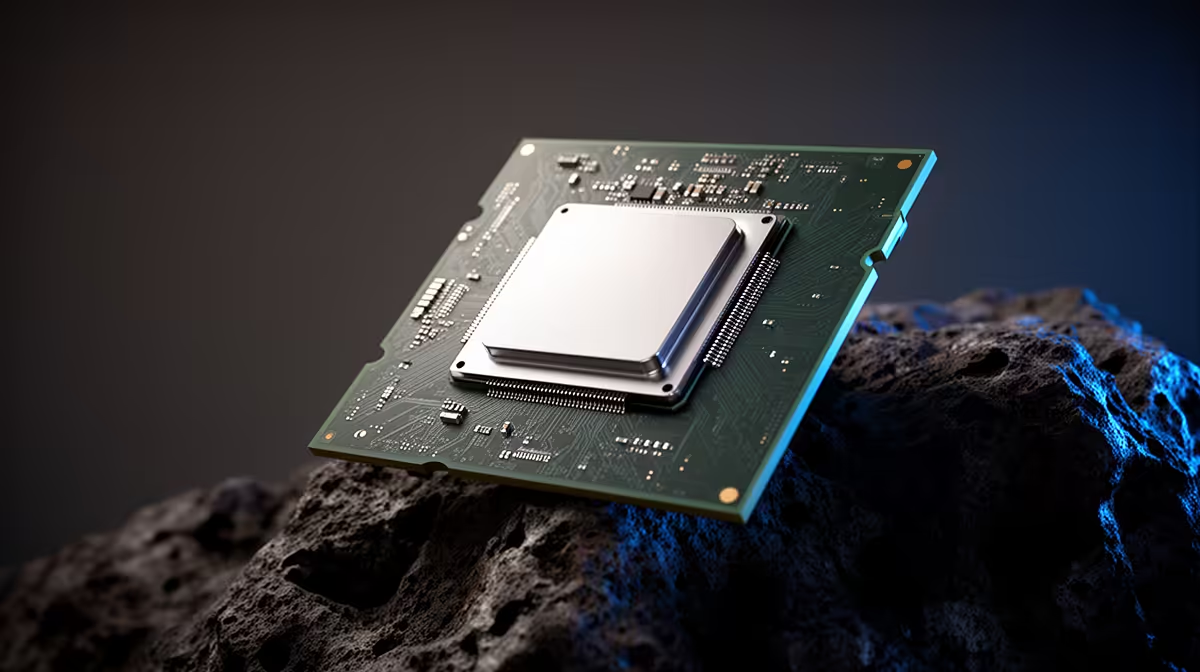
For MMO and live-service games on R12,000, pick the CPU tier that protects frame time before chasing extra cores. The practical shortlist is Ryzen 5 7600 or Core i5-14400F class CPU. Put the bigger share of the budget into the GPU and monitor unless the game is simulation-heavy or you need high-refresh MMO raids.
Decision tree
If the target is 1080p esports-like refresh, choose the stronger gaming CPU first. If the target is 1440p or 4K cinematic play, choose a balanced CPU and spend more on the graphics card. If the title is a large strategy game, city builder, or busy MMO hub, cache and single-thread speed matter more than a long core count.
What the budget changes
At R12,000, avoid paying for unused CPU headroom while the GPU or monitor stays weak. A Ryzen 5 7600 can still make sense in value builds, while a Ryzen 7 7800X3D or 9800X3D is the cleaner high-refresh gaming answer. Broad CPU planning bands run from about R3,000 for value chips to above R10,000 for premium gaming parts.
Pairing rules for SA builds
Use 32 GB DDR5, a B650 or B850 motherboard for AM5, and a cooler that keeps boost clocks steady. A CPU choice should support your monitor target: 60 to 120 fps depending on the GPU and game engine is a useful planning range. For Johannesburg and Cape Town buyers, keep motherboard warranty, BIOS support, and memory compatibility on the same checklist as raw FPS.
FAQ
Should I spend more on the CPU or GPU?
For most MMO and live-service games builds, spend more on the GPU once the CPU is not a bottleneck. Move up to Ryzen 7 X3D only when high-refresh, simulation load, or long platform life is the reason.
Is 32 GB DDR5 enough?
Yes, 32 GB DDR5 is the sensible default for a modern gaming PC. It gives smoother multitasking than 16 GB and avoids overspending on 64 GB unless creator work is part of the plan.
Which CPU is the safest premium pick?
For pure gaming, Ryzen 7 9800X3D is the safest premium-style answer. For mixed gaming and production, Core Ultra 9 285K or a higher-core Ryzen can be considered if the non-gaming work is real.
Pro Tip
Choose the CPU after writing down your monitor refresh rate, target resolution, and three main games; those three facts decide whether cache, cores, or GPU spend matters most.