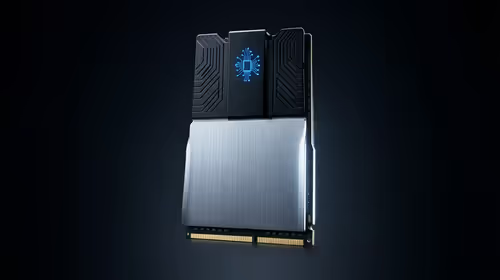
A data scientist's worst friction is the gap between the laptop they prototype on and the cluster they deploy to. Code that works in a notebook breaks on the cloud because the CUDA version differs, a library was pinned wrong, or the model never really ran end to end locally. The DGX Spark is NVIDIA's answer to that gap: a desk-sized machine running the exact CUDA and AI software stack found in its data-centre Grace Blackwell systems, so what works on your desk works unchanged in production.
Quick Answer
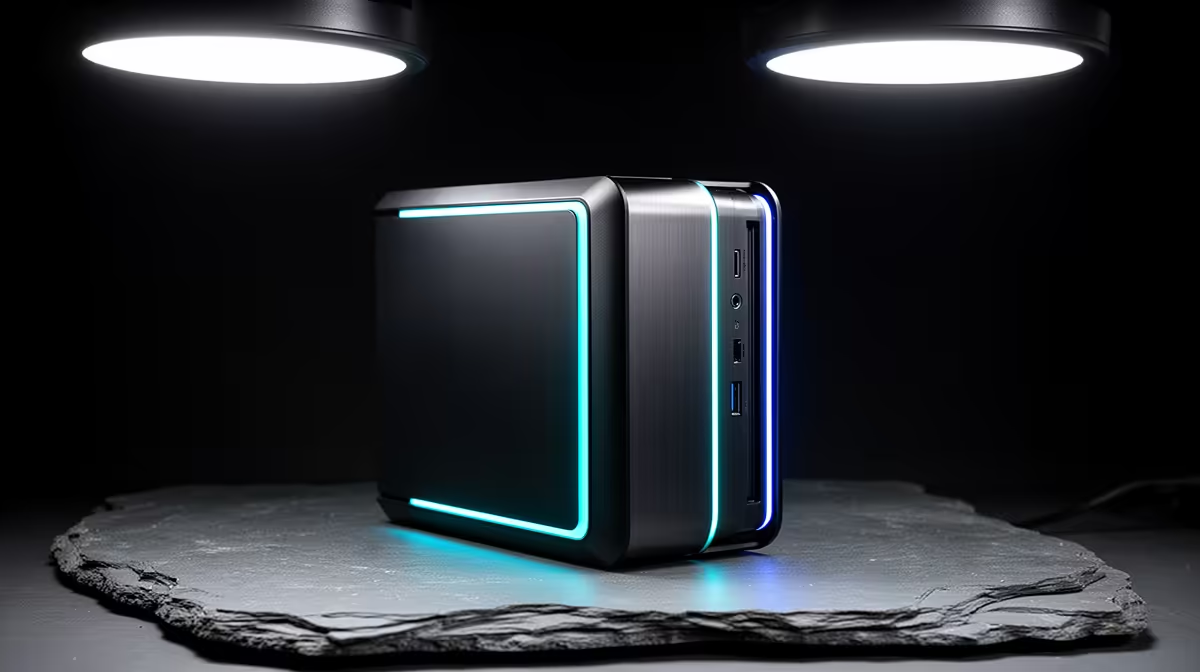
The DGX Spark is a 150mm-square personal AI computer built on NVIDIA's GB10 Grace Blackwell superchip, with 128GB of unified memory and around 1 petaFLOP of FP4 compute, launched at 3,999 USD. For data scientists it matters because it ships with the same vLLM, TensorRT-LLM and NeMo stack as NVIDIA's cloud infrastructure, letting you prototype and fine-tune large models privately and promote the work upstream without rewriting it.
What Is Actually Inside the Box
At the centre sits the GB10 Grace Blackwell superchip, a single package pairing a 20-core Arm CPU (ten Cortex-X925 performance cores and ten Cortex-A725 efficiency cores) with a Blackwell GPU carrying fifth-generation Tensor Cores. The headline figure is the memory: 128GB of LPDDR5x as one coherent pool shared between CPU and GPU over NVIDIA's NVLink-C2C link, which carries roughly five times the bandwidth of PCIe Gen 5.
That unified pool is the part data scientists should care about most. On a normal workstation, a 24GB or 32GB GPU forces you to shard a large model or offload to system RAM across a slow PCIe bus. With 128GB coherent memory, models that simply will not load on a consumer card fit in one space the GPU can address directly. The unit draws about 240W from a standard wall socket, weighs around 1.2kg, and includes up to 4TB of NVMe storage.
Where the petaFLOP figure is honest
The 1 petaFLOP number is FP4 compute, the lowest-precision mode, useful for inference on quantised models rather than a measure of full training throughput. Read it as: this device is built to run and fine-tune large models efficiently, not to replace a rack of training GPUs. For prototyping, evaluation and inference workloads, that is exactly the right tool.
The Stack Is the Real Product
Hardware aside, the reason a data scientist chooses DGX Spark over a self-built workstation is software parity. It ships with DGX OS, a tuned Ubuntu 24.04 LTS, with NVIDIA's full stack preinstalled: CUDA, cuDNN, RAPIDS, NCCL and TensorRT-LLM, plus access to NIM microservices and the NeMo framework through an included NVIDIA AI Enterprise licence. These are the same components running on data-centre DGX systems.
The practical payoff is a clean promotion path. You build a fine-tuning run or an inference service against NeMo and TensorRT-LLM on the Spark, validate it on real model sizes, and move it to a cloud DGX instance with the container and code intact. No "works on my machine" surprises from a mismatched CUDA version or an unpinned dependency, because the environment is the same one your cloud target uses.
Performance has improved since launch
NVIDIA's CES 2026 software update delivered up to 2.5 times the performance of the launch firmware on the same hardware, through TensorRT-LLM optimisations and speculative decoding. That is worth knowing: the device you would buy today is materially faster at inference than early reviews suggested, and the gain came from software rather than a hardware revision.
Who It Is For, and Who Should Skip It
The Spark fits a data scientist or small research team that needs to work with large models on sensitive data, where sending datasets to a cloud endpoint is a compliance or privacy problem. Keeping the model and data inside your own walls, with no per-hour cloud bill accumulating during long experiments, is the core argument. It also suits anyone whose workflow leans on the NVIDIA stack and who wants their local environment to mirror production exactly.
It is the wrong purchase if your work is light enough to run on a single consumer GPU, or if you genuinely need to train large models from scratch, which still belongs on multi-GPU cloud or cluster hardware. The Spark is a prototyping and inference companion to that infrastructure, not a substitute for it. If your needs sit below it, a strong single-GPU build is more flexible and far cheaper; the GPU best sellers cover the cards that handle most local model work without the unified-memory premium.
Fitting it into a South African workflow
For SA teams the privacy and cost case is sharper than the spec sheet suggests. Cloud GPU hours billed in USD add up quickly against the Rand, and a long fine-tuning sweep that runs for days turns into a real bill. A capital purchase you run locally removes that meter entirely, and your data never leaves the building. If you are weighing a Spark against assembling a comparable local AI rig, the AI PC range at Evetech shows what an equivalent self-built workstation costs to put together here.
How It Compares to a Single-GPU Build
The honest comparison for most data scientists is not Spark versus cloud, it is Spark versus a workstation with one big consumer GPU. A 24GB or 32GB card is faster at raw compute for what fits in its memory, and for models that comfortably load on it, a self-built tower will often run them quicker and cost less. The Spark wins specifically when the model does not fit: its 128GB unified pool addresses model sizes a consumer card simply cannot hold without painful sharding or offloading.
So the decision comes down to the size of the models you actually work with. If your day-to-day is fine-tuning and serving models that exceed 32GB, the Spark's memory is the deciding feature and the integrated stack is a bonus. If your models fit a single card, a conventional build gives you more flexibility, easier upgrades and a lower price, and you keep a machine that also handles gaming, rendering or other GPU work the Spark is not built for.
Frequently Asked Questions
Can the DGX Spark train large models from scratch?
Not really. Its strength is prototyping, fine-tuning and inference on large models thanks to 128GB of unified memory, but full from-scratch training of very large models still needs multi-GPU cloud or cluster hardware. Treat the Spark as a local companion to that infrastructure.
How does it differ from a normal GPU workstation?
The key difference is 128GB of coherent unified memory shared between CPU and GPU, so models that will not fit on a 24GB or 32GB consumer card load in one addressable space. It also ships with NVIDIA's full data-centre software stack preinstalled, which a self-built workstation does not.
Will my code move to the cloud without changes?
That is the design goal. Because the Spark runs the same CUDA, TensorRT-LLM and NeMo stack as NVIDIA's data-centre DGX systems, work validated locally promotes to a cloud DGX target with the container and code intact, avoiding environment mismatches.
Is it faster now than at launch?
Yes. NVIDIA's CES 2026 software update brought up to 2.5 times the inference performance of the launch firmware on the same hardware, through TensorRT-LLM tuning and speculative decoding.
Does it need special power or cooling?
No. It draws around 240W from a standard wall socket and fits in a 150mm-square footprint, so it sits on a desk like any small workstation rather than needing data-centre infrastructure.
Bringing model work in-house means owning the right hardware. Talk to Evetech about the AI PC and workstation range to match a local AI build to how your data science team actually works.