



Marvel Rivals launch in South Africa
Marvel Rivals launch needs a balanced parts plan, not a random basket. Map the CPU, GPU, RAM, SSD, cooling, and monitor target to the budget so SA builders know where to spend first.
Read moreDaisy-chain ARGB on a 360mm AIO cuts six to nine connectors out of the radiator stack, which makes airflow paths cleaner and keeps cable combs tidy. SA pricing, warranty cover and current stock are factored in.
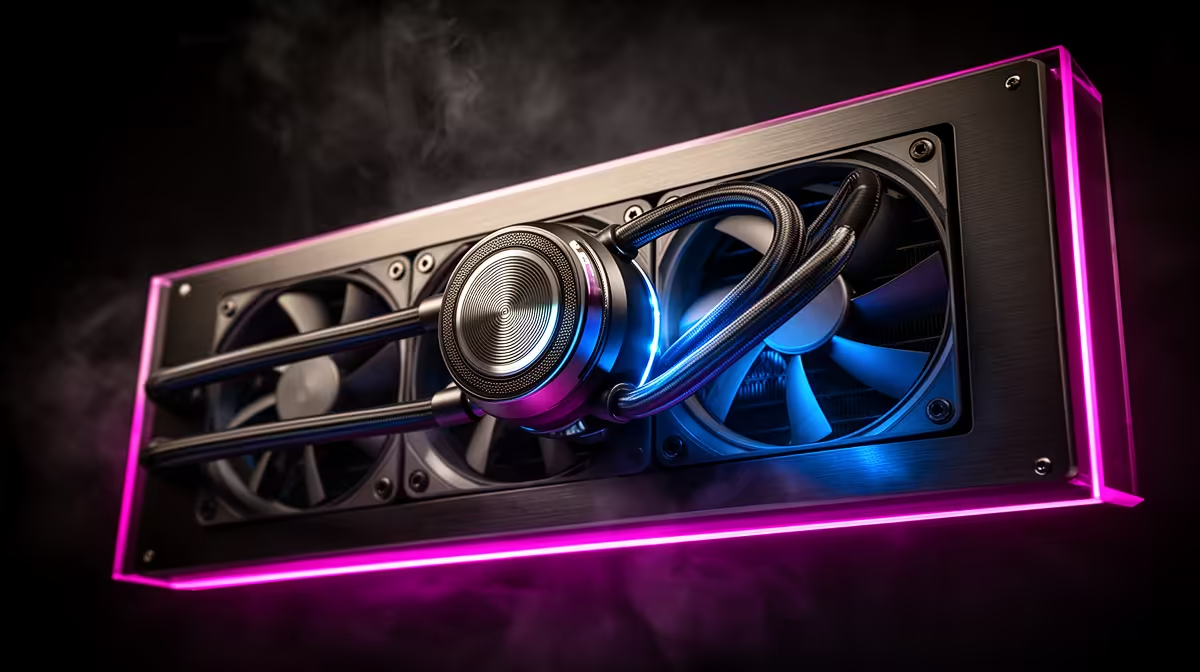
Yes, South Africa's higher average ambient temperatures make a 360mm AIO a more justifiable choice than in cooler European or North American climates. When ambient room temperatures in Pretoria, Johannesburg and Durban regularly reach 28 to 35 degrees Celsius in summer without air conditioning, the additional thermal headroom of a 360mm radiator prevents throttling that a smaller cooler would encounter at those ambient conditions.
CPU coolers do not cool to an absolute temperature; they cool to a delta above ambient. A cooler that keeps a Ryzen 7 9700X at 68 degrees Celsius at a 20-degree ambient will push that same CPU to 83 degrees at a 35-degree ambient, all else being equal. This matters for South African builders without air conditioning, which describes the majority of home gaming setups outside Cape Town's moderate coastal climate. A 240mm AIO operating at the edge of its thermal budget in European conditions becomes a throttling risk during a SA summer afternoon. A 360mm AIO offers roughly 8 to 14 degrees Celsius additional thermal headroom at equivalent ambient temperatures.
The impact is greatest for builders in Gauteng and other inland highveld areas where summer temperatures are consistently high and homes rely solely on ventilation. A gaming session on a January afternoon in Pretoria can take place in a room at 30 to 34 degrees Celsius. Under these conditions, a Ryzen 9 9950X running a game plus stream will hit thermal limits on a 240mm AIO noticeably sooner than on a 360mm unit. Coastal cities like Cape Town typically have cooler summers. Durban's high humidity reduces radiator efficiency slightly compared to the highveld's dry heat.
In SA's current market, the step from a quality 240mm AIO to a comparable quality 360mm AIO costs roughly R600 to R1,200 extra. This premium buys approximately 8 to 14 degrees Celsius lower peak temperatures and meaningfully extended sustained boost clock stability during summer ambient conditions. For a build centred on a CPU costing R7,000 to R12,000, protecting that investment from thermal stress during five to seven years of SA summer gaming sessions justifies the radiator upgrade cost. Evetech stocks 360mm AIOs across the R2,200 to R5,500 price range, with options for both mid-range and flagship CPU platforms.
A simple digital thermometer near your PC gives you accurate ambient data to compare against your CPU sensor readings. This helps you calibrate whether temperature issues are caused by inadequate cooling or simply by operating in a hot room, guiding whether better cooling or better room ventilation solves the problem first.
Not always. For CPUs with 65W TDP like the Ryzen 5 9600X, a quality 240mm AIO provides adequate cooling even at 35-degree ambient. The 360mm advantage is most significant for CPUs above 125W TDP that are more sensitive to ambient temperature changes.
Yes. A well-ventilated case with multiple intake and exhaust fans lowers the internal chassis ambient temperature by 2 to 5 degrees Celsius relative to a poorly ventilated case. Combined with a 360mm AIO, good case airflow is the most effective combination for SA summer conditions.
AIOs with thicker radiators, 30mm to 38mm, and high-static-pressure fans maintain better performance at elevated ambient temperatures because they have more thermal mass to absorb heat before it conducts to the coolant. Look for these specifications when selecting a unit for use in warm SA conditions.
Building in a warm South African climate? Browse Evetech's 360mm AIO range to find cooling solutions with the headroom to handle SA summer ambient temperatures comfortably.
Marvel Rivals launch needs a balanced parts plan, not a random basket. Map the CPU, GPU, RAM, SSD, cooling, and monitor target to the budget so SA builders know where to spend first.
Read more
Path of Exile 2 launch needs a balanced parts plan, not a random basket. Map the CPU, GPU, RAM, SSD, cooling, and monitor target to the budget so SA builders know where to spend first.
Read more
Black Myth Wukong launch needs a balanced parts plan, not a random basket. Map the CPU, GPU, RAM, SSD, cooling, and monitor target to the budget so SA builders know where to spend first.
Read more
Hollow Knight PC requirements should be mapped to resolution, settings and upgrade budget before choosing a tier. Verify current requirements, then balance GPU, CPU, RAM and SSD around SA pricing.
Read more
Hollow Knight build planning should focus on the target resolution, settings and total system balance. Treat launch wording as time-sensitive, then verify requirements before choosing SA PC parts.
Read more
Fallout 4 PC requirements should be mapped to resolution, settings and upgrade budget before choosing a tier. Verify current requirements, then balance GPU, CPU, RAM and SSD around SA pricing.
Read more
Wondering if a TKL wireless mechanical keyboard is worth it for everyday productivity? We break down latency, battery life, comfort, and workflow gains for real work. ⚡⌨️

Maximise battery life on a fanless 15-inch laptop using efficiency core architecture. Cut idle drain, tune power profiles, and improve thermals for longer runtime. 🔋⚙️
Learn how to reduce desk clutter with a TKL wireless keyboard using fewer cables, smart placement, and tidy essentials. Get a faster, calmer workspace with better ergonomics. ✅🧼
RGB keyboard lighting too distracting? Learn how to manage backlight modes, set brightness, and reduce distraction for focus and productivity 😌🖱️

Are themed gaming keyboards worth the extra cost? Compare build quality, switch options, features, and resale value to find the best fit for your setup 🎮⌨️
Full-Size vs Tenkeyless mechanical keyboards for gaming: find out if a smaller layout truly improves aim, speed, and comfort. We break down layout, desk space, latency-feel, and keybinds 🎮⌨️

Dedicated media rollers vs function key shortcuts: learn which setup gives you better workflow control, faster media access, and fewer mistakes. 🖱️🎧

Best Mechanical Switch Type for Gaming: Clicky vs Linear vs Tactile. Find your feel, speed, and noise balance with practical guidance for FPS, MOBA, and productivity 😄🎮
Direct mouse answer: Mouse not keeping up with your work? Everything that matters about dual-mode 2.4GHz + BT 5.0: DPI behaviour, channel switching, battery curves and per-app button mapping. Covers when 2.4GHz USB wins (low-latency desk) and when BT 5.0 wins (laptop, d

Plain wireless mouse guide: Mouse not keeping up with your work? Everything that matters about wireless productivity mouse: DPI behaviour, channel switching, battery curves and per-app button mapping. Includes DPI tuning tips, channel switch shortcuts, and ZAR-aware fea
Real productivity numbers: Set up your wireless mouse in this order: everything that matters about wireless productivity mouse: DPI behaviour, channel switching, battery curves and per-app button mapping. Includes DPI tuning tips, channel switch shortcuts, and ZAR-aware
Pen not feeling like paper? Stylus lag and skipping usually trace to old drivers, dirty nibs, or display refresh mismatches, not the pen itself. Covers pressure curve tuning, tilt thresholds, nib swap timing, and SA pricing brackets.