Quick Answer
Under R20,000 you can buy a genuine high-refresh 1440p or entry 4K card in South Africa, with the RTX 4070 Super and RX 7800 XT class landing in this band and delivering 90-120 fps at 1440p ultra. Spend the extra over the R10,000 tier only if you run a 1440p 165Hz panel or aim at 4K 60.
The Performance Jump From R10,000 To R20,000
Doubling the budget roughly doubles usable frame rate at 1440p. Where a sub-R10,000 card sits at 60 fps ultra, a R20,000-class card pushes 90-120 fps in the same scene and adds enough VRAM (12-16GB) to keep textures maxed. That headroom is what lets a card stay relevant for four years rather than two.
This band also unlocks credible 4K 60. Titles that ran at 35 fps on a budget card now hit 55-70 fps at 4K high, especially with quality upscaling. If your panel is still 1080p, this tier is overkill; the money is better split toward a 1440p monitor.
Cooling, Power And Case Fit
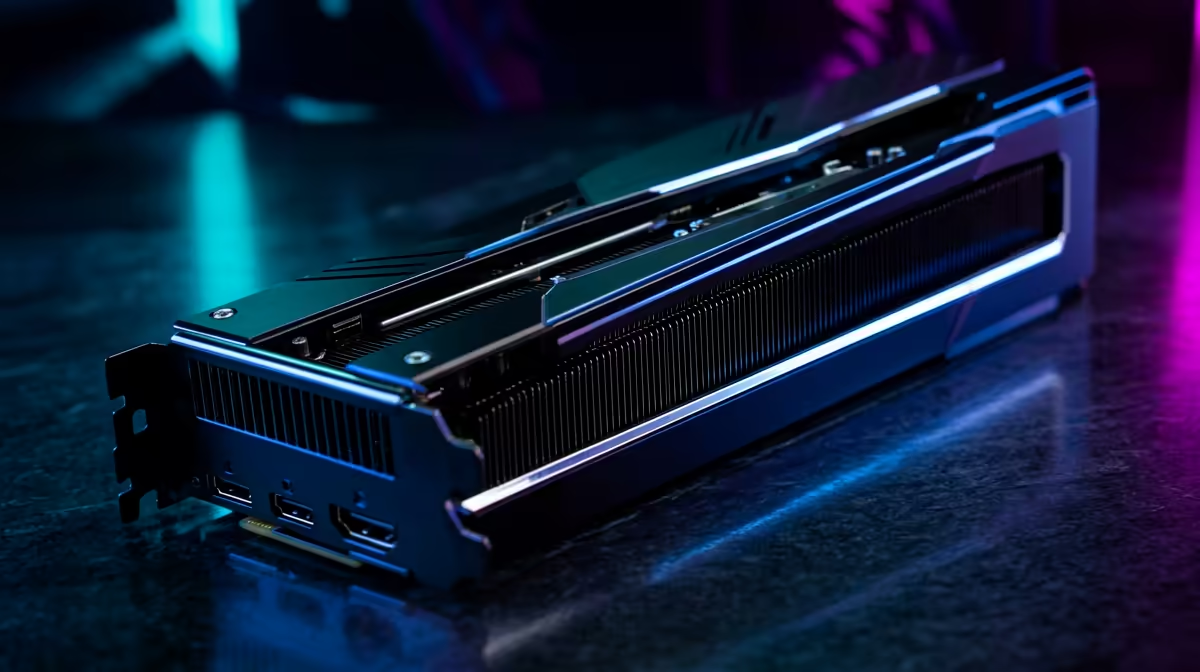
Cards at R20,000 draw 200-285W and run two or three fans, so confirm your case has 300mm+ GPU clearance and a 750W PSU. Good airflow keeps these chips under 72C, which protects boost clocks during long Joburg-summer sessions where ambient temps climb.
FAQ
Is a R20,000 GPU enough for 4K gaming?
For 4K 60 with high settings and upscaling, yes in most titles. For 4K 120 in demanding AAA games you would need to step above this band, so treat these cards as 1440p-high-refresh or 4K-60 buys.
How much VRAM should I expect at this price?
12GB to 16GB. That is enough to max textures at 1440p and run 4K without memory stutter, which is the main reason this tier ages better than budget cards.
What PSU is safe for a R20,000 card?
A reputable 750W unit. These GPUs draw 200-285W, and 750W leaves headroom for transient spikes plus a mid-to-high CPU.
Compare the 1440p cards under R20,000 stocked at Evetech and pick the one that matches your panel's refresh rate.