If you already run an FDM machine and want crisp miniatures, jewellery masters, or dental-grade detail, adding resin is the obvious next move, and the question is rarely whether to do it but which printer earns the bench space. In South Africa the realistic shortlist comes down to the budget Halot R6 at R3,999 against the larger Saturn-class machines, and the right pick depends entirely on how many parts you push and how big they get.
Quick Answer
For a first resin printer alongside an FDM rig, the Creality Halot R6 at roughly R3,999 is the cheapest sensible entry and prints single figures beautifully. If you batch miniatures or print larger busts, a Saturn-class machine costs more but its bigger plate pays for itself fast. Both the printers and their consumable resin are stocked locally.
Why FDM Owners Add a Resin Printer
FDM and resin solve different problems, which is exactly why owning both makes sense rather than replacing one with the other. Your filament machine handles brackets, enclosures, functional jigs, and anything that has to survive being dropped or torqued. Resin handles fine surface detail that FDM layer lines simply cannot reach: chainmail on a 32mm miniature, the facets of a ring master, the seam of a model kit.
The mistake is treating resin as an upgrade to FDM. It is a parallel tool. You keep printing functional parts on filament and route detail work to the resin tank. Once you see both running side by side, the workflow split feels obvious. If you want to compare current models and tank sizes before committing, the resin section of Evetech's 3D printer catalogue lays the options out by build volume and price.
The Halot R6 at R3,999: The Low-Risk Entry
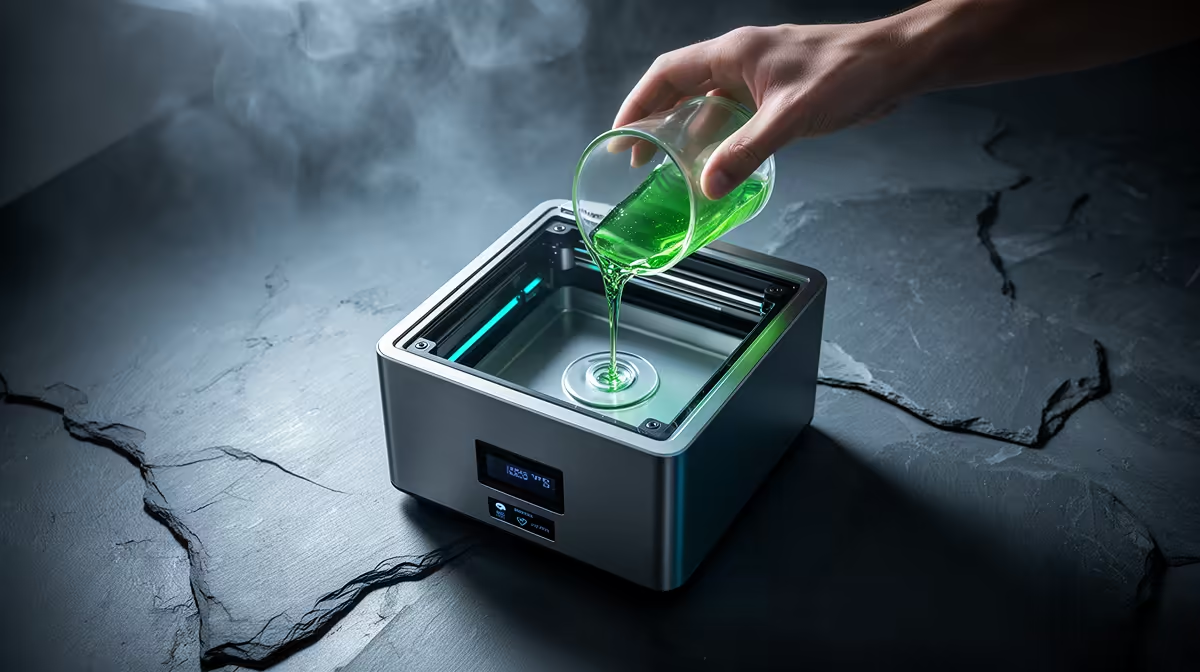
The Halot R6 is the machine to buy if you want to learn resin without a big outlay. At around R3,999 it sits at the bottom of the price ladder. Its build plate measures 130 x 82mm with 160mm of Z travel, which suits standard 28mm to 75mm figures well. The monochrome LCD cures fast and the footprint is small enough to share a desk with your existing printer. Print speed reaches 60mm/h in normal operation, which is quick enough to run a pair of models overnight without babysitting.
Where the R6 Shines
A solo painter or tabletop hobbyist printing one hero model at a time will rarely outgrow it. Print quality on a well-dialled R6 is genuinely excellent for the price, and because resin chemistry is the same across machines, the skills you build here transfer straight up to anything bigger later.
Where the R6 Holds You Back
The plate is the limit. Try to fill it with twenty rank-and-file troops and you will be running multiple jobs back to back, each with its own wash and cure cycle. At 130 x 82mm you cannot nest a full unit of 32mm infantry in a single pass. For occasional printing that is fine. For volume it becomes a bottleneck that costs you hours per week.
Saturn-Class: When the Bigger Plate Pays Off
Saturn-class printers offer a build area starting around 218 x 123mm with taller Z travel, which is more than double the Halot R6's plate in usable surface area. Models in this tier such as the Elegoo Saturn 4 feature 12K resolution monochrome screens and up to 218 x 122 x 220mm of build space. You are buying area and resolution, not just a bigger version of the same printer.
The larger plate lets you nest a full unit of miniatures, several ring shanks, or a couple of large busts into one print and walk away. For anyone selling prints, running a small studio, or supporting a gaming group, that throughput is the entire value proposition.
Batch Maths
If you regularly print ten or more small parts in a session, a big plate cuts your total job count, your handling time, and your IPA washing rounds dramatically. The price gap closes quickly once your time has a value attached to it. Two Saturn runs replace five or six Halot runs for the same output, and each saved wash cycle is fifteen to twenty minutes you get back.
Resolution Is Not the Deciding Factor
Both tiers resolve fine detail well. The genuine difference between them is plate size and the build height you get for taller models. Choose on volume and part dimensions, not on a spec-sheet pixel count.
Running Resin Safely Alongside FDM
Resin printing adds requirements your FDM setup never had. You need nitrile gloves, a wash-and-cure routine, and decent ventilation, because uncured resin and its fumes are not something to be casual about. Keep the resin machine in a ventilated spot, never the sealed cupboard where your filament printer happily lives. Budget for IPA, a wash station, and a UV cure step from day one, since the printer alone is only part of the kit.
Consumables matter too. Standard, water-washable, and tough resins each behave differently, and keeping a bottle or two on hand means you are not stalled mid-project. Local stock helps here, and you can fold resin, gloves, and finishing supplies into a single order from the maker accessories range rather than chasing parts from multiple sources.
Frequently Asked Questions
Should my first resin printer be the Halot R6 or a Saturn-class machine?
Pick the R6 at around R3,999 if you print single models occasionally and want the lowest entry cost. Step up to a Saturn-class machine if you batch miniatures or print larger pieces, where the bigger plate saves real time.
Can I keep my FDM printer once I add resin?
Yes, and you should. Filament stays better for functional, durable parts while resin takes over fine detail work. They complement each other rather than compete.
What extra gear does resin printing need?
Plan for nitrile gloves, isopropyl alcohol, a wash station, a UV cure step, and proper ventilation. These are not optional extras, they are part of safe resin printing.
Is resin printing harder than FDM?
It is different rather than harder. Cure times and supports take some dialling in, but the cleaner first-layer behaviour and lack of stringing surprise many FDM users pleasantly.
Where can I buy resin and a printer locally in SA?
Both the Halot R6 and Saturn-class printers, plus resin and finishing supplies, are stocked at Evetech and ship within South Africa, so you avoid import waits and currency surprises.