Quick Answer
Low FPS in modern games is most often caused by outdated GPU drivers, settings too high for your hardware, a CPU bottleneck at high frame rate targets, or DLSS and FSR being disabled. Work through these in order before assuming you need a hardware upgrade.
Step One: Update Drivers and Enable DLSS or FSR 🔧
Outdated drivers are a common cause of underperformance in recent game releases. NVIDIA and AMD both release game-ready driver updates tuned for major title launches. Use NVIDIA App or AMD Software Adrenalin Edition to check for updates.
After updating, check whether your game supports DLSS (NVIDIA cards) or FSR (AMD and NVIDIA). Enable DLSS and set the preset to Quality. DLSS Quality mode at 1080p renders internally at approximately 720p and reconstructs a sharp output image using Tensor Cores, boosting frame rates by 30 to 60% in supported titles without obvious visual degradation. FSR 3 with frame generation achieves similar results on AMD RX 9000-series cards.
Step Two: Identify Which Settings Cost the Most FPS 🎮
Not all graphics settings hit performance equally. In most modern games the highest-cost settings are: ray tracing, shadow quality, ambient occlusion, and global illumination. Texture quality and model detail are far cheaper. In most titles, disabling or reducing ray tracing recovers the most FPS. Dropping shadow quality from Ultra to High is the second-biggest gain.
A practical approach for mid-range GPUs like the RTX 5060 or RX 7600: start at the High preset with all ray tracing off and DLSS or FSR at Quality. From that baseline, selectively re-enable higher quality settings until frame rate targets are met.
Step Three: Check for CPU Bottlenecking 💡
At 1080p with 144 Hz or 240 Hz displays, the CPU often limits frame rates in esports titles. CS2, Valorant, and League of Legends generate heavy CPU draw call loads. If CPU cores are at 95% or above while GPU sits at 60% or below, the CPU is your constraint.
Verify with HWiNFO64 during gameplay, monitoring both CPU and GPU utilisation simultaneously. In esports titles the main CPU bottleneck fix is a CPU upgrade. In open-world games, reducing population density and draw distance can free headroom without a hardware purchase.
Wait for Shader Compilation Before Judging Performance ⚡
After a major driver update or fresh Windows installation, modern games recompile their shader caches on first launch, causing stuttering and lower FPS. Let the game run through a full area once before evaluating performance. Frame rates normalise significantly from the second session onward once the shader cache is built.
FAQ
My GPU is at 99% but FPS is still low. What do I do?
The GPU is the bottleneck and your settings are too high for your GPU tier at your resolution. Lower ray tracing first, then shadow quality. Alternatively, enable DLSS or FSR if the game supports it to recover significant frame rates without lowering visual quality noticeably.
Does reinstalling a game fix low FPS?
Rarely, unless the shader cache is corrupted. For DirectX 12 or Vulkan games, delete the shader cache folder in AppData and force a rebuild on next launch. This can resolve heavy CPU-side stuttering without a full reinstall.
Will a faster SSD improve FPS?
Directly, no. SSDs affect loading times and open-world streaming but not sustained in-game FPS. Ensure at least 16GB of system RAM before attributing FPS problems to your SSD, as insufficient RAM forces page file usage which does degrade performance.
Tried the fixes and still not hitting your frame rate targets?
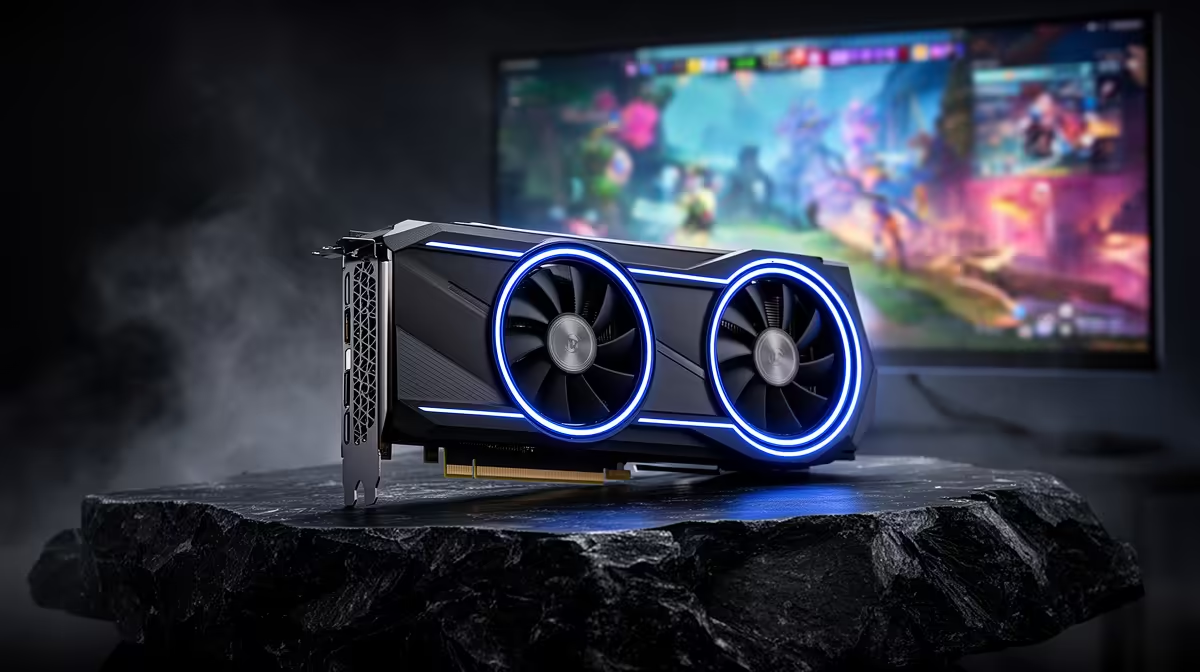
Evetech stocks mid-range and high-end graphics cards that remove the GPU ceiling from 1080p and 1440p gaming. Browse the graphics card category to find the right upgrade tier for your system.