Quick Answer
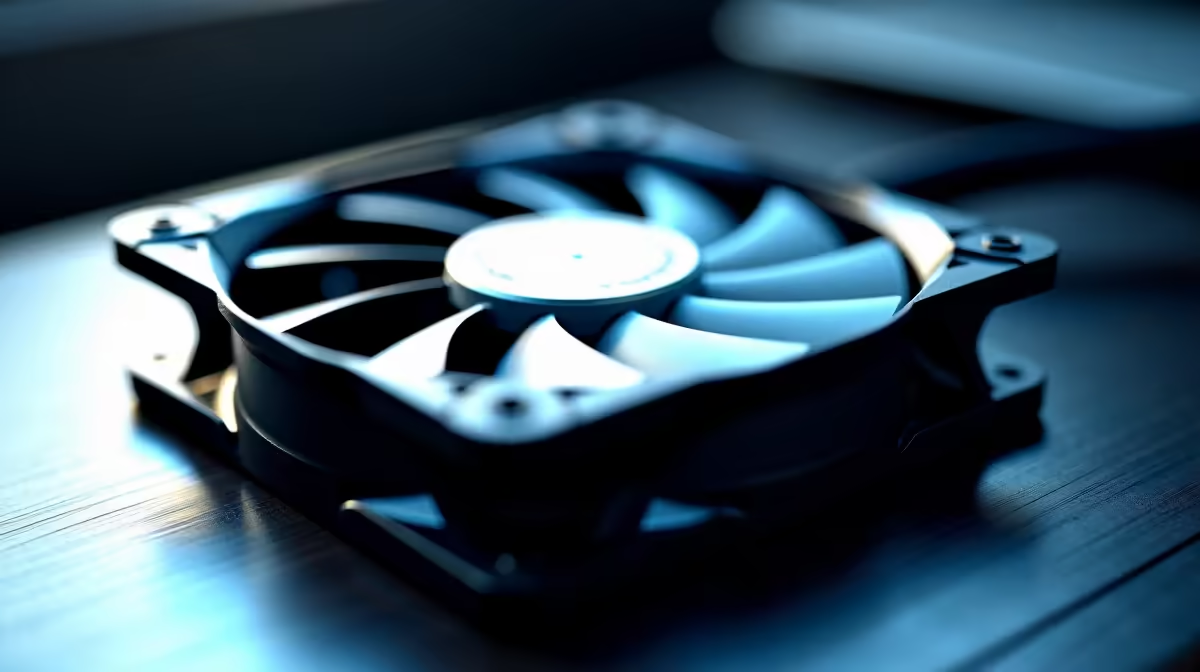
PWM fan control reduces noise by running fans at the lowest RPM needed to maintain safe temperatures, rather than a fixed speed. A well-tuned PWM curve cuts noise by 8 to 15 dBA during light workloads while preserving full cooling headroom on demand, with no cooling performance penalty under load.
How PWM Signalling Actually Works 📡
Pulse-width modulation controls fan speed by rapidly switching the motor on and off at a fixed frequency (typically 25 kHz). The percentage of time the signal stays "on" is the duty cycle. At 30% duty, the fan runs near-silent. At 100%, it runs at full rated RPM. Because the switching happens faster than the fan motor can respond mechanically, the fan sees a smooth average voltage rather than choppy steps. This is why PWM fans spin more accurately at low speeds than DC fans: a 3-pin DC fan loses torque and stalls below about 40% voltage, while a quality 4-pin PWM unit can spin stably from 15 to 20% duty cycle, reaching as low as 300 to 400 RPM on some premium models.
Setting the Right Fan Curve 🔧
The secret to near-silent running without thermal compromise is a steep ramp in the 60 to 80 degree Celsius range. Below 55 degrees, most gaming PCs at idle can run fans at 25 to 35% duty cycle, which translates to 400 to 600 RPM on a 120mm fan and generates less than 20 dBA. The curve should then rise sharply so that by 75 degrees the fans are at 70 to 80% duty cycle, reaching safe exhaust rates before temperatures hit dangerous territory. Most ASUS, MSI, and Gigabyte motherboards allow per-header curve editing in BIOS, accessible without installing any software.
Hardware Limits: Headers, Hubs, and Controllers 🖥️
A standard ATX motherboard provides two to four chassis fan headers, each rated at 1A (12W). Running multiple fans on a single header risks burning it out, especially at high RPM. A quality PWM fan hub clones the PWM signal across six to eight ports while drawing power directly from a SATA connector, protecting the motherboard header. For South African builds where replacing a motherboard can cost R2,500 to R8,000, a R250 to R400 fan hub is cheap insurance. Ensure your hub passes the PWM signal through faithfully rather than converting it to DC, otherwise you lose low-speed accuracy.
Enable Zero RPM Mode for Near-Silence ⚡
Many modern motherboards offer a Zero RPM or Stop Fan mode that halts fans completely below 40 degrees Celsius. For a PC used mainly for browsing or document work at a quiet SA home desk, this feature eliminates fan noise entirely during light tasks without any thermal risk, since temperatures rarely exceed 35 to 38 degrees at idle.
FAQ
Do all fans support PWM control?
Only 4-pin fans support true PWM control. 3-pin fans use DC voltage regulation and lose torque below 40 to 50% speed, making them much noisier at low-speed settings. When upgrading for a silent build, confirm the fan connector is 4-pin.
Will a lower fan speed shorten fan lifespan?
No. Running fans at moderate speeds (40 to 60% duty cycle most of the time) reduces bearing wear significantly and extends fan life beyond the rated MTBF. Constant full-speed operation is actually harder on bearings than thermal-reactive PWM cycling.
Can I control fans independently for CPU and GPU zones?
Yes, if your motherboard supports it. Assign CPU-adjacent headers to a curve based on CPU package temperature, and chassis exhaust headers to GPU junction temperature. This prevents GPU heat from ramping up CPU fans unnecessarily during gaming sessions.
Want a quieter PC without sacrificing cooling?
Evetech stocks 4-pin PWM case fans and fan hubs that make building a near-silent system straightforward. Browse the cooling accessories section to start your quiet build.