Quick Answer
You can cut GPU noise by 5 to 15 decibels without sacrificing meaningful performance by combining a custom fan curve, a mild undervolt, and good case airflow. Most modern high-end cards also support a semi-passive zero-RPM mode at idle and light loads, which eliminates fan noise entirely when the GPU is not under stress.
Understanding Where GPU Noise Comes From 🔊
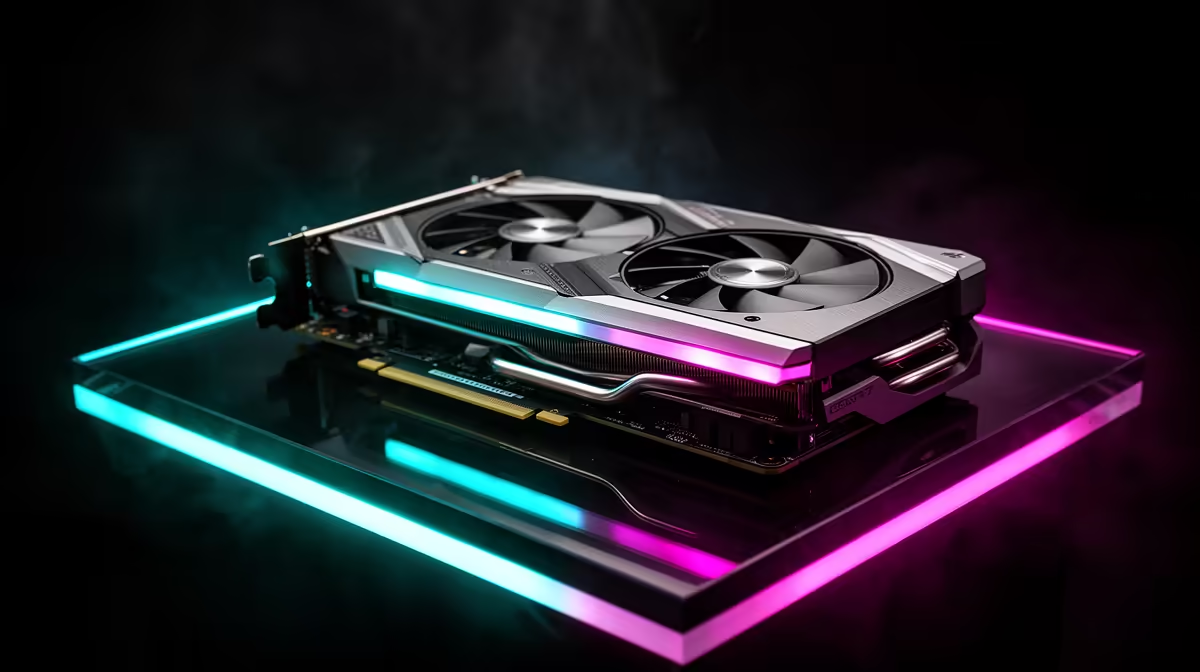
The overwhelming majority of GPU noise is fan noise, not coil whine. On a triple-fan card like the Palit GameRock RTX 5090, each fan spinning above 1,800 RPM becomes audible, and at 2,500 RPM the combined noise can exceed 45 decibels at one metre. The GPU's default fan curve is tuned conservatively to protect the chip under the worst ambient conditions, which means it often runs louder than necessary in a well-ventilated setup. A secondary noise source is coil whine, a high-pitched squeal caused by electronic components vibrating at switching frequencies. Coil whine cannot be eliminated through fan control and is unrelated to thermal performance.
The Undervolt and Fan Curve Combination 🔧
The most effective approach combines two adjustments. Apply a mild GPU undervolt using your GPU utility's voltage-frequency curve editor, reducing voltage by 50 to 75 millivolts at the maximum frequency point. This typically lowers heat output by 10 to 20 watts without any measurable frame rate drop. Second, create a custom fan curve holding fans at 40 to 45 percent speed until 75 degrees, then ramping steeply. Together these changes reduce fan noise by 6 to 10 decibels while keeping temperatures within the same safe range.
Case Airflow as the Multiplier 🖥️
Case airflow changes how hard the GPU fans need to work. A positive pressure case with two 120mm intake fans reduces the card's inlet air temperature by 3 to 6 degrees compared to a poorly ventilated case. At lower inlet temperatures, the GPU fan curve never reaches its noisiest range. South African users in warmer inland climates like Pretoria in midsummer benefit most from dedicated GPU-adjacent intake fans. Keeping dust filters clean, especially important in Highveld conditions, prevents the inlet restriction that forces fans to spin harder.
Zero-RPM Mode for Desktop Silence ⚡
Most RTX 50-series and RX 9000-series cards support a semi-passive mode where fans stop entirely below a set temperature threshold of around 50 degrees. Enable this in your GPU control panel for a completely silent desktop experience. Fans only engage when a real gaming load begins.
FAQ
Will undervolting void my GPU warranty?
Undervolting via software does not void the warranty on cards sold through authorised South African retailers. It does not alter the physical hardware, and resetting to stock settings is instant. Only physical modifications affect warranty status.
How do I know if my GPU noise is coil whine rather than fan noise?
Stop the fans temporarily using your GPU utility at idle. If the high-pitched noise persists even with fans at zero RPM, it is coil whine. If it disappears, it was fan noise. Coil whine varies with GPU load and frame rate.
Does a larger triple-fan cooler always mean quieter operation?
Typically yes. Larger fans move the same volume of air at lower RPM, reducing noise at a given airflow rate. A triple-fan 360mm cooler is quieter at equivalent airflow than a dual-fan design because each fan runs slower.
Ready to upgrade to a quieter GPU setup?
Browse Evetech's range of triple-fan graphics cards with semi-passive cooling and zero-RPM idle modes, available with local warranty support.