Quick Answer
Daisy-chaining lets multiple fans share a single motherboard header via pass-through connectors, cutting cable count from three separate runs to one. Instead of routing individual PWM and ARGB cables across the case, each fan plugs into the next, so installation is faster and the finished build looks noticeably neater inside the case.
How Fan Daisy-Chaining Actually Works 🔧
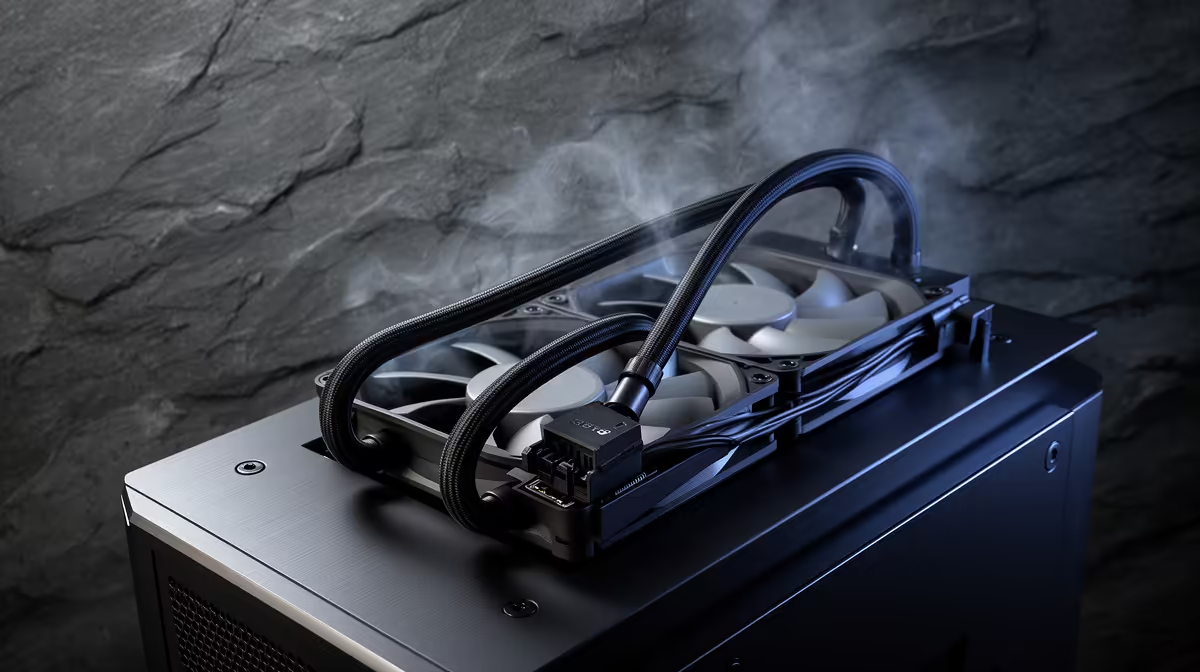
Each daisy-chainable fan carries two ports on its body: one input and one output. You connect the first fan directly to the CPU_FAN or SYS_FAN header on the motherboard, then chain the second fan into the first fan's output port, and the third into the second.
The same principle applies to the ARGB lighting chain. One 5V ARGB cable from the motherboard's ARGB header feeds colour data through every fan in sequence, enabling synchronised lighting without a splitter or additional cables. On a standard three-fan radiator that would otherwise require three separate ARGB runs, daisy-chaining reduces that to one clean line.
Cable Management Benefits Inside the Case 🖥️
A typical mid-tower build with a 360mm AIO and three separate fans might need six to nine cables running from the radiator to the motherboard: three PWM, three ARGB, possibly a USB 2.0 header for the pump. Daisy-chaining collapses the fan side to one PWM and one ARGB cable.
For South African builders assembling in full-tower or mid-tower cases where airflow paths matter, fewer cables crossing the interior means less obstruction between front intakes and the GPU exhaust zone. Thermals can benefit marginally, but the visual result of a tidy interior is the main draw for most builders.
Practical Installation Tips for SA Builders 🚀
Before you start, confirm your motherboard has a dedicated ARGB header (5V, 3-pin) and a PWM fan header that supports daisy-chain fan configurations at the rated amperage. Most current AM5 and LGA1851 boards do, but budget B650 and B760 boards sometimes limit combined fan header current to 1A, and three high-RPM 120mm fans can draw 0.6 to 0.9A total under load. Check your manual before committing.
During installation, mount the radiator before connecting the chain so you can route the single exit cable cleanly from the radiator mounting position. AIO coolers priced in the R2,500 to R4,500 range at Evetech typically include pre-daisy-chained fans, so no custom wiring is required; you simply connect the single bundle to the headers indicated in the manual.
Label Your Chain Direction ⚡
Fans in a daisy chain have directional data flow, so swapping the input and output ends will break ARGB sync. Check the small arrow or IN OUT labels printed on the fan housing before connecting, especially when reseating after cable tidying. A two-second check saves a full disassembly later.
FAQ
Can I mix brands in a daisy chain?
PWM speed signals are universal, so mixing brands works for fan control. ARGB data, however, is proprietary: ASUS Aura, MSI Mystic Light, and Corsair iCUE all use incompatible protocols. Mixing ARGB fans from different ecosystems on the same chain will produce incorrect colours or no lighting sync at all.
How many fans can one header support in a chain?
Most motherboard fan headers are rated for 1A. A single 120mm PWM fan typically draws 0.15 to 0.3A, so three fans in a chain is within safe limits on most boards. Going to four or more fans on a single header risks exceeding current limits; use a fan hub in that scenario.
Does daisy-chaining affect fan speed control accuracy?
No. PWM signal is passed through the chain without degradation. All fans receive the same duty cycle from the motherboard and respond identically, which is ideal for a 360mm radiator where uniform fan speed across all three fans is the goal for balanced static pressure.
Ready to clean up your build?
Browse the full range of AIO liquid coolers at Evetech, many with daisy-chain fans included, so your 360mm radiator install takes one cable, not six.