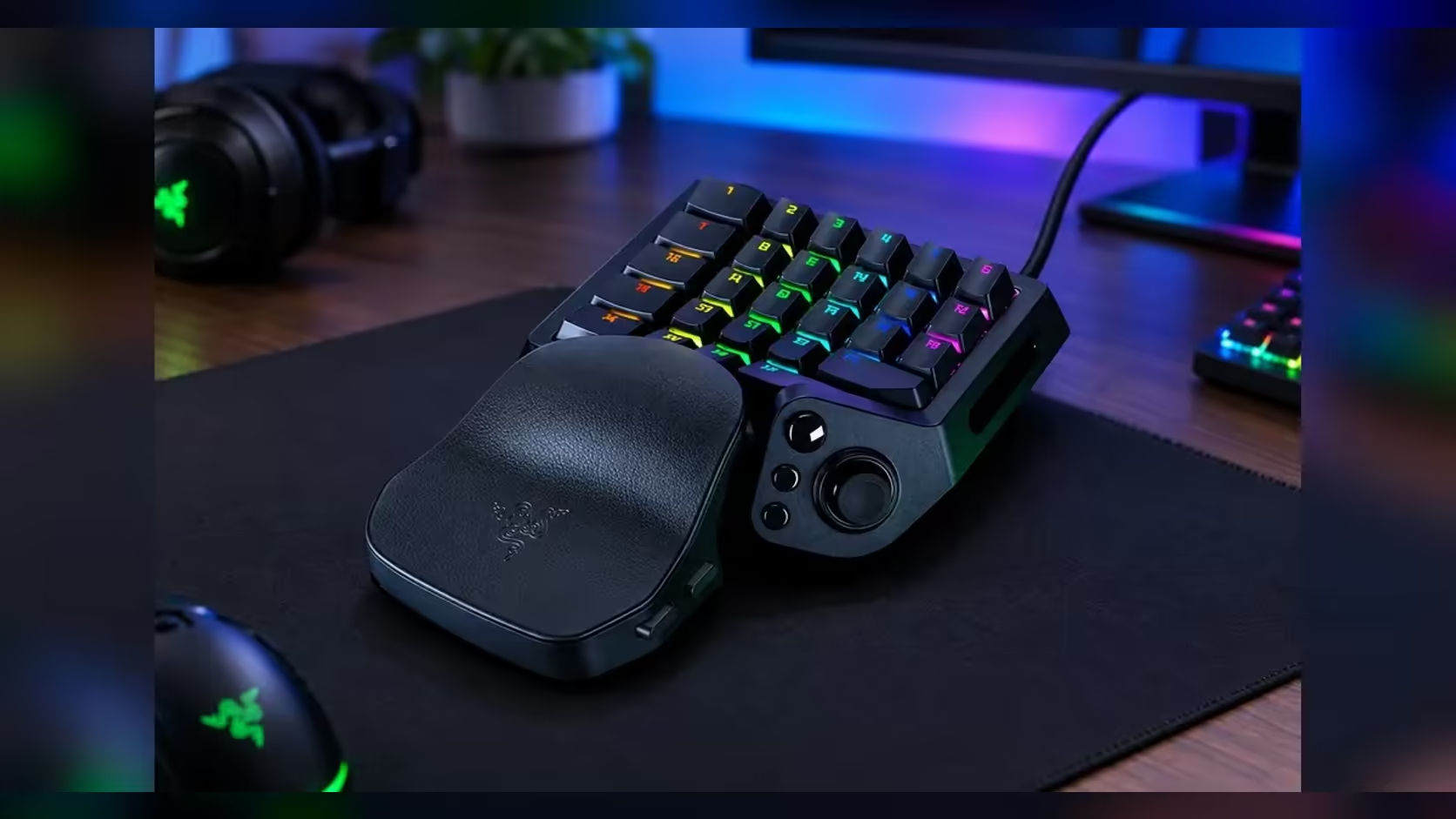
Rapid Trigger changes one thing about a key: where its reset point sits. On a standard fixed-actuation key, the switch fires at one depth and only becomes ready again after the key rises back past a separate point. Rapid Trigger moves that reset point so the key is ready again after a much smaller movement. The Gen-2 analog optical switches on the Tartarus V2 Pro make that possible because they read the depth of the key continuously, rather than waiting for a single on-off point.
Quick Answer
Rapid Trigger tracks the key's travel and resets as soon as the key starts to rise. Gen-2 analog optical switches read depth continuously, which lets the reset happen early. The Tartarus V2 Pro carries both features at R4,799, so a repeated key is ready again sooner than it would be on a fixed design.
📈 Reading depth continuously
A digital switch reports two states, pressed and not pressed, with a single switch point in between. An analog optical switch reports a number at every moment, the current depth of the key, and the keypad turns that number into decisions. Once the keypad knows the depth across the 0.1mm to 4.0mm span, it can apply different rules for going down and for coming back up.
That is the foundation of Rapid Trigger. The keypad tracks the lowest point the key reached on the way down. It then watches for the key to rise a small distance from that point. The moment the rise is large enough, the key is armed again, even though it has not returned to the top of its travel.
🔬 A worked example with a 1.2mm trigger
These numbers illustrate the mechanism. They are not measurements of the Tartarus V2 Pro. Set a fixed key to fire at 1.2mm on the way down and to re-arm only once it rises back to 1.6mm. You press it to 2.0mm, release to 1.5mm, and press again. The key has not reached 1.6mm, so it is still disarmed, and the second press is ignored.
With Rapid Trigger, the keypad tracks the lowest point the key reached, which in this case is 2.0mm at the bottom of the press. Once the key has risen a small distance from that low point, it re-arms. In the same illustration, a 0.3mm lift from 2.0mm is enough, so the key re-arms at 1.7mm, and the next press from 1.7mm to 1.2mm fires. The movement for the second shot drops from a lift to 1.6mm and a press back down, to a short lift and a short press.
🎮 What it changes in a fight
Rapid Trigger matters most when the same key fires again and again, such as a strafe or a repeated ability with no cooldown between presses. In a fast fight, a key that re-arms early lets your hand keep a steady rhythm, instead of stopping to let the key climb back up. The benefit is about 5ms per cycle in this illustration, and those milliseconds stack up over a long engagement.
It matters less for single presses. An ability on a cooldown fires once and then waits, so the reset point is irrelevant during the wait. Rapid Trigger earns its place on the keys your hand repeats, and it is wasted on keys you press once.
🧭 Pairing it with the trigger depth
The trigger depth and the reset work together. A key with a shallow trigger, such as 0.5mm, fires after 0.5mm of travel, while a key at 2.0mm waits for 2.0mm. The shallow key therefore starts 1.5mm ahead in its travel on every press. Combine that with Rapid Trigger on the same key and you get an early fire and an early re-arm.
Do not push the trigger shallower than you need. A very shallow setting with a quick reset can misread a hand tremor as two presses. When a key double-fires, raise its trigger depth in 0.5mm steps and test again, keeping the change as small as the problem allows. For the keypad options that offer these settings, the gaming keyboards range is a useful place to compare models, and the keyboard best sellers page shows which boards other buyers have chosen.
🧪 A repeat drill in milliseconds
Put the timing into numbers. At eight presses a second, one press cycle lasts 125ms. If a fixed key needs an extra 40ms to re-arm, that delay costs a press in every second of a burst. With Rapid Trigger the same key re-arms after a shorter lift, so the cycle leaves more time for the press itself.
Run a 30-second drill on that key with the feature off, then on, and count the presses that land. Five or more extra presses in the second run is a clear gain. Fewer than two is within the noise of a single session, and the setting should be judged over several runs before it stays.
If a key shows no gain after 3 sessions, switch Rapid Trigger off for it and move on. The feature should earn its place on the keys that repeat, and a key that does not repeat gains nothing from it.
Frequently Asked Questions
Does Rapid Trigger need analog switches?
It works best with analog switches, because the keypad needs a continuous reading of depth to know when the key has risen far enough. That is why the Gen-2 analog optical design matters here.
How far does a key have to rise before it re-arms?
It depends on the setting and the press. The illustration above uses 0.3mm, but it is not a measured figure for the Tartarus V2 Pro, so test the feel in a training area rather than relying on a number.
Does Rapid Trigger make the keypad faster to fire the first time?
No. It affects the re-arm after release, not the first press. The first press depends on the trigger depth you set.
Is there a downside to Rapid Trigger?
A shallow setting paired with a fast reset can misread tremor as two presses. Raise the trigger depth in 0.5mm steps if that happens.
Want the reset speed on more keys?
Compare keypads in the gaming keyboard range, then test the one you pick on the keys your hand repeats most.