Quick Answer
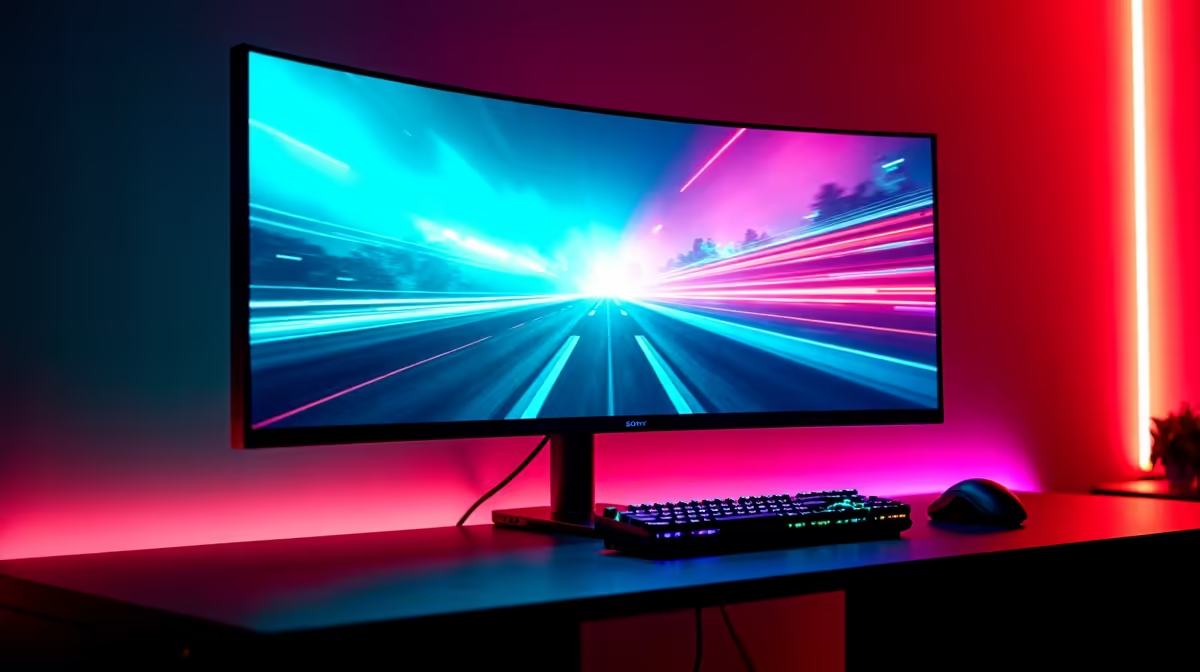
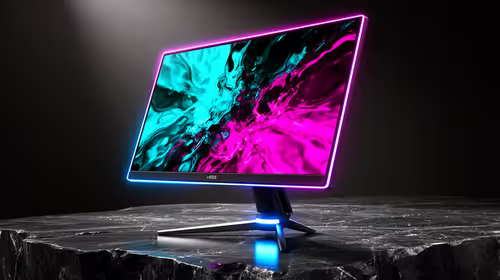
High-refresh-rate monitors improve competitive gaming by reducing motion blur during tracking, lowering display latency, and providing more frames of game-state information per second. Moving from 60Hz to 144Hz cuts per-frame display time from 16.7ms to 6.9ms, measurable in blind player tests. SA esports players competing in CS2, Valorant, and Rocket League at Mettlestate events use 144Hz minimum, with the competitive top-end now at 240Hz to 360Hz.
The Science Behind Refresh Rate Advantage 🎮
At 60Hz, a player sees 60 snapshots of game state per second. At 360Hz, a movement appears on screen within 2.7ms versus 16.7ms at 60Hz. At competitive skill levels where flick shots are initiated within 100ms to 150ms of an enemy entering peripheral vision, delivering that information 14ms earlier accumulates into a real advantage across hundreds of engagements. NVIDIA's latency research shows a 14ms to 18ms total system latency reduction from 60Hz to 360Hz using NVIDIA Reflex and a high-refresh panel, roughly equivalent to the reaction time gap between regional-level and national-level competitive play.
SA Esports Scene Context 🇿🇦
South Africa's competitive scene centres on CS2, Valorant, Rocket League, and FIFA through Mettlestate events and university clubs at UCT, Stellenbosch, and UP. The monitor standard for serious SA CS2 players has shifted from 144Hz (the 2022 baseline) to 240Hz as quality 240Hz IPS panels have dropped into the R8,000 to R12,000 range locally. The 360Hz tier at R12,000 to R18,000 is adopted by players treating competitive gaming as a serious investment comparable to a premium keyboard or mouse.
GPU Requirements to Actualise the Benefit 💡
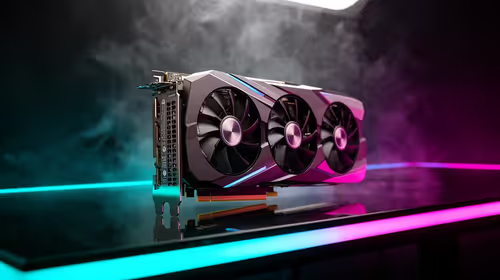
A high-refresh monitor delivers its advantage only when the GPU sustains sufficient frames. For CS2 at 1080p, an RTX 5060 Ti sustains 250 to 400 fps, genuinely suited to a 240Hz to 360Hz panel. At 1440p in the same title, 200 to 300 fps still comfortably feeds a 240Hz display. For heavier titles at 1440p, an RTX 5070 Ti or better keeps fps above 165 consistently.
Enable NVIDIA Reflex or AMD Anti-Lag 2 ⚡
NVIDIA Reflex, available in CS2, Valorant, Apex Legends, and Fortnite, reduces the CPU render-ahead queue from three frames to one, cutting latency by 30 to 50 percent independently of refresh rate. On a 240Hz monitor with Reflex enabled, total measured latency can drop below 10ms, a significant advantage in games where tracking happens in 80 to 120ms windows.
FAQ
What refresh rate do most SA esports players use in competitive CS2?
144Hz is the community minimum, 240Hz is the competitive standard among serious SA players, and 360Hz serves the top-tier segment. Below 144Hz is widely considered non-competitive for fast-paced FPS at any skill level above casual.
Does a higher refresh rate help in strategy games like Dota 2?
Strategy games benefit much less from refresh rate since critical interactions rely on cursor precision over aim speed. A 144Hz monitor is ample for RTS and MOBA play; the investment above 144Hz is better directed toward a lower-latency mouse in these genres.
Is a 240Hz curved monitor suitable for SA competitive FPS?
Yes, though curvature provides no competitive advantage in FPS. A flat 240Hz IPS is marginally preferable for aim-line consistency. For players who also play single-player titles, a 1500R curved 240Hz at R9,000 to R13,000 locally is a strong all-rounder.
Compete at the pace SA esports demands.
Browse 144Hz, 240Hz, and 360Hz gaming monitors at Evetech, stocked locally with fast delivery and local warranty across South Africa.