Quick Answer
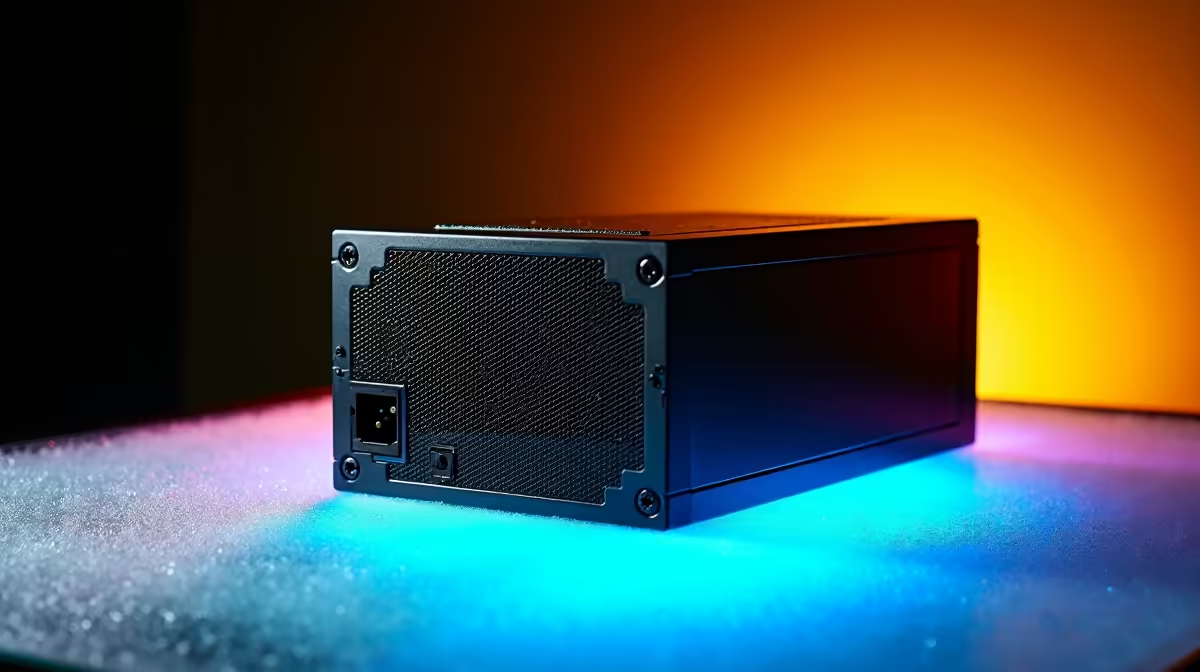
A conformal PCB coating extends power supply longevity by reducing moisture-related degradation, which can otherwise shorten capacitor and solder joint lifespan by 30 to 50 percent in humid operating environments. For South African coastal cities where humidity regularly exceeds 75 percent, a coated PSU PCB is a meaningful durability advantage over an uncoated equivalent running identical loads.
The Mechanism Behind PCB Coating Benefits 🔧
Inside a PSU, the primary PCB operates at mains voltage on its input side with high-frequency switching on the secondary side. Moisture on PCB surfaces creates conductive paths between solder pads and traces, leading to leakage currents that cause erratic voltage regulation and eventual partial short circuits. A conformal coating at 25 to 75 microns of acrylic or silicone polymer blocks moisture from reaching the copper surface beneath the solder mask. In a PSU operating at 30 degrees and 80 percent humidity, typical of coastal SA in summer, the difference between coated and uncoated boards shows up first in the primary bulk capacitors, where moisture permeation accelerates electrolyte migration. Coated PSUs slow this process substantially, particularly on capacitors where sealing tolerance is lower.
Coating, Capacitor Quality, and How They Interact 🖥️
PCB coating is a complement to, not a substitute for, high-quality components. A coated PSU with 85-degree standard capacitors will still age faster than an uncoated unit with 105-degree Japanese caps in the same environment, because the capacitor's internal chemistry is the primary lifespan determinant. The best-performing PSUs for South African conditions combine both: conformal coating on the PCB plus 105-degree capacitors rated at 5,000 hours or more. This combination, found on premium units in the R4,000 to R6,500 range for 850W to 1200W output, represents the upper end of consumer durability engineering and is the sensible choice for builds intended to last seven or more years. Field reliability data from SA technicians consistently shows coastal units failing earlier than inland units from the same product generation, with primary failure modes being bulged capacitors and corrosion on low-voltage secondary connectors. Conformal coating directly addresses the connector corrosion pathway.
Storage Humidity Matters Too ⚡
If your PC sits in a garage or outside room that gets humid overnight then cools by air conditioning during the day, thermal cycling draws moisture into unsealed components repeatedly. For PSUs in these conditions, coating is especially valuable. Running a small dehumidifier during wet summer months protects all components, not just the PSU.
FAQ
Can I verify whether my PSU's PCB is coated without opening the unit?
Check the product specification page for keywords including conformal coat, moisture protection, protective coating, or humidity resistance. Some brands market this explicitly in their feature list; others include it only in the detailed technical specification document.
Does coating affect heat dissipation inside the PSU?
At 25 to 75 micron thickness, conformal coatings have negligible thermal resistance for the current levels flowing through PSU traces. The insulation effect is immeasurably small compared to the heatsinks and fan used for primary thermal management.
Is there a meaningful difference between acrylic and silicone coatings for PSU use?
Silicone tolerates higher sustained temperatures, up to 200 degrees Celsius versus 130 degrees for most acrylics, and maintains flexibility across a wider temperature range. For PSU primary-side PCBs near hot switching components, silicone offers marginally better long-term adhesion. Acrylic is more common and fully adequate for secondary-side low-voltage areas.
Want a PSU built for South African conditions?
Evetech carries power supplies with conformal PCB coatings and 105-degree capacitors across popular wattage ratings. Check the power supply section for units matching your build requirements.