Quick Answer
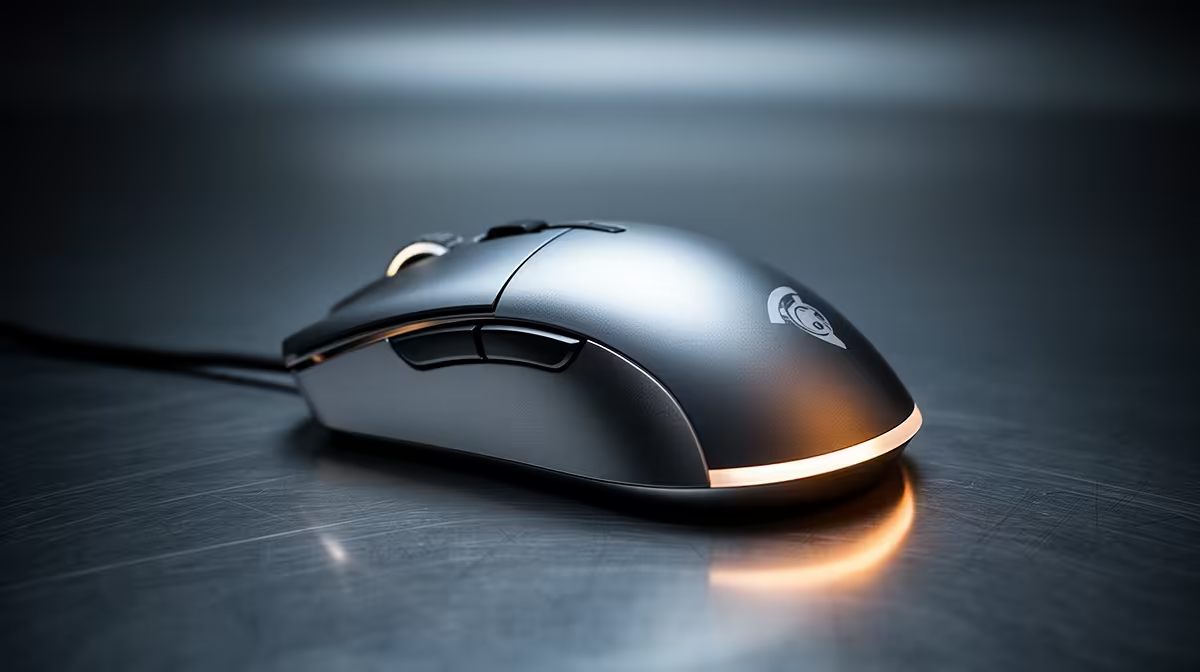
Budget between R2,200 and R3,200 for a professional-grade 8,000 Hz wireless gaming mouse in South Africa. At this price point you get a top-tier optical sensor, proprietary 2.4 GHz wireless, lightweight construction below 80 grams, and a polling rate that provides measurable benefit at 240 Hz monitors and above.
What the 8,000 Hz Premium Actually Buys 🔬
The jump from 1,000 Hz to 8,000 Hz polling is a genuine performance upgrade. At 8,000 Hz your mouse reports position every 0.125 ms. On a 240 Hz monitor where each frame is 4.17 ms, a 1,000 Hz mouse delivers up to 4 position reports per frame. An 8,000 Hz mouse delivers up to 33, giving the game engine a far more complete picture of your cursor path before committing each frame to the display. The practical result is smoother cursor motion during fast flicks and reduced blur on high-refresh panels.
Current 8,000 Hz wireless mice available in South Africa include the Razer Viper V3 Pro (HyperSpeed Wireless, PixArt PAW3950, approximately R2,800) and the HyperX Pulsefire Haste 2 Wireless (approximately R1,900 to R2,200 for its high-polling variant).
Breaking Down the Cost Components 💰
Why does 8,000 Hz wireless cost more than standard 1,000 Hz? The RF chip must transmit and process 8 times more data per second while maintaining sub-1 ms latency, requiring a more expensive and power-hungry controller. Battery management must compensate with either a larger cell or intelligent downscaling when motion is not detected. Premium optical sensors capable of feeding 8,000 Hz with clean data also add cost. Finally, keeping these components under 80 grams demands premium shell engineering.
For context, a solid 1,000 Hz wireless mouse (Razer DeathAdder V3 HyperSpeed, Logitech G305) sits around R800 to R1,400. The 8,000 Hz tier costs roughly R800 to R1,800 more, justified only if you are gaming on a 240 Hz or higher monitor at a competitive level.
Value Assessment for SA Competitive Players 🏆
For casual and mid-tier players on 144 Hz monitors, the 8,000 Hz premium is not necessary. A 1,000 Hz wireless mouse with a quality sensor (PixArt PAW3395) provides imperceptible latency at 144 Hz. For players competing in ACGL or Mettlestate ladders on 240 Hz setups, the 8,000 Hz tier is a legitimate performance investment. The local price premium (around R800 to R1,500 over 1,000 Hz options) is reasonable amortised over the 3 to 5-year lifespan of a premium wireless mouse with optical switches.
8,000 Hz Needs a Direct USB Port ⚡
At 8,000 Hz your mouse sends data every 0.125 ms, and USB hubs cannot guarantee this timing. Always connect the dongle directly to a rear motherboard USB port. Front-panel USB ports on budget cases can introduce enough jitter to negate the benefit of the higher polling rate.
FAQ
Do I need a special PC to run a mouse at 8,000 Hz?
A small but measurable CPU overhead accompanies 8,000 Hz polling. On Ryzen 5000-series or Core 12th-gen or newer processors, the impact is negligible. Older quad-core systems from 2016 to 2019 may see a small increase in CPU usage from mouse interrupt handling.
Can I use an 8,000 Hz mouse at a lower polling rate?
Yes. All 8,000 Hz mice allow you to set polling rate in software to 500 Hz, 1,000 Hz, 2,000 Hz, 4,000 Hz, or 8,000 Hz. Running at 1,000 Hz on an 8,000 Hz mouse is perfectly fine and extends battery life significantly.
Are there any 8,000 Hz wired options that cost less?
Yes. 8,000 Hz wired mice are available in the R1,200 to R1,800 range and deliver the same polling rate without the wireless premium. If wireless freedom is not a priority, a wired 8,000 Hz mouse offers the best cost-to-performance ratio.
Ready for 8,000 Hz wireless performance?
Evetech stocks the latest flagship wireless gaming mice including 8,000 Hz polling models. Browse the full range at Evetech and find a professional-grade mouse that fits your setup and budget.