Quick Answer
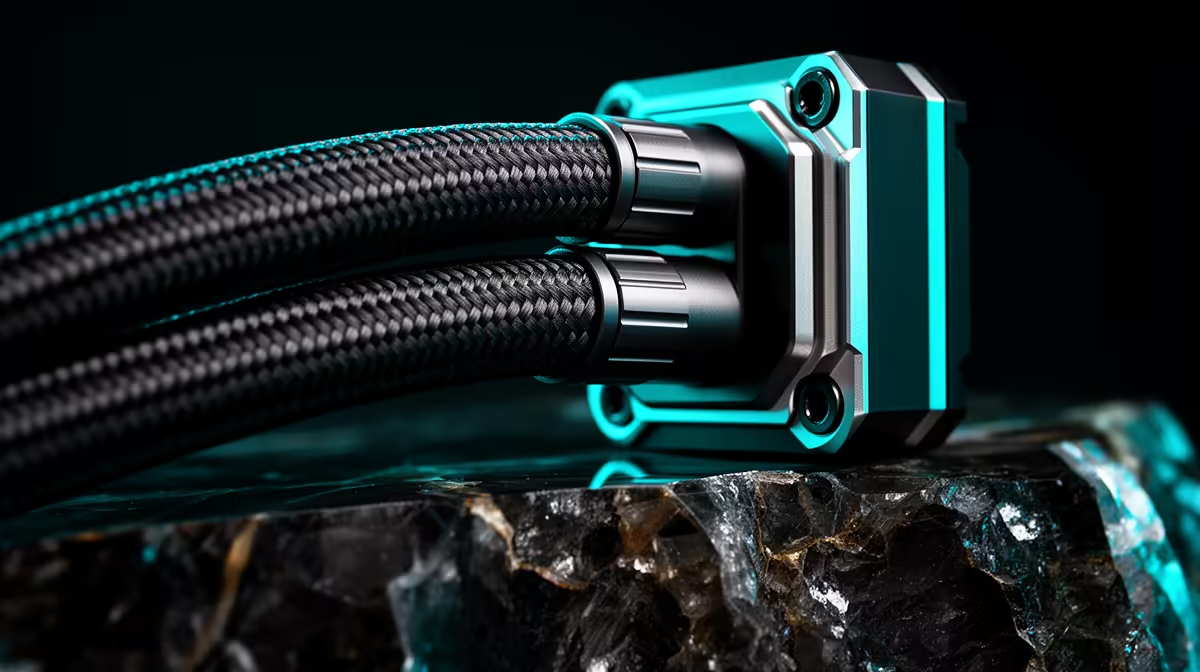
Reinforced sleeved tubing on AIO coolers resists kinking, maintains its shape under bending stress, and is more resistant to slow coolant evaporation than bare rubber tubing. This directly improves durability over the cooler's service life and makes fitment inside the case easier, as the tube holds its routed position without collapsing on tight bends.
What Reinforced Sleeving Actually Does to Tubing 🔧
Standard AIO tubing is typically made of rubber or silicone, which is flexible but prone to kinking when bent tightly and gradually loses coolant through microscopic permeation over years. Reinforced sleeved tubing adds a woven nylon or polyester braid around the inner tube, serving two functions. First, the braid provides structural support that prevents the inner tube from collapsing or kinking when bent around a corner inside the case. Second, the sleeve reduces coolant permeation rate by adding a physical barrier layer. Over a five-year period, an unsleeved tube may lose enough coolant to affect pump performance, while a reinforced tube in good condition retains its coolant volume much more consistently. The sleeve also protects the inner tube from abrasion against case edges or cable management clips.
Fitment Advantages in Real Case Builds 💨
One of the most underappreciated benefits of reinforced sleeved tubing is its fitment behaviour inside the case. Bare rubber tubes flop unpredictably and can contact GPU fans or cable bundles if not secured. Sleeved tubes hold a pre-formed curve after routing, staying where you place them without re-routing. Reinforced tubing makes the radiator-to-pump-head arc clean and predictable, simplifying installation in the compact mid-tower cases popular with SA builders.
Long-Term Durability in SA Conditions 🌍
SA's warm summers and daily temperature cycling stress AIO tubing at the compression fittings where it meets the pump head and radiator. Over hundreds of cycles, bare tubing seals weaken faster than reinforced ones. A premium AIO with sleeved tubing handles thermal cycling better, reducing slow drip leak risk. Choosing a locally warranted unit adds protection; a tubing fault within warranty is handled through Evetech without international courier costs.
Route Tubes Before Tightening the Pump Head ⚡
When installing an AIO, loosely position the pump head and route the tubing before fully tightening any mounting screws. This lets you find the most natural tube arc without stress at the fittings. Tightening the mount first and then bending tubing into position strains the fitting connections.
FAQ
Does sleeved tubing prevent coolant leaks at the fittings?
The sleeve itself does not create the seal; that is the job of the compression fittings where tube meets pump head or radiator barb. However, reinforced tubing is less likely to expand and contract unevenly at fittings during thermal cycling, which reduces stress on those seals over time.
Can I replace AIO tubing if it develops a slow leak?
Most consumer AIOs use sealed, non-serviceable loops. Attempting to replace tubing on a sealed AIO voids the warranty and risks introducing air into the loop. If tubing fails under warranty, the correct path is a full unit replacement through the distributor.
How can I tell if an AIO has reinforced sleeved tubing before buying?
Check the product specification sheet or listing. Terms like "reinforced tubing", "sleeved tubing", or "braided tubing" indicate the feature. Photographs showing a woven or textured tube exterior rather than a plain rubber surface also confirm sleeving.
Looking for an AIO built to last in a South African climate?
Browse quality AIO coolers with reinforced tubing stocked at Evetech.