Quick Answer
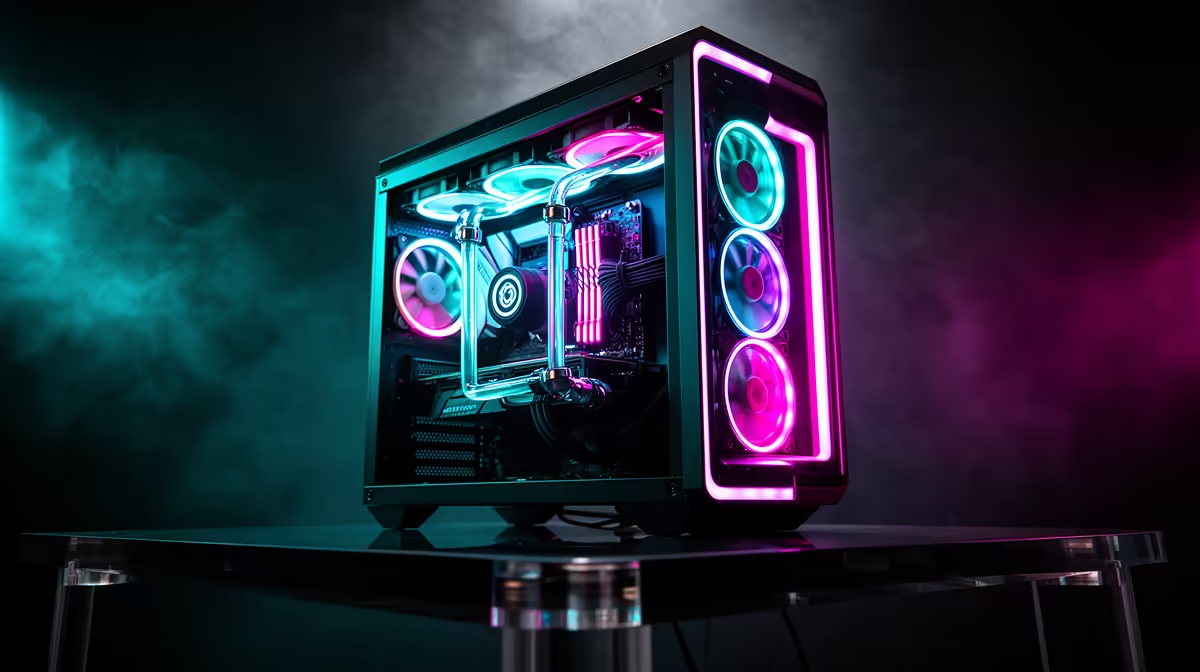
With 15-fan support and a 420mm radiator slot, mount the 420mm AIO up front as intake, add three 140mm fans at the top as exhaust, and fill the rear 120mm position as exhaust. This balances positive pressure that pulls cool air across the GPU and VRM heatsinks before it exits.
Mapping Fan Positions Before You Buy Fans 🔧
A case rated for 15 fans typically offers a front 3-to-4 fan array, a top 3-to-4 fan array, a bottom 2-to-3 fan array, and rear plus side mounts. The 420mm radiator occupies the front three 140mm mounts entirely. Your remaining budget covers the top array (three 120mm or 140mm) and the rear exhaust. The bottom intake helps with GPU cooling on the RTX 5090 or RX 9070 XT, both of which draw from below the card. A high-end X870E-class board typically provides six to eight fan headers, enough for 10 fans before you need a splitter hub.
Airflow Direction and Pressure Strategy 🌬️
Front-mounted radiators pull ambient air through the radiator fins, cooling the coolant before it circulates to the CPU block. Every other fan array should achieve slight positive pressure overall. With a 420mm front radiator plus three top exhausts and one rear exhaust, your net airflow is positive by one to two fan units. Run BIOS fan curves on a linear ramp from 30 percent at 40 degrees Celsius to 100 percent at 80 degrees Celsius for near-silent operation at idle and full performance during gaming sessions.
Cable and Hub Management for 15-Fan Setups 🖥️
Fifteen fans generate 30 cables (power and signal) inside the case. A daisy-chain ARGB hub wired to a single header handles up to eight fans from one PWM cable, then a second hub covers the remaining seven. Mount hubs behind the PSU shroud using 3M adhesive pads. Estimated cost for a full 15-fan ARGB setup in South Africa runs from R2,000 to R5,000 depending on fan brand and ARGB sync compatibility.
Set Radiator Fans to PWM, Not DC ⚡
Radiator-mounted fans perform best under PWM control because it maintains torque at low duty cycles, keeping fans spinning quietly at 400 to 500 RPM at idle. DC-controlled fans sometimes stall below 600 RPM on startup, causing brief temperature spikes before stable speed is reached. Check your motherboard BIOS fan header mode before finalising your AIO installation.
FAQ
Does adding more fans always reduce temperatures?
Not beyond a point. Adding fans past positive pressure returns diminishing results as the bottleneck shifts to heatsink contact and thermal paste. Seven to nine fans is sufficient for most high-end builds; extra positions are useful for future expansion.
Can all 15 fans be ARGB in a single build?
Yes, provided your motherboard has ARGB headers or you use a hub on a single 5V 3-pin header. Most hubs support 12 to 16 fans at a 3A maximum current, covering 15 standard ARGB fans at typical LED densities.
Is a 420mm AIO overkill for a Ryzen 9000-series CPU?
For a Ryzen 9 9950X at 170W TDP, a 420mm AIO keeps junction under 80 degrees Celsius at full load in a 30-degree room. A 360mm AIO manages the same chip with 5 to 10 degrees less headroom, affecting sustained boost duration.
Ready to fill out a 15-fan cooling setup?
Browse Evetech's fan and AIO cooler range to build the ultimate airflow configuration for your high-performance PC.