Quick Answer
Fitting a 360mm radiator and a 420mm-long graphics card in one case requires a chassis with at least 65mm of front clearance behind the mesh panel and a GPU clearance spec of 420mm or greater. Mid-towers with these specs exist, but full-towers are the safer choice for this combination.
Understanding Clearance Specs: Radiator Thickness vs GPU Length 🔧
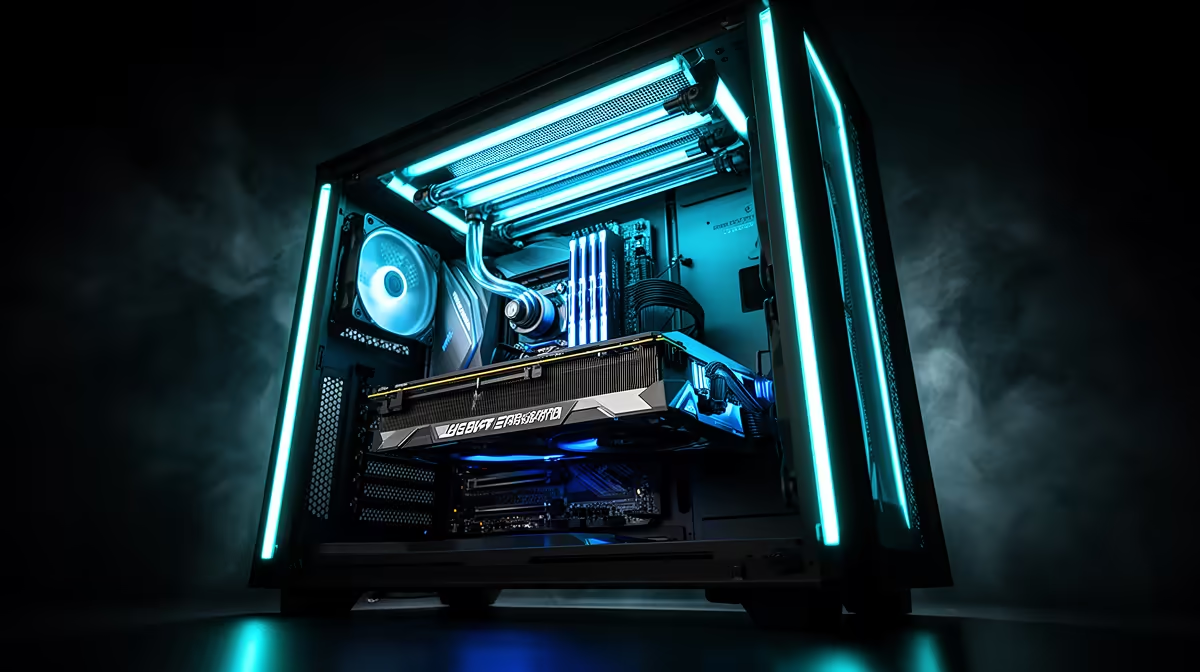
The 360mm radiator dimension refers to the radiator's length (three 120mm fans side by side). The 420mm GPU clearance refers to how far into the case a graphics card can extend horizontally. These are independent measurements but they share space. A 360mm radiator mounted at the front of the case occupies 40mm to 60mm of internal depth (radiator body plus fan thickness). The GPU sits perpendicular to this in the PCIe slot. A case claiming 420mm GPU clearance must achieve this measurement after the front radiator is installed, not before. Always look for the GPU clearance figure listed as the measurement with front radiator installed; some manufacturers list only the bare clearance without cooling hardware.
Which Cases Handle Both in South Africa 🖥️
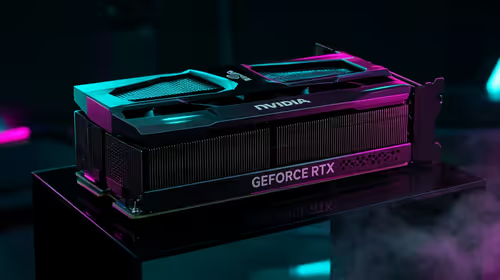
Cases that reliably accommodate a front-mounted 360mm radiator alongside a 420mm-class GPU include the Fractal Design Meshify 2 XL, Phanteks Eclipse G500A, and Lian Li Lancool III. These cases are stocked locally and have internal depths of 220mm to 260mm from front mesh to rear motherboard tray, giving enough room for a 45mm-thick radiator plus fans plus the GPU without physically contacting the GPU backplate. The RTX 5090 Founders Edition measures approximately 336mm in length; third-party RTX 5090 cards from ASUS ROG or MSI reach 360mm to 380mm, so GPU length is a real consideration even with good case clearance.
Build Order for Tight Clearance Configurations 💡
When fitting a radiator and long GPU in a case with limited clearance, build order matters. Install the radiator and fans first, route the radiator hoses, then install the motherboard with CPU and RAM. Install the GPU last, with the PCIe power cable routed beforehand. If the GPU physically contacts the front radiator fans, add 5mm fan spacers to push the fans forward. Do not attempt to force clearance by removing GPU backplates; they provide structural rigidity and are part of the card's cooling system.
Measure Your GPU Before Buying the Case ⚡
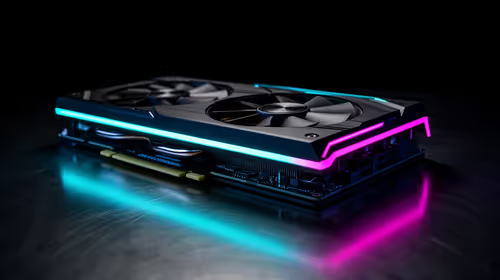
GPU length varies by partner model even within the same chip. An RTX 5080 can measure anywhere from 310mm to 380mm depending on the manufacturer. Confirm the exact length of your specific GPU from the manufacturer spec sheet before selecting a case, not just the chip family length.
FAQ
Can a 360mm top-mounted radiator and a 420mm GPU coexist in a mid-tower?
Yes, more easily than the front-mounted version. A top radiator does not reduce GPU clearance. The limitation with a top-mounted 360mm AIO is motherboard clearance: tall RAM heatspreaders over 45mm can foul the bottom fan of the top radiator. Check RAM height compatibility before buying.
Is a 420mm GPU clearance spec standard across all similarly sized cases?
No. Two cases with the same external dimensions can have different internal clearances due to PSU shroud height and front panel thickness. Never assume; always read the specification sheet clearance figure from the manufacturer.
Does running a 360mm AIO and a 420mm GPU in one case cause temperature issues?
If the radiator is at the front as intake and the GPU exhausts downward and out the rear, thermal management is straightforward. The radiator draws in cool air, the CPU stays below 70 degrees under load, and the GPU uses its own heatsink. The only risk is recirculation if the case has insufficient rear exhaust capacity.
Fitting a large GPU with a 360mm AIO?
Evetech stocks spacious ATX and full-tower cases with generous GPU and radiator clearance, plus a wide selection of AIO coolers and high-end GPUs, all available locally.