Quick Answer
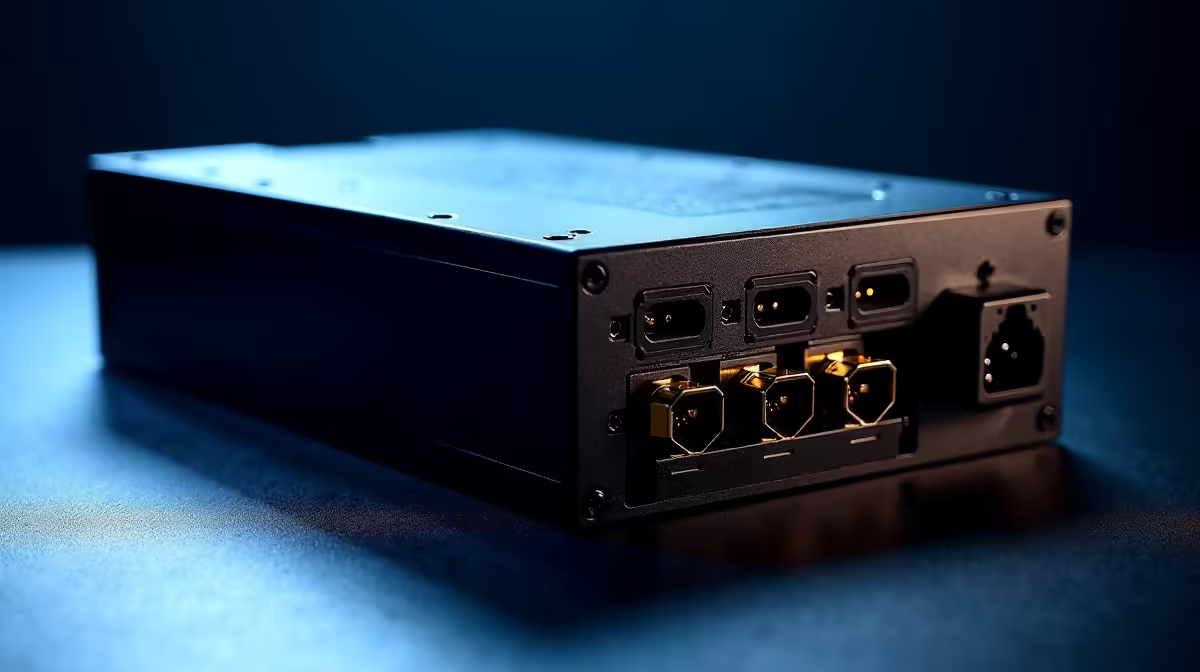
Fully modular PSUs let you connect only the cables your build actually needs, eliminating dead-end bundles that block airflow. Route each cable flat along the back panel, use velcro ties at bend points, and sleeve bundles before threading them through grommets. The result is a cleaner interior and improved airflow that can lower component temperatures by 5 to 10 degrees Celsius.
Why Fully Modular Beats Semi-Modular for Clean Builds 🔧
A semi-modular PSU permanently attaches the 24-pin ATX and EPS CPU cables. Even tucked carefully, those stiff pre-attached cables limit routing options. A fully modular PSU lets you pull every cable from the unit and route them individually. You connect only what the motherboard, GPU, and drives require. In a high-end build with an RTX 5080 and four ARGB fans, you might use six cable runs. A non-modular unit of the same wattage adds eight to twelve unused loops that must be stuffed somewhere, typically blocking rear-panel airflow or filling the drive bay.
Step-by-Step Cable Routing for a Modular PSU Build 📐
Start with the 24-pin ATX cable: route it along the bottom-right edge of the motherboard tray, through the nearest cable grommet, behind the back panel, and up to the motherboard header. Next, route the EPS 4+4 CPU cable up the right spine of the case, over the top grommet, and straight to the CPU power header. GPU power cables on an RTX 5090 use a 16-pin 12VHPWR connector: route this single cable up the left side of the case to the GPU, avoiding bends sharper than 35mm radius. SATA cables route behind the drive bay. Velcro ties every 15 cm prevent sagging.
Aftermarket Sleeved Cables: Worth It for Premium Builds 💰
Stock PSU cables use basic insulation. Aftermarket sleeved cables use individually braided conductors that hold their shape and bend predictably, making routing easier and results visually uniform through a tempered-glass panel. A full cable kit for a 750W to 1000W build costs between R800 and R1,800 locally. Always verify compatibility: aftermarket cables must match your PSU's proprietary connector pinout, so purchase kits rated explicitly for your PSU model.
Pre-Bend Cables Before Installing ⚡
Bend each cable along its intended route and hold it for 30 seconds before installation. The insulation retains the curve, making routing through grommets easier once you work inside the case. This saves 20 minutes of frustration during a tight cable run near the GPU connector.
FAQ
Do modular cables from different PSU brands work interchangeably?
No. PSU modular cable pinouts are not standardised across manufacturers. Using a Corsair cable on a Seasonic unit can cause a short circuit. Always use cables supplied with your specific PSU model or confirmed-compatible aftermarket kits.
How do I manage the 12VHPWR cable for an RTX 5090 or 5080?
The 12VHPWR connector requires a minimum 35mm bend radius nearest the card. Use the adapter included with the GPU if your PSU lacks a native 16-pin output, ensuring the cable exits horizontally before bending, never bending at the connector itself.
Will better cable management improve PC temperatures?
Yes, measurably. Cables blocking intake fan paths raise component temperatures by 3 to 8 degrees Celsius under sustained load. Clean routing that maintains clear paths from front intakes to rear exhaust reduces CPU and GPU temperatures, and fans spin down accordingly.
Upgrading to a modular PSU for your next build?
Browse Evetech's range of fully modular power supplies including 80 Plus Gold and Platinum rated units in wattages from 650W to 1600W, stocked in South Africa.