


iRacing SA Gaming PC Build Guide
iRacing build planning should focus on the target resolution, settings and total system balance. Treat launch wording as time-sensitive, then verify requirements before choosing SA PC parts.
Read moreWhat is an input lag gaming monitor and why does it matter for South African gamers? 🎮 This guide explains everything from input lag vs. response time to the best settings for reducing delay, giving you the competitive edge you need to dominate your game. Stop losing fights to lag! 🏆
You’ve been there. Lined up the perfect headshot in Valorant, your crosshair is flawless… but you’re the one who ends up spectating. Or maybe you’ve felt that slight, frustrating delay in Apex Legends that makes your movements feel like you’re wading through mud. Before you blame your internet connection, consider the invisible enemy: the input lag from your gaming monitor. It’s the ghost in the machine costing you precious milliseconds, and in South Africa’s competitive scene, that’s everything.
Let's clear this up, because it’s often confused with other specs. Input lag is purely the time it takes for your monitor to display the image sent from your graphics card. It’s the delay between you clicking your mouse and seeing the muzzle flash on-screen. ⚡
It’s not the same as:
A good input lag gaming monitor minimises this processing delay, ensuring what you see is happening almost at the exact moment you command it. For competitive gaming, you want this number to be as low as possible, ideally under 16ms.
For casual, single-player games like Baldur's Gate 3, a bit of input lag isn't a train smash. But for fast-paced titles, it’s the difference between clutching a round and tilting. In games where reaction time is king, high input lag means you’re always playing from behind. Your opponent literally sees you fractions of a second before you can properly react to them.
This delay creates a disconnect between your actions and the on-screen results, making your aim feel "floaty" or unresponsive. Investing in a monitor with low input lag provides a tangible competitive edge, making your gameplay feel crisp and immediate. You can browse all our gaming monitors to see the specs for yourself.
The total delay you experience isn't just down to one thing. Several components in the chain contribute, but the monitor itself is the biggest player.
This is the number one cause. Some panels, especially older TVs or office-grade screens, have extensive image processing (like motion smoothing or dynamic contrast) that adds significant delay. A purpose-built gaming screen is designed to bypass most of this. Whether you're looking at immersive curved monitors or crisp, high-resolution 4K monitors, the gaming-focused models will prioritise low latency.
Features that make movies look great can be terrible for gaming. Turning on your monitor’s “Game Mode” is crucial. This setting typically disables non-essential processing to slash input lag. It's often the single most effective change you can make. Even some premium portable monitors now include a low-latency game mode for on-the-go sessions.
Almost every modern gaming monitor has a 'Game Mode' or similar setting in its on-screen display (OSD) menu. Find it and turn it on. This is the fastest way to reduce the input lag on a monitor as it strips out unnecessary image processing, prioritising raw speed over cinematic enhancements. It can cut your monitor's delay in half instantly!
While buying the right input lag gaming monitor is the biggest step, you can still optimise your existing setup. If you're looking for an upgrade, checking out the best PC monitor deals is a great place to start.
Here are a few quick wins:
By understanding and tackling input lag, you're not just buying better hardware… you're buying yourself more time to react, aim, and win. ✨
Ready to Eliminate Lag for Good? A responsive, low-latency monitor is the ultimate upgrade for any serious South African gamer. Stop fighting your gear and start fighting the competition. Explore our range of ultra-responsive gaming monitors and find the perfect display to conquer your game.
For competitive gaming, an input lag under 16ms is excellent. Pro gamers often seek monitors with sub-5ms input lag for a near-instantaneous response to their actions.
No. Input lag is the delay between your action (e.g., mouse click) and it appearing on screen. Response time refers to how quickly a pixel changes color, which affects motion blur.
To reduce input lag, enable your monitor's 'Game Mode', turn off any motion smoothing or post-processing features, and ensure you are using a high-quality DisplayPort cable.
Yes, a higher refresh rate (like 144Hz or 240Hz) can significantly lower input lag. The screen updates more frequently, so your actions are displayed on the screen much sooner.
Most casual gamers won't notice input lag below 30-40ms. However, competitive players can often perceive delays as low as 10-15ms, which can impact their performance.
Yes, V-Sync is a major cause of input lag. It forces your GPU to wait for the monitor, creating a delay. Use Adaptive Sync technologies like G-Sync or FreeSync instead.
iRacing build planning should focus on the target resolution, settings and total system balance. Treat launch wording as time-sensitive, then verify requirements before choosing SA PC parts.
Read more
Skyrim PC requirements should be mapped to resolution, settings and upgrade budget before choosing a tier. Verify current requirements, then balance GPU, CPU, RAM and SSD around SA pricing.
Read more
Skyrim PC builds is a cautious guide for game PC build planning. Compare game requirements, tier fit, resolution goals, RAM, storage, and GPU choice for SA buyers without assuming live prices, availability, or exact benchmark results.
Read more
Hades 2 PC builds is a cautious guide for game PC build planning. Compare game requirements, tier fit, resolution goals, RAM, storage, and GPU choice for SA buyers without assuming live prices, availability, or exact benchmark results.
Read more
Roblox PC builds is a cautious guide for game PC build planning. Compare game requirements, tier fit, resolution goals, RAM, storage, and GPU choice for SA buyers without assuming live prices, availability, or exact benchmark results.
Read more
Mortal Kombat 1 launch needs a balanced parts plan, not a random basket. Map the CPU, GPU, RAM, SSD, cooling, and monitor target to the budget so SA builders know where to spend first.
Read more
Wondering if a TKL wireless mechanical keyboard is worth it for everyday productivity? We break down latency, battery life, comfort, and workflow gains for real work. ⚡⌨️

Maximise battery life on a fanless 15-inch laptop using efficiency core architecture. Cut idle drain, tune power profiles, and improve thermals for longer runtime. 🔋⚙️
Learn how to reduce desk clutter with a TKL wireless keyboard using fewer cables, smart placement, and tidy essentials. Get a faster, calmer workspace with better ergonomics. ✅🧼
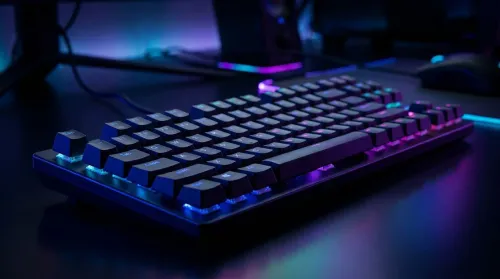
RGB keyboard lighting too distracting? Learn how to manage backlight modes, set brightness, and reduce distraction for focus and productivity 😌🖱️
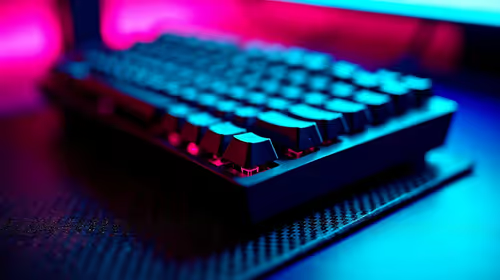
Are themed gaming keyboards worth the extra cost? Compare build quality, switch options, features, and resale value to find the best fit for your setup 🎮⌨️
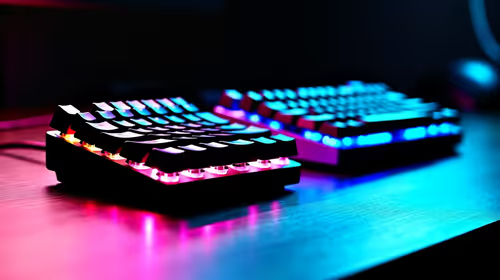
Full-Size vs Tenkeyless mechanical keyboards for gaming: find out if a smaller layout truly improves aim, speed, and comfort. We break down layout, desk space, latency-feel, and keybinds 🎮⌨️
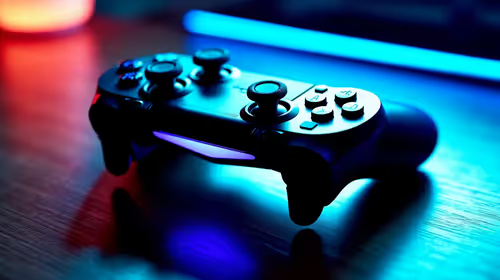
Dedicated media rollers vs function key shortcuts: learn which setup gives you better workflow control, faster media access, and fewer mistakes. 🖱️🎧
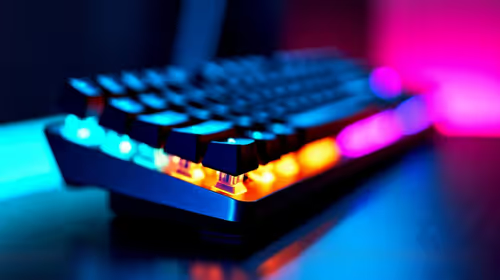
Best Mechanical Switch Type for Gaming: Clicky vs Linear vs Tactile. Find your feel, speed, and noise balance with practical guidance for FPS, MOBA, and productivity 😄🎮
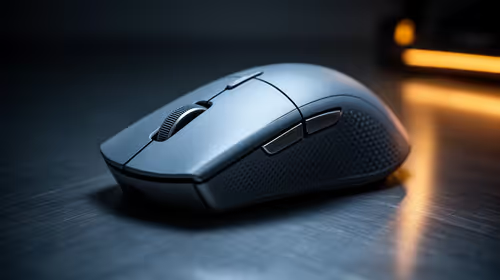
Direct mouse answer: Mouse not keeping up with your work? Everything that matters about dual-mode 2.4GHz + BT 5.0: DPI behaviour, channel switching, battery curves and per-app button mapping. Covers when 2.4GHz USB wins (low-latency desk) and when BT 5.0 wins (laptop, d
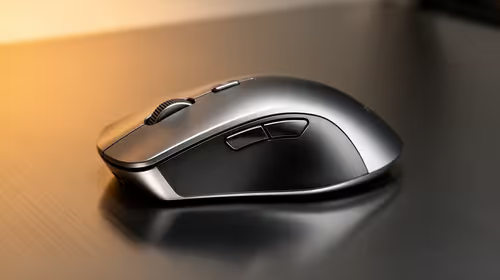
Plain wireless mouse guide: Mouse not keeping up with your work? Everything that matters about wireless productivity mouse: DPI behaviour, channel switching, battery curves and per-app button mapping. Includes DPI tuning tips, channel switch shortcuts, and ZAR-aware fea
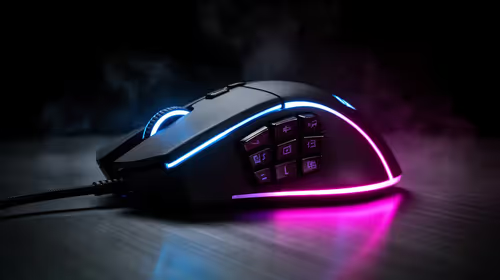
Real productivity numbers: Set up your wireless mouse in this order: everything that matters about wireless productivity mouse: DPI behaviour, channel switching, battery curves and per-app button mapping. Includes DPI tuning tips, channel switch shortcuts, and ZAR-aware
Pen not feeling like paper? Stylus lag and skipping usually trace to old drivers, dirty nibs, or display refresh mismatches, not the pen itself. Covers pressure curve tuning, tilt thresholds, nib swap timing, and SA pricing brackets.