Quick Answer
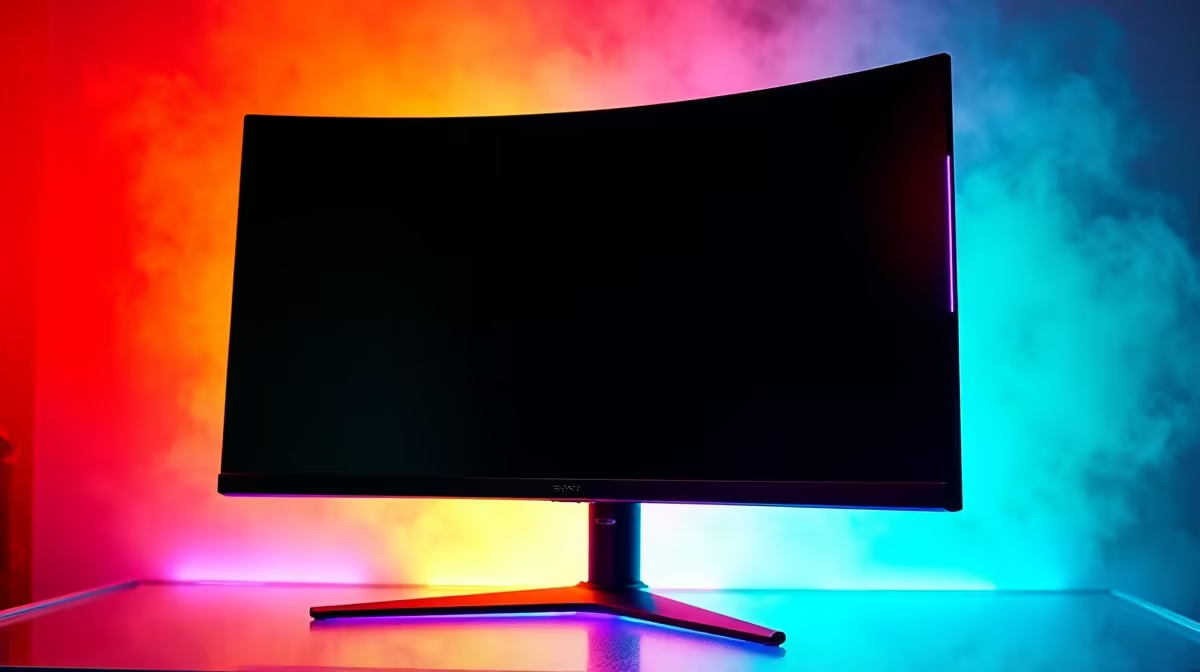
3840x1080 is good enough for immersive gaming on a 49-inch screen but not for detail-focused productivity or competitive pixel-perfect accuracy. The wide field of view and dual-monitor replacement capability are the strengths; pixel density of around 81 PPI is the limitation compared to a 1440p or 4K display at the same size.
What 3840x1080 Actually Delivers on a 49-Inch Panel 🖥️
3840x1080 at 49 inches produces approximately 81 pixels per inch, compared to 109 PPI on a 49-inch 5120x1440 (DQHD) ultrawide. The difference is visible when viewing text-heavy content or fine in-game UI elements at standard desk distances of 60 to 90cm. Where 3840x1080 excels is the 32:9 aspect ratio: it delivers approximately 97 horizontal degrees of field of view, which no 16:9 monitor matches. Racing titles like Assetto Corsa Competizione and flight simulators use this horizontal width to create peripheral depth that significantly improves immersion, even if the pixel density is lower than a 27-inch 1440p monitor.
GPU Load at 3840x1080 Versus Higher-Resolution Alternatives 🎮
3840x1080 has 4.1 million pixels, compared to 3.7 million at 1440p and 8.3 million at 4K. It is moderately demanding but far less so than DQHD (5120x1440 at 7.4M pixels), making 3840x1080 the more accessible ultrawide resolution for mid-range builds. An RTX 5070 Ti drives 3840x1080 at 144fps in most titles at high settings without frame generation, making this resolution with a 144Hz panel a practical target for the R45,000 to R60,000 build tier common in South Africa. DQHD at 5120x1440 needs an RTX 5080 or better for consistent 144fps at high settings, adding significant GPU cost.
Is the Resolution Limitation a Dealbreaker? 📋
For competitive gaming in titles like Valorant or CS2, 3840x1080 at full 49-inch width can work against you: enemy models appear very small at the horizontal extremes. Many competitive players use the panel in Picture-by-Picture mode as a dual-monitor arrangement rather than gaming across the full width. For productivity, two-screen equivalent space at 2x 1920x1080 is functional for web browsing, code, or spreadsheet work. Graphic designers needing sharp visual fidelity should step up to a 5120x1440 DQHD panel, available in SA from approximately R12,000 to R22,000.
Check Game Ultrawide Support Before Buying ⚡
all games natively support 32:9 aspect ratios. Some titles letterbox to 21:9 or 16:9 with black bars on the sides. Check community sites listing ultrawide aspect ratio compatibility for your primary games before purchasing a 49-inch DFHD monitor. Racing sims and flight sims have excellent 32:9 support; many linear story games do not.
FAQ
Does 3840x1080 look blurry compared to a standard 1080p monitor?
Not blurry, but lower-density than expected at close viewing distances. At 70cm or more from the screen, the lower PPI is less noticeable during gaming. Text documents at close range are where the resolution limit shows most clearly.
Can a 49-inch 3840x1080 monitor replace two separate monitors?
Yes. Most 49-inch ultrawides include Picture-by-Picture mode that divides the screen into two independent 1920x1080 display inputs. This is a clean dual-monitor replacement with no bezels and a single panel to manage.
What stand depth does a 49-inch monitor require on a South African desk?
49-inch ultrawides on native stands typically need 30 to 40cm of desk depth for the stand base. A wall-mounted VESA bracket (100x100mm compatible) eliminates the stand footprint entirely and is preferred on shallower SA gaming desks.
Considering a 49-inch ultrawide for your gaming setup? Browse Evetech's range of ultrawide gaming monitors and find the panel size and resolution that suits your game library and GPU.