Quick Answer
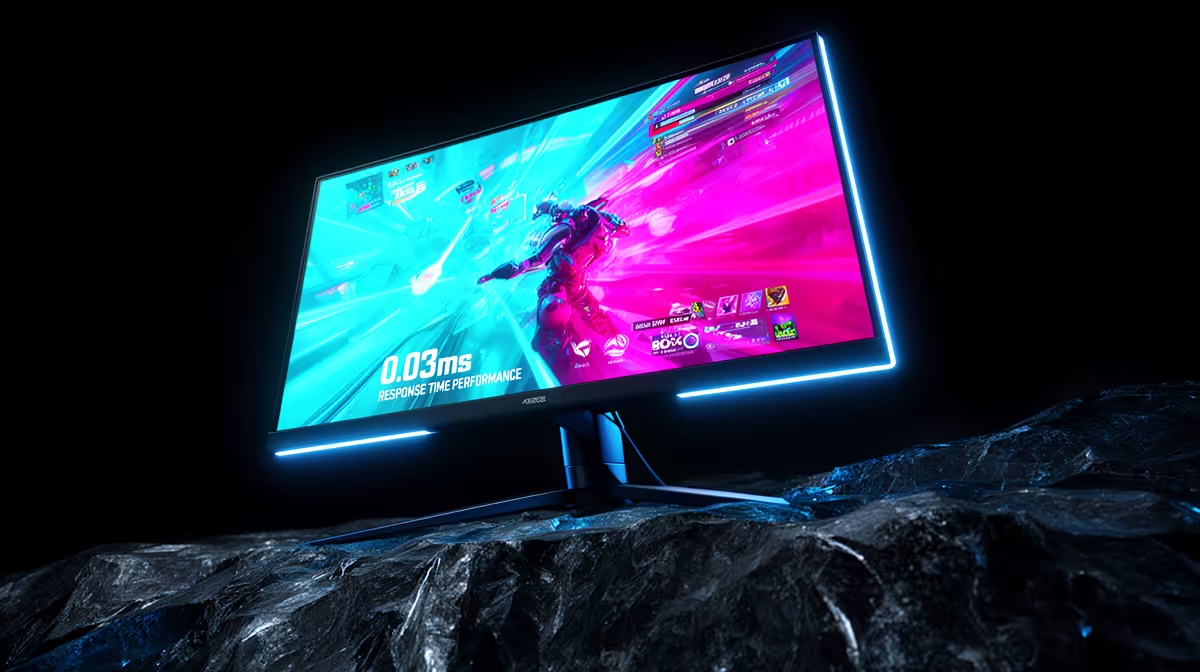
Yes, 0.03ms response time is worth it for competitive gaming, but not because 0.03ms is directly perceivable over 1ms GtG. The real value is that OLED panels achieving 0.03ms also deliver superior motion rendering without overdrive artefacts, and the technology package at this spec tier (240Hz, low input lag, infinite contrast) collectively improves competitive gaming more than the sub-millisecond figure alone.
What 0.03ms GtG Actually Delivers in Gameplay 🎮
A 0.03ms grey-to-grey response time means individual pixel transitions are essentially instantaneous. On a 240Hz display each frame lasts 4.17ms, so a 0.03ms pixel transition uses less than 1% of the available frame time. By comparison, a 1ms Fast IPS panel uses about 24% of the frame time on pixel switching, and a 5ms standard IPS uses over 100% of the frame time, which is why trailing and ghosting appear. At 0.03ms, no overdrive voltage boost is needed to accelerate pixel transitions, which also means zero risk of inverse ghosting or coronas around moving objects.
Where 0.03ms OLED Helps More Than Alternative Technologies 🏆
Compared to 0.3ms Fast IPS at equivalent refresh rates, 0.03ms OLED panels show measurably cleaner motion trailing in direct comparisons. In fast-paced FPS scenarios like tracking an airborne player in Apex Legends, the cleaner trailing of the OLED panel makes the target slightly easier to follow precisely. This advantage is compounded by OLED's infinite contrast, which makes targets against dark backgrounds or environmental transitions more visually distinct. The combined effect of 0.03ms pixel response, 240Hz refresh, and infinite contrast is meaningfully better for competitive gaming than any single specification alone.
Cost and Context for SA Competitive Gamers 💰
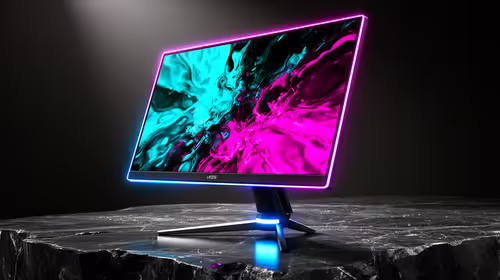
OLED gaming monitors with 0.03ms GtG are currently priced between R11,000 for entry 1080p OLED esports panels and R22,000 for 4K 27-inch QD-OLED models. The 0.03ms spec appears across the range, not only at the top. For SA competitive gamers on a moderate budget, a 1080p or 1440p OLED panel at 240Hz with 0.03ms GtG in the R11,000 to R15,000 range is the most accessible path to this technology, giving the motion clarity benefits without the full 4K premium.
Skip Extreme Overdrive on OLED ⚡
Many OLED gaming monitors ship with an overdrive setting called Extreme or Fastest. On 0.03ms OLED panels, this setting is counterproductive and introduces inverse ghosting because the emitters already switch faster than any overdrive compensation needs to trigger. Set overdrive to Normal or Variable for artefact-free competitive gameplay.
FAQ
Can you tell the difference between 0.03ms and 1ms during an actual game?
Direct AB comparison at 240Hz with trained eyes shows a visible difference in trailing clarity. In unsupervised play without a direct comparison, most players cannot reliably distinguish 0.03ms from 0.3ms. The competitive advantage of OLED comes from the full package: high refresh, zero ghosting, infinite contrast, and overdrive-free operation.
Do 0.03ms OLED monitors have higher input lag than IPS monitors?
No. Flagship OLED gaming monitors have input lag comparable to or lower than equivalent IPS monitors. Input lag on OLED gaming panels typically measures 0.5ms to 2ms at their rated refresh rate, which is in the same range as fast IPS monitors. Input lag is determined by the display pipeline and scaler, not the pixel response time.
Is 0.03ms only available on OLED monitors?
Currently yes, the 0.03ms GtG specification is achieved only by OLED (including QD-OLED and W-OLED) gaming monitors. The fastest IPS panels achieve 0.3ms GtG. The physical limit of LCD pixel transitions prevents IPS from approaching OLED's emitter-level response speed.
Want the fastest pixel response on the market?
Evetech stocks OLED gaming monitors at 0.03ms GtG across multiple sizes and refresh rates. Visit the OLED monitor section at Evetech to find your competitive display.