Quick Answer
Yes, 8GB remains sufficient for 1080p gaming in 2026 with one practical caveat: keep texture quality at High rather than Ultra in the most demanding recent titles. At 1080p High settings, 8GB covers virtually every current game without VRAM-induced stutters or hitching.
What 8GB Handles Comfortably at 1080p 🎮
Most open-world and competitive titles at 1080p High settings use between 4GB and 7.5GB of VRAM. Esports games like Valorant, CS2, and Apex Legends sit well under 4GB at any quality level. Demanding open-world titles like Elden Ring, God of War Ragnarok, and Hogwarts Legacy stay below 8GB at 1080p High with no texture quality reduction needed.
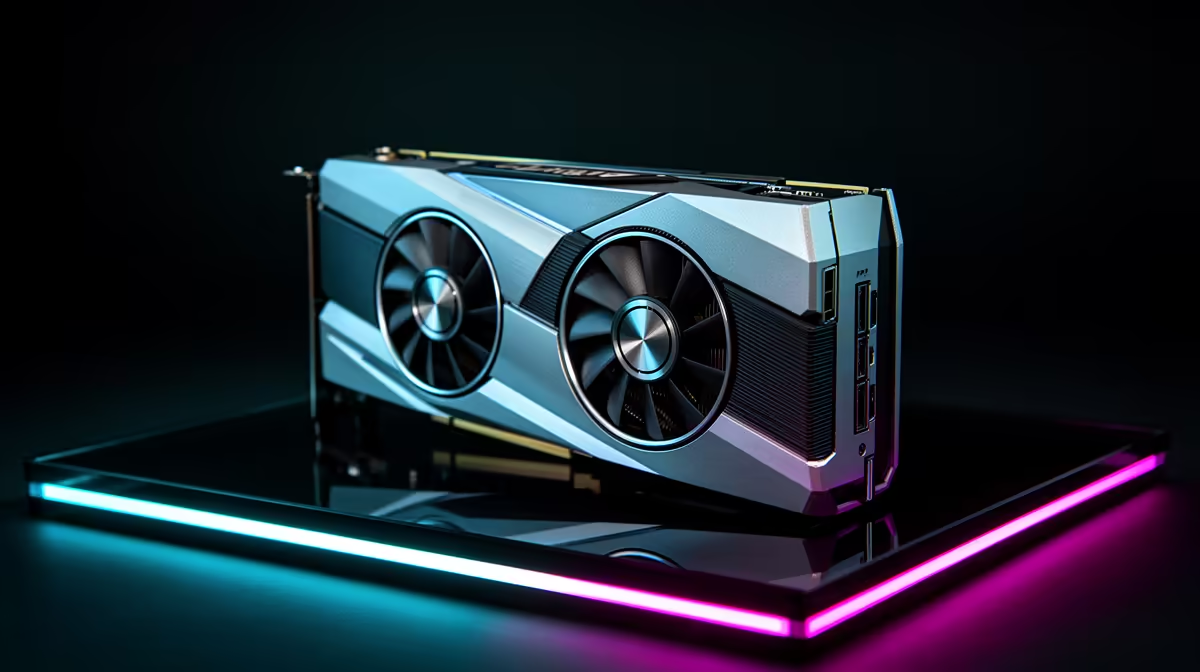
Cards like the Palit RTX 5060 Dual 8GB and RTX 4060 8GB demonstrate this clearly in benchmarks: at 1080p they deliver 80 to 120 fps in most current titles at High settings without VRAM saturation. The 8GB frame buffer paired with GDDR7's higher bandwidth makes the RTX 5060 tier notably more resistant to VRAM pressure than the RTX 4060 with GDDR6 at the same capacity.
Where 8GB Can Feel Tight 🔧
Three categories push 8GB harder at 1080p. First, games with optional high-resolution texture packs, such as The Last of Us Part I and Forspoken, can exceed 8GB at their Ultra texture settings. The fix is simple: disable the high-res texture pack or drop one quality level.
Second, ray tracing adds VRAM overhead from acceleration structures. Full ray tracing in Cyberpunk 2077 at 1080p can exceed 8GB. Using DLSS Quality mode alongside ray tracing resolves this on RTX 5060-class cards by reducing the internal render resolution and its VRAM footprint.
Third, heavily modded games with 4K texture replacements can far exceed 8GB regardless of display resolution. If you run extensive texture mods in Skyrim or Fallout 4, 8GB is not the right frame buffer size.
How Long Will 8GB Stay Relevant at 1080p? 💡
Based on current VRAM usage growth trends, 8GB at 1080p should remain adequate for mainstream gaming through at least 2027 to 2028. The memory type matters here: 8GB GDDR7 on a current-gen card handles memory pressure better than 8GB GDDR6 on older architectures because faster bandwidth allows quicker asset streaming in and out of VRAM.
For SA gamers buying a card in the R8,000 to R12,000 range, 8GB GDDR7 is a sound long-term choice for 1080p. If budget allows stepping to a 12GB card on the same GPU generation without compromising GPU tier, the extra headroom is worthwhile. But 8GB on a modern architecture is not a limiting factor for 1080p gaming today.
Watch VRAM Usage in Real Time With GPU-Z ⚡
Run GPU-Z with the Sensors tab open during gaming to track VRAM usage. Sustained readings above 7.5GB indicate the game is aggressively paging assets and you should reduce texture settings by one step. On 8GB GDDR7 cards this adjustment is rarely needed at 1080p High in mainstream titles.
FAQ
Should I buy a 12GB card for future-proofing at 1080p?
If the price gap is R1,500 or less, the 12GB option is worth considering. If it requires spending R3,000 or more extra, additional VRAM alone does not justify the cost for dedicated 1080p use. GPU architecture and shader performance have a bigger effect on gaming experience than additional VRAM at this resolution.
Does 8GB VRAM directly lower frame rates?
Only when the card runs out of it. Exceeding the frame buffer causes the GPU to access slower system RAM as overflow, producing stutters and frame time spikes rather than a smooth FPS drop. Staying within 8GB delivers the same frame rates as any larger VRAM card on the same GPU chip.
Can VRAM on a graphics card be upgraded?
No. VRAM is soldered directly to the GPU board and cannot be upgraded after purchase. The capacity you buy is permanent, which is why choosing the right VRAM tier at the time of purchase matters.
Shopping for a 1080p GPU with the right VRAM balance?
Evetech stocks 8GB, 12GB, and 16GB graphics cards across multiple GPU generations. Browse the graphics card category to compare options for your setup and budget.