Coding in South Africa is a unique challenge. Between an unexpected outage interrupting your flow and the need to be productive anywhere from a coffee shop in Cape Town to your home office in Jozi, your laptop isn’t just a tool… it’s your entire workstation. Choosing the right one is critical. A slow machine doesn't just waste time; it kills creativity. Let's break down what makes certain laptops for programming in South Africa absolutely essential for any serious developer.
Why Your Laptop Choice is a Big Deal
Ever waited five minutes for your code to compile, staring at a frozen screen while your great idea fades away? That’s the pain of an underpowered machine. For developers, time is everything. A sluggish Integrated Development Environment (IDE), a computer that chokes when you run a local server, or the inability to handle virtualisation tools like Docker can bring productivity to a grinding halt.
The right developer laptop is an investment in efficiency. It allows you to focus on solving problems and writing clean code, not fighting with your hardware. This is especially true when considering the specific needs of laptops for programming in South Africa, where reliability and performance are non-negotiable.
The Core Specs That Truly Matter 🔧
Forget marketing jargon. When you're buying a laptop for coding, these are the four components you need to get right.
The Processor (CPU): Your Engine
The CPU is the brain of your operation. It handles compiling code, running tests, and juggling multiple applications. The debate between Intel and AMD is less about which is "better" and more about what suits your workload.
- Multi-Core Performance: Modern programming heavily relies on multiple cores. Tools, compilers, and virtual machines can spread their workload across them. This is where AMD often shines, offering excellent multi-threaded performance. Many modern AMD laptops provide a fantastic price-to-performance ratio for heavy compiling.
- Single-Core Speed: For some tasks, the speed of a single core is still paramount. Intel has a long history of strong single-core performance, making many of their capable Intel-powered machines incredibly responsive for general use and specific development tasks.
Ultimately, look for a modern Core i5/Ryzen 5 at a minimum, with a Core i7/Ryzen 7 being the sweet spot for serious work.
Memory (RAM): Your Digital Workspace
RAM is your short-term memory. It's where your OS, browser tabs (we all have at least 20 open), IDE, and running applications live.
- 8GB: The absolute bare minimum. You can get by, but you'll feel the slowdown when you start multitasking.
- 16GB: The recommended standard. This gives you enough headroom to run Docker containers, a complex IDE like JetBrains Rider, and your browser without your system grinding to a halt.
- 32GB+: Ideal for mobile app development (Android Studio is hungry!), large-scale data analysis, or running multiple virtual machines.
Pro Tip ⚡
For Windows users, Windows Subsystem for Linux (WSL) 2 is a must-have. It lets you run a genuine Linux environment directly on Windows, without the overhead of a full virtual machine. It's perfect for web developers and anyone working with open-source tools. Just open PowerShell as an admin and run wsl --install.
Storage (SSD): Your Access Speed
If your laptop still has a mechanical hard drive (HDD), it’s a major bottleneck. A Solid-State Drive (SSD), specifically an NVMe SSD, is essential. The difference is night and day. Your laptop will boot in seconds, projects will load instantly, and the entire system will feel incredibly snappy. A 512GB NVMe SSD is a great starting point.
Graphics Card (GPU): Niche but Crucial
Do you need a powerful, dedicated graphics card? It depends.
- Web/Backend/Software Dev: Not really. The integrated graphics on modern CPUs are more than enough.
- Game Development, AI/Machine Learning, Data Science: Absolutely. Tasks like training models, rendering 3D assets in Unity or Unreal Engine, or processing large datasets are massively accelerated by a dedicated GPU. For these fields, looking at powerful gaming laptops is often the smartest move, as they pack the necessary graphical power. ����
Beyond the Core: The Quality-of-Life Features
The best laptops for programming in South Africa also nail the small details that make a huge difference during long coding sessions.
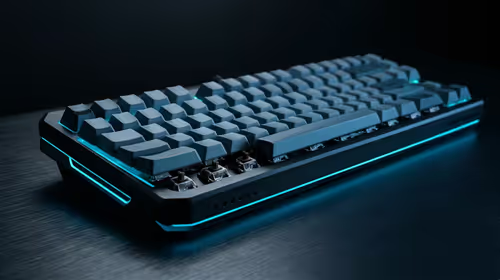
- The Keyboard: You'll be typing on it for hours. Look for a comfortable, backlit keyboard with good key travel.
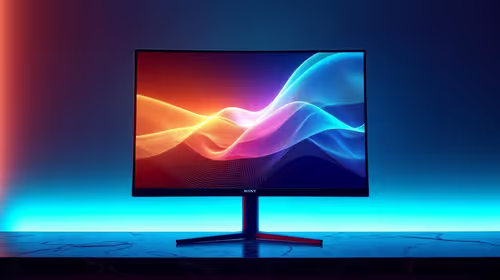
- The Screen: A high-resolution (Full HD, 1920x1080 minimum) screen with good colour accuracy and brightness makes code easier to read and reduces eye strain.
- Battery Life: With an unexpected outage as a constant reality, a long-lasting battery isn't a luxury; it's a necessity. Aim for a machine that can survive a 2-4 hour power outage while you work. ✨
Choosing the right machine is the first step to building amazing things. It's about empowering yourself with a tool that works with you, not against you.
Ready to Code Without Compromise?
Finding the perfect spec'd laptop is key to unlocking your full potential. For the best performance, choice, and value in South Africa, you need a machine that can keep up with your ambition. Explore our massive range of laptop specials and find the perfect machine to bring your projects to life.