Quick Answer
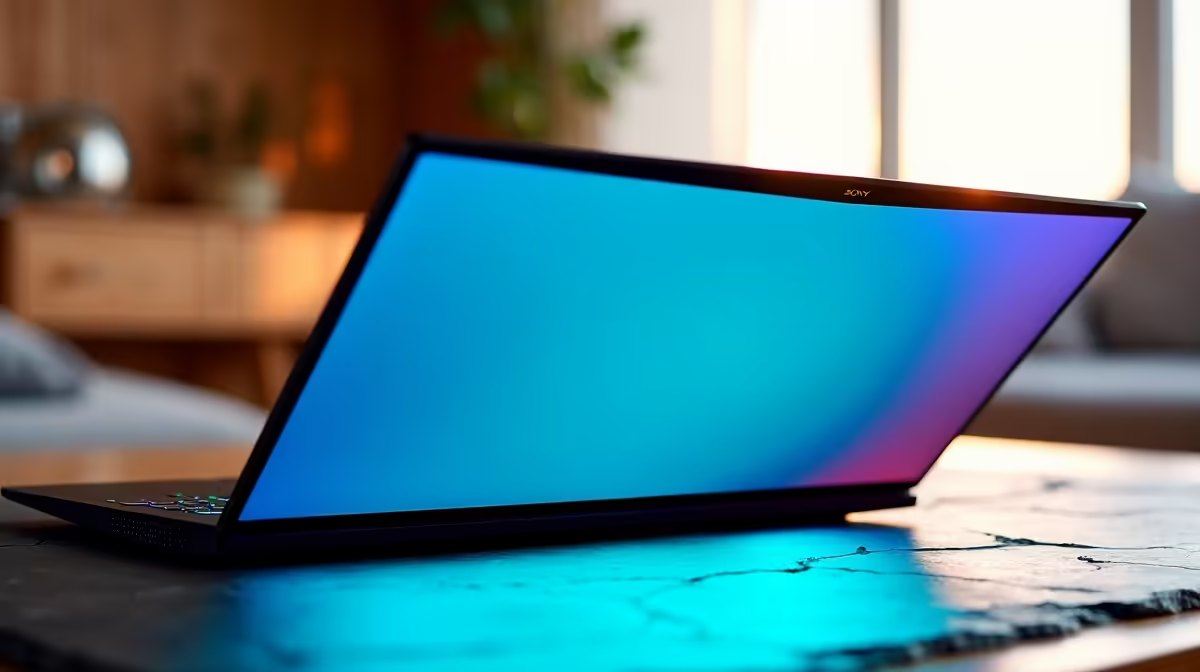
An NSFAS laptop shortlist in South Africa must start with the budget gap: the R5,200 device allowance does not usually cover a new Evetech laptop by itself. Treat R8,000-R12,000 as the realistic entry band for a new Windows study laptop, then prioritise 8GB to 16GB RAM, a 256GB or 512GB SSD, and reliable warranty support.
Choose The Core Spec First
For NSFAS laptop buying, shortlist the laptop around CPU, GPU, RAM, and SSD before cosmetics. The practical floor is 16GB RAM for heavier work and a 512GB SSD; gaming or CAD workloads should move toward RTX 4050 or RTX 4060 class graphics. Models such as Lenovo IdeaPad Slim 3, ASUS Vivobook 15, Acer Aspire 5, and MSI Modern 15 are useful comparison anchors, but live Evetech stock should decide the final cart.
Check Portability And Cooling
A laptop that travels between campus, office, and home must be judged on weight, charger size, fan noise, and keyboard comfort as well as benchmark scores. For Johannesburg, Cape Town, Durban, and Pretoria buyers, warranty handling and courier delivery are part of the value. A 144Hz screen is useful for gaming, while a brighter IPS panel matters more for study notes and design work.
Spend Where The Workload Notices It
Use R8,000-R18,000 as a cautious category band. Put money into 16GB to 32GB RAM, a better GPU, and SSD capacity before RGB trim or extreme refresh rates. If the title use case is light study, keep the laptop practical; if it is Revit, SolidWorks, Blender, or AAA gaming, do not drop below a modern dedicated GPU unless the budget forces it.
FAQ
Does the NSFAS device allowance cover a new laptop?
Not usually. The R5,200 allowance is below the normal new-laptop entry point, so buyers should plan for a top-up or compare approved campus options carefully.
What is the minimum study laptop spec?
Aim for at least 8GB RAM, a 256GB SSD, Wi-Fi, and a 14-inch or 15.6-inch screen. If the laptop must last several years, 16GB RAM and 512GB SSD storage are safer.
Should NSFAS students buy a gaming laptop?
Only if the course or personal use justifies the extra cost. For normal notes, research, Teams calls, and digital textbooks, a lighter study laptop is usually easier to carry and cheaper to maintain.
Buying check
Before adding a student laptop to cart, write down the exact screen, desk, software, and accessory requirements. Remove any option that misses one must-have port, capacity, warranty, or comfort check.