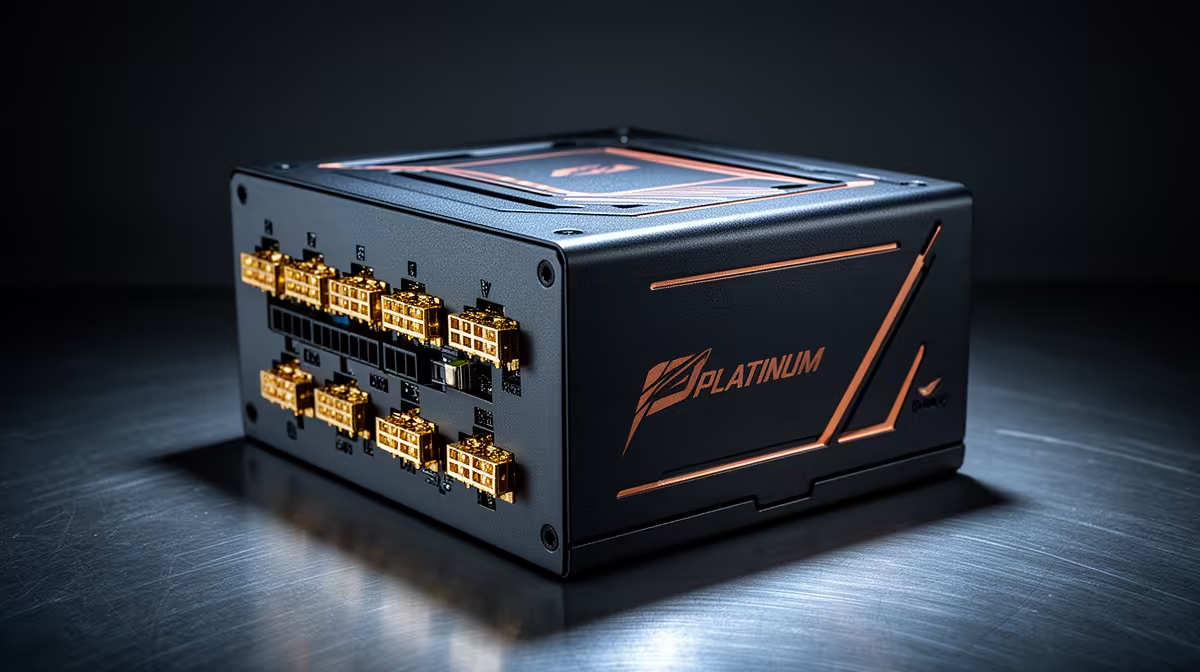
Efficiency labels differ by a few percentage points while PSU quality reaches far beyond efficiency. A Platinum vs Gold PSU comparison should include platform, noise, protections, warranty and expected load before estimating any energy saving.
Quick Answer
A Platinum PSU is worth the premium over Gold when the exact unit also gives you the electrical platform, noise profile, connectors and warranty you want, and the PC runs under load for enough hours to value a small efficiency gain. Gold is enough for most gaming builds. The 80 PLUS tier describes tested efficiency points under specified conditions. It does not guarantee tight voltage regulation, low ripple, quiet fans or long warranty cover.
Efficiency measures power lost inside the PSU
Your components draw DC power from the power supply. The PSU draws more AC power from the wall because conversion is not perfect. The difference becomes heat inside the unit.
If a PC needs 500W of DC output, a more efficient PSU can draw fewer watts from the socket than a less efficient one at that operating point. The saving is the gap between those two inputs, not the full 500W.
Certification tests use defined input voltage and load points. South African mains and your real gaming workload may not match every test condition. Check the certification record for the exact model and capacity, because a family name can cover several internal designs.
Calculate your own annual saving
You need four inputs: average DC load during use, hours per day, days per year and electricity price per kilowatt-hour. Then compare measured efficiency for the two exact PSUs near that load.
For each unit:
- Divide DC load by efficiency expressed as a decimal to estimate wall input.
- Subtract the two wall-input values to find the watt difference.
- Multiply by annual hours and divide by 1,000 for kilowatt-hours.
- Multiply by your current electricity tariff.
Use realistic gaming and idle periods rather than the PSU's full rated wattage. A 1,000W label does not mean the PC draws 1,000W all evening. A gaming machine may spend much of its life browsing, downloading or switched off.
The calculation often shows a modest annual gap between two sound Gold and Platinum units. A workstation rendering for long shifts can build a stronger case.
Rated wattage changes the operating point
PSUs tend to reach their best efficiency across a middle portion of the load range, with behaviour changing at very low and very high load. Oversizing can place an idle PC in a weak part of the curve, while undersizing can leave little transient headroom and raise fan noise.
Size from the CPU, GPU, drives, fans and upgrade plan. Use the graphics-card maker's connector and power guidance, then allow sensible margin. Do not double capacity in search of a badge.
Modern GPUs can create short power excursions. The PSU platform, cable standard and protection tuning matter more here than Gold versus Platinum on the label. Choose native connectors required by the hardware and avoid unsafe adapter chains.
Platinum can reduce heat without guaranteeing silence
Lower conversion loss means less heat for the PSU fan to remove at the same DC load. That can support quieter operation. Fan curve, bearing, heatsink design and semi-passive mode decide what you hear.
Read noise testing across several loads. A Platinum unit with an aggressive fan can be louder than a quiet Gold model. Semi-passive fans may stop at low load and start with an audible change as temperature rises.
Case placement matters. Give the PSU intake clean air, keep the filter clear and leave exhaust space. A bottom-mounted unit should not sit against thick carpet.
Electrical quality lives beyond certification
Voltage regulation describes how closely output rails hold their targets as load changes. Ripple and transient response show other parts of output quality. Safeguards for excess current, abnormal rail voltage, short circuits and excess heat depend on design and implementation.
80 PLUS does not certify all of those behaviours. Use professional reviews with suitable test equipment for the exact model. A product family can change OEM, platform or component selection between wattages and revisions.
Warranty length also varies within Gold and Platinum tiers. Read the written term for the exact stock item and region. Long cover can signal manufacturer confidence, but service process and exclusions still matter.
Modular cables need model-specific discipline
Premium PSUs are often fully modular, which makes installation clean. The removable cables are not universal. Never move a cable from another PSU unless the maker lists both exact models as compatible.
Check cable count, length and connector spacing. A large case may need a longer CPU lead, while a multi-GPU-style cable bundle has no value in a single-card build. Use separate GPU cables when the PSU and graphics-card instructions call for them.
ATX version and native 12V-2x6 support may matter for a new GPU. Inspect the connector for full insertion and avoid a tight bend at the plug.
Compare whole units at the needed capacity
Open the Corsair power-supply range and shortlist the exact wattage, platform support and cable set. Then use the PSU best-seller page to compare popular alternatives across efficiency tiers.
Score each model for independent electrical testing, noise at your expected load, connectors, physical size, warranty and total cost. Put the electricity saving beside those factors rather than making it carry the decision.
A strong Gold PSU can be the better component than a weak Platinum model. When two units are sound in every other respect, the Platinum choice buys lower conversion loss and may bring nicer supporting features. Pay only for features present on the exact unit.
Include replacement timing in the value check. A power supply can outlive the first graphics card, so connector support and manufacturer service may matter across two builds. At the same time, buying far beyond a realistic upgrade plan locks money into unused capacity. Write the next likely CPU and GPU beside the current parts, then size for that path.
FAQ
How much electricity will Platinum save over Gold?
It depends on exact efficiency curves, PC load, annual hours and your tariff. Calculate the wall-input gap at the load you use.
Does Platinum guarantee better build quality?
No. The tier covers efficiency under test conditions. Regulation, ripple, protections, acoustics and warranty need separate evidence.
When does Platinum make sense?
It makes more sense for long daily workloads, high sustained draw or when the exact Platinum unit also wins on noise, connectors and cover.
Calculate the annual wall-power difference at your real load, then choose the PSU with the stronger tested platform, cables and warranty.