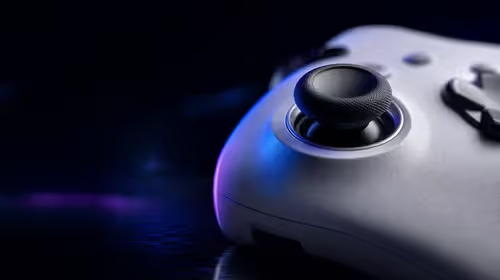
TMR is a magnetic way to read thumb position, not a promise that every stick problem disappears. Gamers choose TMR sticks for drift resistance and precise control while still checking calibration, mechanics, settings and physical feel.
Quick Answer
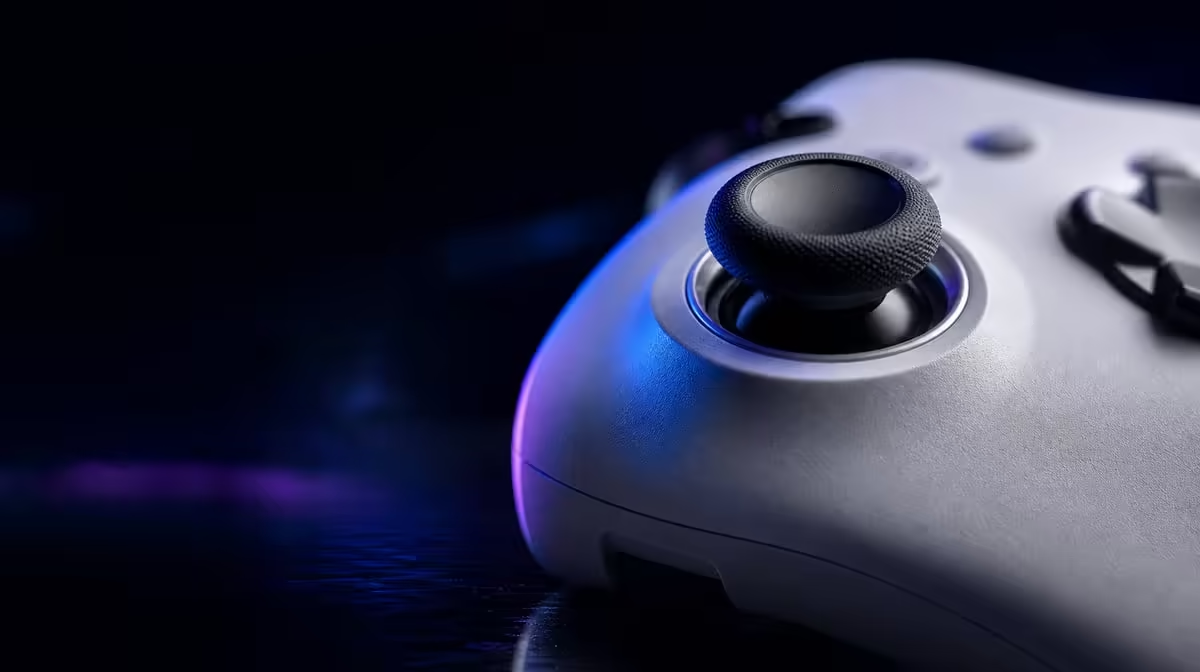
GameSir equips the R1,499 G7 Pro with Mag-Res TMR thumb modules, avoiding the conventional resistive sensing contact found in potentiometers. Drift-conscious players can value that design while recognising that no moving mechanism is failure-proof.
🧲 Understand the magnetic measurement
A stick module must report its position across two axes. Traditional designs commonly use resistive contact in potentiometers to measure that movement.
TMR reads magnetic changes instead. Avoiding the conventional contact path addresses one wear source associated with drift.
This does not mean the stick has no contact anywhere. It means the position-sensing method avoids the resistive path used by a traditional potentiometer. Keep the claim attached to sensing rather than the entire mechanism.
TMR and Hall Effect are related magnetic ideas but not interchangeable product labels. The G7 Pro specifies Mag-Res TMR for its sticks and Hall Effect for its triggers.
The term describes sensing, not stick tension, cap texture or height. Those physical details need hands-on evaluation.
Grip and thumb geometry can make two controllers with similar sensor principles feel different. A player should test the complete range from a natural hold rather than buying the sensor name alone.
Game software adds another layer. Sensitivity curves and dead zones can make a well-centred module feel unresponsive or overly sharp. Record those settings during every comparison.
Magnetic sensing also does not remove springs, pivots and other moving pieces. Calibration and damage can still affect the input.
Store the controller carefully and use the dock where it suits the routine, but do not turn good handling into a guarantee. A baseline and measured symptom remain the best foundation for later troubleshooting.
Evetech's gaming controller selection provides a place to compare complete controllers after learning the sensor difference.
🎯 See why players value drift resistance
Drift appears as unintended movement near centre. In a game, a character or camera can move after the player releases the stick.
TMR addresses the resistive-contact wear path, making drift-resistant a useful description. Never-drift would overstate what one sensor change can guarantee.
Set a baseline when the controller is new. Record centre, dead zone, sensitivity and the test game.
Include platform and connection. Wired Xbox, PC cable or 2.4GHz, and Bluetooth Android can place the same stick in different game and software environments.
Photograph or write the input-view result where practical. A reference makes gradual change easier to identify than memory alone.
Move slowly near neutral, trace the full range and release from several directions. Repeat after a normal play session.
Check diagonal motion and a small circle around centre. These movements reveal more than repeatedly hitting the outer boundary.
Use both sticks even if the complaint concerns only one. The paired result helps identify whether an issue follows a particular module, axis or game role.
Calibrate before increasing dead zones enough to hide a symptom. Large masks can remove fine control.
Reconnect and restart before concluding that calibration failed. If the behaviour follows one game profile, compare its settings with another title before assigning the cause to hardware.
Write the symptom precisely: camera creep, character movement, incomplete range or uneven return. Each points to a different observation and should not be collapsed into the word drift.
Browse Evetech's gaming accessories category once the input test is defined.
🕹️ Decide whether precision improves play
Use slow tracking, small target corrections and a large turn that must settle. Keep game settings and connection unchanged.
Run several attempts and judge the ordinary result, not a single perfect pass. Accuracy depends on repeatability under the player's normal grip.
Alternate target directions so the preferred hand motion does not dominate the test. Include upward, downward and diagonal corrections.
Count consistency rather than the best attempt. Magnetic technology cannot supply aim practice or the correct sensitivity automatically.
If the player improves after several sets, separate learning from sensor preference. Repeat the earlier configuration later in the session to reduce order bias.
Ask whether the stick makes small correction easier, returns predictably and remains comfortable. These are usable observations without inventing a numerical precision claim.
Test on the main platform. Xbox is wired, PC offers cable or 2.4GHz and Android uses Bluetooth. The same sticks can enter different game profiles.
For PC, keep 1000Hz polling unchanged during the stick comparison. A reporting-rate change can affect timing impressions without altering the sensed position.
For Android, first confirm that the game supports controller input. Poor game mapping is not evidence about TMR technology.
Separate polling from precision. The G7 Pro's 1000Hz PC mode changes report interval; it does not change the TMR position itself.
Separate triggers too. Hall Effect trigger travel and micro switch stops concern index-finger input. A strong stopped-trigger result does not validate thumbstick centring.
Hall Effect triggers use magnetic sensing for finger travel, another job entirely. Their stops should not be counted as stick evidence.
⚖️ Fit TMR into the R1,499 decision
A drift-conscious buyer can make TMR the leading reason while still checking platform links, comfort and the games played.
A player satisfied with a current traditional controller may place less value on changing sensor type immediately.
Traditional analog sticks can still be accurate. The buyer is comparing current performance, wear priorities and complete product value rather than declaring one installed controller defective by category.
At R1,499, the G7 Pro also includes four macros, adjustable triggers, swappable parts and a dock. Score them separately.
Create a weighted list. Give TMR the largest share only when drift resistance and thumb control are leading concerns. Reduce it when platform connection or trigger behaviour matters more.
For a multi-platform player, familiar sticks across Xbox, PC and Android can add value, provided the different links are accepted.
Keep the baseline for later troubleshooting. Repeat the same test before altering several settings or declaring a hardware fault.
Schedule a later comparison after ordinary ownership. Use the same game scene, connection and dead zone. A repeatable note is more informative than a vague memory that the sticks once felt better.
End the assessment with two statements: what the magnetic design changes and what remains dependent on mechanics, software and the player. This keeps the reason for choosing TMR precise.
Recheck both statements after a normal reconnect and game session. At R1,499, the strongest conclusion is a drift-resistant sensing choice that also fits the buyer's platform, hand and repeatable control test.
Review Evetech's popular accessories with drift resistance and platform fit in distinct rows.
Frequently Asked Questions
What does a TMR stick sense?
It reads thumbstick position through magnetic changes.
Which TMR implementation is used in the G7 Pro?
It uses GameSir Mag-Res TMR modules.
Why do players associate TMR with drift resistance?
The design avoids conventional resistive sensing contact associated with one wear source.
Can a TMR module still develop an input problem?
Yes. Calibration, mechanics, settings and damage remain possible influences.
Does TMR technology set the stick tension?
No. The sensing method does not define every part of physical feel.
Will TMR sticks improve every player's accuracy?
No. Game settings, technique and comfort still shape accuracy.
What should be compared alongside stick technology?
Check platform support, trigger control, connection, physical fit and exact price.
Want drift resistance grounded in a repeatable test?
Compare Evetech's controllers and save a centre, range and aim baseline for the G7 Pro's Mag-Res TMR sticks.