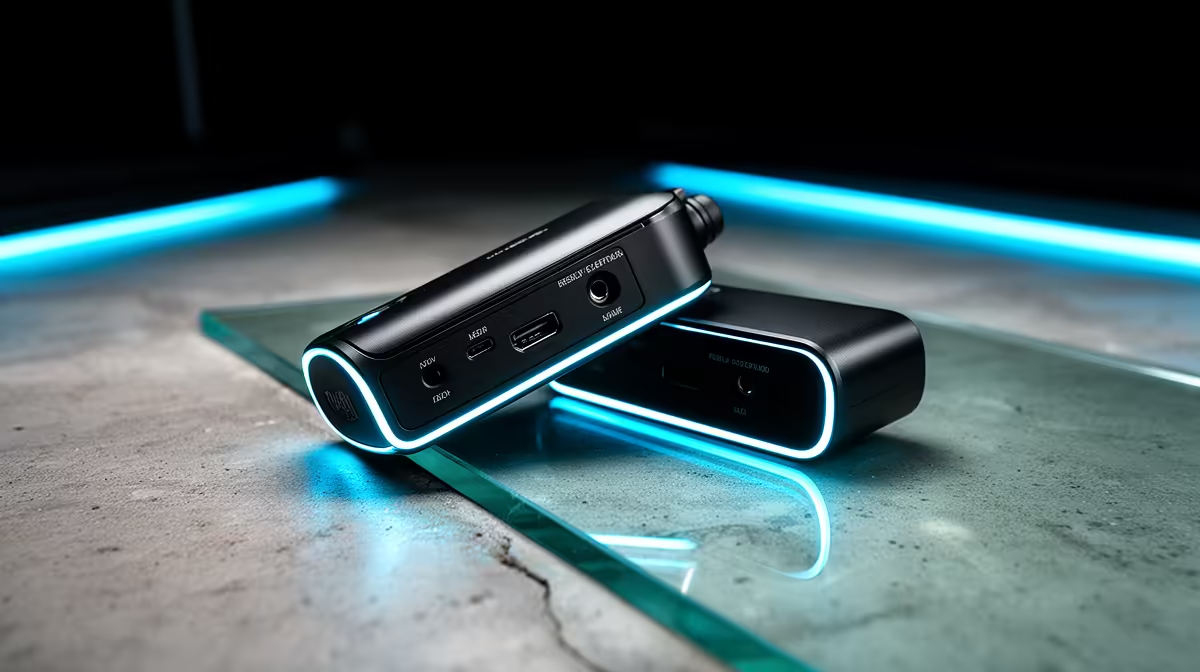
The presenter who walks onto a South African conference stage, hands a wired mic to the next speaker, and waits while the cable gets untangled has already lost the room. Plug-and-play wireless mic setups solve that friction entirely: the transmitter clips onto a lapel, the receiver slots into a USB-C port, and the laptop sees a clean audio source with no driver installation required. For corporate events, university lectures, and product launches across the country, that simplicity is not a convenience. It is a professional necessity.
Quick Answer
A plug-and-play wireless mic setup pairs a USB-C receiver with a clip-on lavalier transmitter. No drivers, no mixers. A single-channel kit handles one presenter; a dual-channel kit lets two people share one receiver. Expect 6 to 8 hours of battery life per charge on most kits.
🔌 How Plug-and-Play Wireless Audio Works
The key to the zero-configuration experience is audio class compliance. USB audio devices that follow the standard audio class specification are recognised natively by Windows, macOS, and modern Android devices without any custom software. The receiver presents itself to the host device the same way a USB headset would. The operating system sees it, assigns it as an audio input, and everything else follows from there.
Inside the transmitter is a small wireless radio, typically operating in the 2.4 GHz band. That band is broadly available in South Africa without licensing requirements, which matters for presenters moving between different venues and cities. The transmitter and receiver pair during initial setup, usually by pressing a single button with both units near each other, and that pairing persists across power cycles.
The lavalier microphone capsule sits on the clip-on body, usually around 20 centimetres from the presenter's mouth when mounted on a collar or jacket lapel. That proximity means the capsule captures voice before room acoustics have a chance to blend with it. A presenter in a large venue with hard surfaces benefits especially from this placement, since the direct-to-capsule pickup largely ignores the reflective environment around them.
Dual-Channel Kits for Multi-Presenter Events
A dual-channel receiver holds two independent wireless links simultaneously. Two transmitters, each paired to a different channel, send audio back to the same receiver. The receiver mixes both signals into a single output feed, which the laptop or audio interface receives as one stereo or dual-mono stream.
This arrangement means a panel discussion with two participants needs only one USB-C connection at the laptop. The audio engineer or AV technician running the event has a cleaner cable situation, fewer devices to manage, and a single point to monitor. For events where transitions between speakers are frequent, dual-channel is the configuration to look for.
🎯 Battery Life and Real-Event Planning
Battery capacity in wireless lav transmitters has improved significantly. Most current plug-and-play kits offer between 6 and 8 hours of continuous audio transmission from the transmitter, with the receiver drawing its power directly from the host device over USB-C.
A full-day conference in Joburg or Cape Town that runs eight hours including setup time is at the edge of what a single charge supports. The practical answer is a charging case. Many kits include a case that holds enough power to recharge the transmitters two or three times, essentially extending battery life to a multi-day event without finding a wall socket between sessions.
For half-day workshops and single-session lectures, battery anxiety is rarely a real concern. A fully charged transmitter will last the entire session with charge to spare. The calculation only becomes important for events that run from morning through to evening.
🧠 Range, Interference, and Venue Realities
The 2.4 GHz frequency range in South African event venues is often shared with Wi-Fi networks, Bluetooth devices, and other wireless audio equipment. This is the background noise of any contemporary event space, and modern plug-and-play wireless kits handle it through frequency hopping, continuously shifting to whichever part of the band is clear.
Line-of-sight range for most 2.4 GHz lav kits sits around 50 metres. In an open conference room that is generous, covering a presenter anywhere on stage. In a venue with thick concrete columns, multiple partition walls, or metal seating structures, that range compresses. A ballroom in a Cape Town convention centre and a breakaway room with prefab partitions present very different wireless environments.
The practical rule is to test range before the event begins. Walk the transmitter to the furthest point the presenter will occupy while monitoring the receiver signal indicator. Most kits show a stable, dropping, or lost signal clearly enough that a five-minute range test before the first session catches any venue-specific issues with time to reposition the receiver.
Pro Tip ⚡
Charge transmitters the night before the event rather than the morning of it. Last-minute charging at a venue often happens through laptop USB ports that deliver limited current, meaning the transmitter arrives at the session partially charged. A full overnight charge from a wall adapter removes that variable entirely.
🔧 Plug-and-Play vs XLR Wireless: When Each Makes Sense
Professional XLR wireless systems have been the broadcast and theatre standard for years, and they earn their place in permanent installations. They offer deeper frequency control, lower latency on some systems, and the ability to integrate into a full mixing desk. For a touring broadcast production or a permanently installed conference room, that depth is worth the setup complexity.
Plug-and-play systems make a different argument: they fit in a laptop bag, they work on any device with a USB-C port, and a non-technical presenter can set one up without help. At a South African startup event where a founder is also managing their own slides, that self-sufficiency is genuinely valuable. At a university tutorial where a lecturer moves between different rooms each day, the portable kit that lives in a bag is more useful than a permanent system locked to one venue.
The decision is mostly about context. Fixed venues with dedicated AV support lean toward XLR. Mobile presenters and events without technical staff lean toward plug-and-play.
Frequently Asked Questions
How long do wireless lav transmitters last on a full charge?
Most current plug-and-play transmitters run for 6 to 8 hours of continuous use. Kits with a charging case can extend this substantially by topping up between sessions. For a full-day event, carry the charging case and use any natural break to drop transmitters back in for 20 to 30 minutes.
Do these mics require any software or driver installation?
No. The USB-C receivers use standard audio class protocols that every modern operating system recognises without custom drivers. Plug in the receiver, the OS assigns it as an audio input, and it is immediately available to any conferencing or recording software. This also means they work on tablets and phones with USB-C ports.
Can two presenters use one wireless receiver at the same time?
Yes, with a dual-channel kit. Two transmitters each pair to a different channel on the same receiver, which outputs both audio streams as a combined feed. This is the standard configuration for panel events and Q&A sessions where multiple speakers need simultaneous wireless coverage.
Is a clip-on lav better than a handheld wireless mic for stage presentations?
For presenters who move, gesture, or use slides, yes. A lavalier keeps the capsule close to the mouth without tying up a hand. It also maintains consistent pickup distance as the presenter turns to address different parts of the room, which a handheld mic only achieves if the presenter remembers to keep it raised, which most people forget.
What happens to the wireless signal in a crowded venue?
Frequency hopping helps considerably. The transmitter and receiver constantly shift to less congested parts of the 2.4 GHz band, which handles most interference from competing Wi-Fi and Bluetooth in the room. Very dense RF environments like large trade shows may cause occasional dropouts. Testing the range in the specific venue before the event is the most reliable way to identify any issues.
Ready to set up wire-free presenting at your next SA event?
Browse the wireless microphone range for presenters who need reliable, driver-free audio without the setup complexity.