Quick Answer
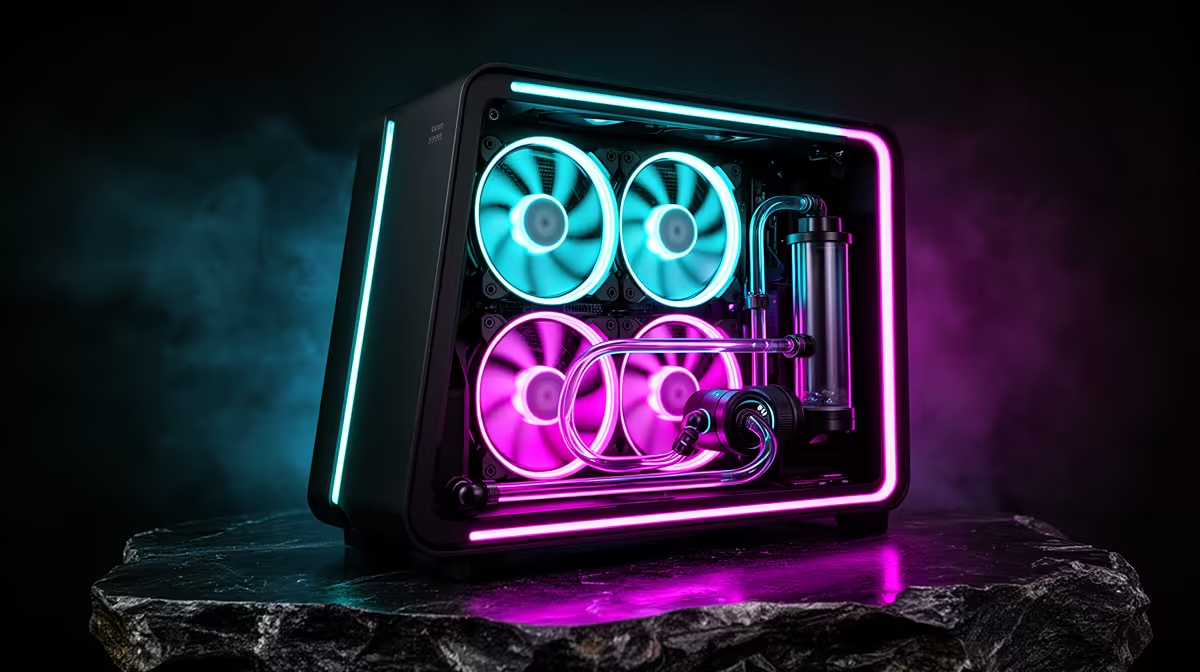
Pre-installed ARGB fans bundled with a case typically offer better rand-per-fan value than buying equivalent fans separately, with cases that include three to four ARGB fans often saving R400 to R900 versus purchasing identical fans individually. Adding fans later gives you more control over brand, quality, and airflow specs but costs more and requires planning.
The Economics of Pre-Installed Fans 💰
Cases with four pre-installed ARGB fans in South Africa typically retail between R1,800 and R3,500, while equivalent standalone ARGB fans of similar quality cost R250 to R500 each. Buying four separately puts you at R1,000 to R2,000 in fans alone before the case purchase. The bundled value is clear when the case itself would otherwise cost R1,500 to R2,500 without fans. The catch is that bundled fans are typically mid-tier quality: adequate airflow and a good ARGB effect, but not the performance ceiling of premium standalone fans from specialty brands. For most gaming builds in the R25,000 to R40,000 range, the bundled fans are entirely adequate for CPU and GPU cooling without upgrades.
When to Add Fans Separately Instead 🔧
Adding fans later is the better choice when your build contains a CPU with a TDP above 150W, a high-end GPU like the RTX 5080 or 5090 that generates substantial heat, or when you want a specific fan brand ecosystem for RGB software integration. Motherboard ARGB ecosystems from major manufacturers work best when all fans share the same control protocol, and mixing bundled fans with premium standalone units can create software conflicts that require a separate controller. For an enthusiast build where every component is deliberate, sourcing matching fans from the same premium brand produces a more cohesive result both thermally and visually.
Fan Quality Differences That Matter Practically 🌬️
Pre-installed fans in the R300 to R500 each range typically use hydraulic or sleeve bearings with rated lifespans of 30,000 to 40,000 hours and noise levels of 25 to 32 dBA at full speed. Premium aftermarket ARGB fans use fluid dynamic or magnetic levitation bearings, reach 50,000 hours MTBF, and often run quieter at equivalent airflow. For a system that will run daily for five or more years, the bearing quality difference becomes relevant in year three or four when cheaper fans begin to develop bearing noise. Replacing four worn-out bundled fans with quality aftermarket options costs R1,200 to R2,000 at that future point, which is a planning consideration worth noting at build time.
Check Fan Hub Compatibility Before Adding Fans ⚡
Many cases with pre-installed ARGB fans include a dedicated fan and lighting hub that is pre-wired. Adding new fans to this hub requires matching the connector type, typically 3-pin ARGB and 4-pin PWM. Before buying additional fans, confirm your case hub supports the number of total fans you want to add, as some hubs max out at four connections.
FAQ
Can I replace bundled case fans with premium fans later?
Yes, case fans are universal in terms of mounting, and any 120mm or 140mm fan can replace a pre-installed fan without modification. The only consideration is matching the ARGB connector type to your hub or motherboard header.
Do pre-installed fans void the case warranty if I remove them?
No, removing or replacing pre-installed fans does not affect the case warranty. The case warranty covers the chassis itself, not the fans as separate components.
How many fans does a typical gaming build actually need?
For a mid-range gaming build with a 360mm AIO and a single high-end GPU, three front intake fans plus one rear exhaust fan is sufficient for the case body. The AIO radiator provides its own three fans. A total of seven to eight fans is typical for a well-cooled showcase build with a 360mm AIO.
Comparing case and fan options for your next build?
Evetech stocks gaming cases with bundled ARGB fans and standalone ARGB fan packs, browse both categories to work out the best value for your build.