Quick Answer
Spend more on wattage headroom, efficiency tier (Gold minimum), brand reliability, and warranty length. Save on modularity type (semi-modular costs R300 to R700 less than fully modular at equivalent specs), and avoid paying for wattage far beyond what your build needs.
Where Every Rand Counts: What Not to Overpay For 💰
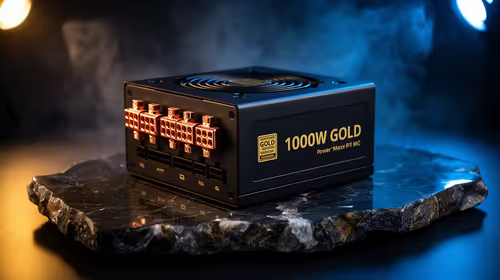
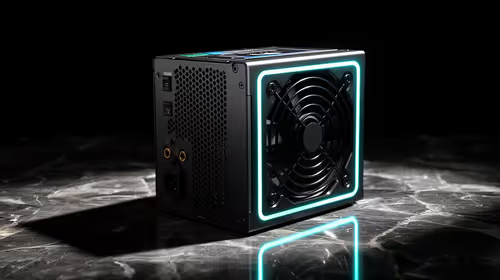
Fully modular PSUs command a genuine premium, typically R400 to R700 over a semi-modular equivalent from the same brand at the same wattage. For most South African mid-range builds, the fixed cables on a semi-modular unit (24-pin ATX and EPS CPU) are the ones you use anyway. The remaining detachable PCIe and SATA leads provide most of the cable management benefit at a lower price. Save here if build aesthetics are not a priority. Similarly, avoid oversizing wattage purely for future-proofing: a 1200W PSU for a current RTX 5070 build is unnecessary spend. A correctly sized 850W Gold unit is more efficient at your actual load and costs R1,500 to R2,500 less.
Where to Spend More Without Regret 🛡️
Efficiency tier is worth the step-up from Bronze to Gold. In South Africa, the price gap between an 850W Bronze and an 850W Gold unit from a comparable brand is R300 to R700, which pays back in lower electricity bills and reduced case heat. Brand and warranty tier deserve a full budget commitment. A reputable brand offering a seven to ten year warranty at R3,500 is a better long-term spend than an unknown brand at R2,800 with a two-year warranty. A failed PSU can damage the GPU, motherboard, or storage drives it powers, making the premium brand the cheaper outcome if something goes wrong. ATX 3.1 compliance is non-negotiable for current-gen GPU pairings; paying R200 to R400 more for a certified unit over an ATX 2.x equivalent is mandatory, not optional.
How Rand Volatility Should Shape Your Buying Timing 📊
Premium PSUs, mostly manufactured in Asia and priced in dollars, become significantly cheaper when the rand strengthens. Tracking the USD-ZAR rate over a four to eight week window before a big purchase is practical. A rand at R17 versus R19 to the dollar represents roughly an 11% price difference on imported hardware, which on a R4,000 PSU is R440 in potential savings. There is no guarantee of timing the optimal window, but awareness of the rate trend prevents buying at a known peak.
Buy the PSU Before the GPU in an Upgrade Path ⚡
If you are planning a GPU upgrade to current-gen hardware, buy the correct ATX 3.1 PSU first. It is the lower-cost component, and having it ready lets you act immediately when the GPU you want comes into stock at Evetech rather than delaying the build waiting for the power supply to arrive.
FAQ
Is an 80 Plus White PSU ever worth buying in South Africa?
No. 80 Plus White certifies only 80% efficiency at 50% load. Gold units have become close enough in price that White represents poor value regardless of absolute price. Always reach for Bronze at minimum, and Gold where budget allows.
Does paying for a higher efficiency tier actually save money on electricity in SA?
The saving is real but modest for a gaming-only rig, roughly R80 to R150 per year moving from Bronze to Gold under heavy use. The better argument for Gold is reduced case heat. For workstations running sustained heavy loads eight or more hours daily, the annual saving grows to R250 to R400.
Are grey-market imported PSUs cheaper than local stock in South Africa?
Grey-market imports sometimes show lower prices but carry no local warranty and may be region-specific retail units not intended for the SA market. Buying from established local retailers like Evetech ensures local warranty coverage and import compliance.
Building smart on a South African budget?
Browse Evetech's PSU range to find the right balance of wattage, efficiency, and brand reliability at current rand-priced stock, updated as import cycles and exchange rates shift.