Quick Answer
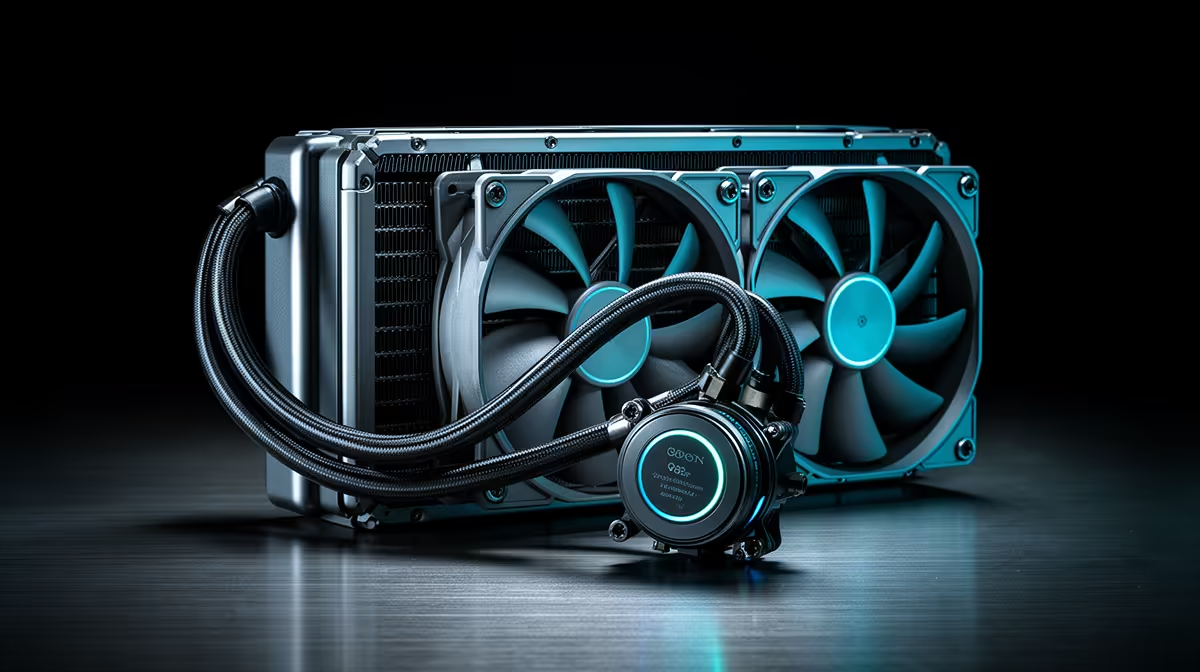
CPU temperature spikes are reduced by combining adequate pump flow rate, sufficient radiator surface area and high-static-pressure radiator fans. No single variable solves spike behaviour in isolation: a large radiator with a weak pump flows warm coolant inefficiently, while a strong pump on a small radiator cannot shed heat quickly enough during burst workloads.
Understanding the Spike: Why It Happens 🔬
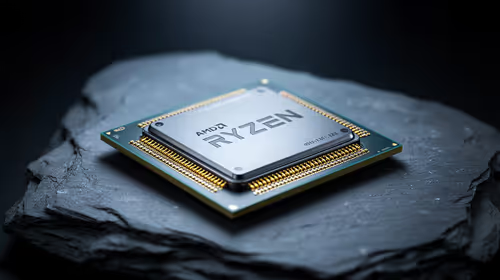
Modern CPUs like the Ryzen 9 9950X and Intel Core Ultra 9 285K use aggressive boost algorithms that spike power draw to 230W or above for milliseconds to seconds at a time. During this spike, heat transfers from the IHS to the cold plate faster than the coolant loop can carry it to the radiator. The temperature spike visible in HWiNFO64 is the cold plate rising while the loop catches up. A higher pump flow rate delivers cool coolant faster, and a thicker radiator sheds accumulated heat from the coolant more quickly between spikes.
Tuning Pump Speed for Spike Reduction 🔧
AIO pump speed is the most directly adjustable variable. Most AIO software and BIOS controls allow setting the pump to a fixed percentage or a temperature curve. Running the pump at 80 to 100% during demanding workloads reduces the thermal lag between a CPU power spike and coolant delivery to the radiator. The noise penalty at pump speed above 90% is usually modest compared to fan noise; pumps on quality AIOs are not the primary noise source. For a Ryzen 9 9950X overclocked past 200W PBO limit, keeping the pump at a high constant speed during render or benchmark sessions is a straightforward first step before investing in a larger radiator.
Radiator Size and Fan Pressure Working Together 💨
Upgrading from a 240mm to a 360mm radiator reduces the coolant temperature delta between inlet and outlet because there is 50% more fin surface area shedding heat per litre of coolant passing through. Pairing this with static-pressure fans rated above 2.5 mmH2O ensures that at moderate fan speeds the airflow through the dense radiator fins is sufficient to transfer that heat into the case air. In SA conditions where Pretoria summer ambient temperatures exceed 30 degrees Celsius, every degree of reduced coolant temperature directly translates to reduced CPU peak temperature. Swapping a 240mm AIO for a premium 360mm unit on a Ryzen 9 9950X system can reduce peak temperature spikes by 10 to 18 degrees Celsius, depending on the specific units compared.
Set Pump to Fixed High Speed During Benchmarks ⚡
Before running a Cinebench, Blender or game benchmark, manually set your pump to 100% speed through your AIO software or BIOS. This minimises thermal lag during the opening minute of the workload where temperature spikes are most severe, giving you a cleaner baseline for performance comparison.
FAQ
How much does pump speed actually affect CPU temperatures?
At identical ambient conditions, moving from 50% to 100% pump speed typically reduces peak temperatures by 3 to 6 degrees Celsius on high-TDP CPUs. The effect is most pronounced during initial workload spikes and less significant once the coolant loop reaches thermal equilibrium.
Does case fan exhaust speed affect how well the radiator dissipates heat?
Yes significantly. If exhaust fans cannot move warm air out of the case quickly enough, the ambient temperature inside the chassis rises, and the radiator fans pull in warm air rather than cool ambient air. A well-ventilated case with at least two rear or top exhaust fans is a prerequisite for accurate AIO performance.
Can I reduce CPU temperature spikes without replacing my cooler?
Yes. Setting a power limit on your CPU via BIOS or Ryzen Master to cap package power at 142W instead of 230W reduces spike magnitude directly. This costs some peak performance in burst workloads but significantly improves thermal consistency and is a useful interim solution before a hardware upgrade.
Dealing with temperature spikes during intense workloads?
Explore Evetech's range of 360mm AIO coolers built to handle high-TDP CPUs with consistent thermal performance.