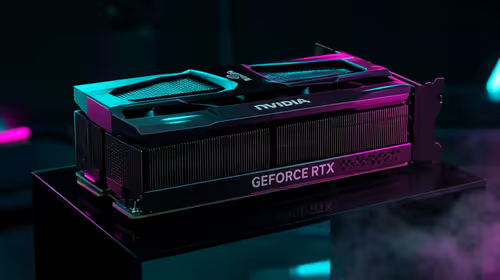
Open a large assembly in SolidWorks on a gaming card and the viewport can flicker, drop RealView shading or render transparency wrong, and no amount of GeForce horsepower fixes it. The split between RTX PRO and GeForce RTX for SolidWorks is not about raw speed, it is about certified drivers. Only NVIDIA's ISV-certified RTX PRO drivers unlock RealView graphics and Order Independent Transparency cleanly, while GeForce cards are prone to display faults in exactly the assemblies professionals work on every day.
Quick Answer
For professional SolidWorks and CAD, you need an ISV-certified RTX PRO card. Its certified driver enables RealView and Order Independent Transparency and keeps large assemblies stable in the viewport. GeForce RTX cards, however fast, are not certified for SolidWorks and can produce display faults, missing shading and transparency errors.
What ISV certification actually means
Independent Software Vendor (ISV) certification is a formal validation between NVIDIA and software makers like Dassault, the company behind SolidWorks. The graphics driver is tested against the application until both sides certify it as stable. RTX PRO cards (the workstation line formerly branded Quadro) ship with these certified drivers. GeForce drivers are tuned for games, where a one-frame glitch is invisible, not for CAD, where a misdrawn assembly is a real problem.
That distinction is why a gaming card with more raw shader throughput can still be the wrong tool. SolidWorks uses graphics features in ways games do not, and certification is the guarantee those features behave.
RealView graphics: why it needs the certified driver
RealView is the feature that puts realistic materials, reflections and environment lighting on your model in the viewport. It relies on graphics paths that SolidWorks only enables on certified hardware. On a GeForce card, RealView is typically greyed out or unstable, because SolidWorks checks for a recognised certified GPU before switching it on. If you want models that look like the finished part while you design, the certified RTX PRO driver is the gate you pass through. You can see the current professional cards in the workstation graphics range to match a model to your assembly size.
Order Independent Transparency
Order Independent Transparency (OIT) is what lets you see through overlapping transparent bodies correctly, a housing over a circuit board, a fluid inside a pipe. Without certified support, transparent faces draw in the wrong order and the image is wrong. RTX PRO certification enables OIT reliably so transparency renders correctly regardless of how parts overlap.
Large-assembly stability
Where GeForce most visibly falls short is the big assembly. As part counts climb into the thousands, uncertified drivers can flicker, fail to redraw or corrupt the viewport during rotation. The certified driver is validated against this exact workload, so the viewport holds steady. For an engineer billing hours, a viewport you can trust is not a luxury, it is the baseline.
VRAM and assembly size
Beyond certification, match VRAM to your largest assembly. Bigger models and more textures need more graphics memory to stay smooth. A certified card with too little VRAM will still struggle on a massive assembly, so size the memory to your work, then let certification handle correctness.
How NVIDIA Validates Certification for SolidWorks 2026
NVIDIA maintains a public hardware certification list for SolidWorks that is updated with each software release. The RTX PRO 6000 Blackwell, RTX PRO 4500, and RTX PRO 4000 series all carry SolidWorks 2026 certification. This means Dassault and NVIDIA have jointly tested the driver against the application and confirmed that RealView, ambient occlusion, hardware shadows, and viewport rotation all behave as intended. A card that appears on this list also qualifies for joint technical support from NVIDIA and Dassault if a driver-related problem appears, which is meaningful for a firm whose productivity depends on the tool working.
GeForce cards do not appear on this list. That is not a gap that a driver update or workaround fills: certification is an active relationship between the software vendor and the GPU vendor, not a property of the hardware alone.
The Cost of Getting It Wrong
An engineer who buys a GeForce card for a professional SolidWorks station typically discovers the certification gap when RealView is greyed out, when transparency renders incorrectly on a complex assembly, or when a viewport corruption appears under a tight deadline. Diagnosing these issues takes time, and neither NVIDIA nor Dassault supports the combination. The cost of a correct certified card at purchase is almost always less than the time lost to a problematic uncertified one.
Who can get away with GeForce
A student learning SolidWorks, a hobbyist on small parts, or someone doing light modelling without RealView can run a GeForce card and accept the occasional quirk. The moment the work is professional, the assemblies are large, or a client sees the render, certification stops being optional. The trade-off is correctness and stability, and that is what RTX PRO buys. If you are speccing a full machine, the PC best sellers give a sense of the workstation builds that pair these cards with the right CPU and memory.
Frequently Asked Questions
Why can't a fast GeForce card just run SolidWorks?
Raw speed is not the issue. SolidWorks relies on certified graphics features like RealView and Order Independent Transparency that NVIDIA only validates on RTX PRO cards. A GeForce card may be faster on paper but can still misdraw assemblies and disable RealView.
What is RealView and why does it need certification?
RealView applies realistic materials, reflections and lighting to your model in the viewport. SolidWorks only enables it on a recognised certified GPU, so it is typically unavailable or unstable on GeForce cards and reliable on certified RTX PRO drivers.
What is Order Independent Transparency?
OIT renders overlapping transparent bodies in the correct visual order, so you can see through layered parts accurately. Without certified driver support, transparent faces draw incorrectly. RTX PRO certification makes OIT reliable.
Do I still need to worry about VRAM?
Yes. Certification guarantees correctness, but large assemblies and heavy textures also demand enough graphics memory to stay smooth. Match VRAM to your biggest model, then rely on certification for stability.
Can a student use a GeForce card for SolidWorks?
For learning and small parts, yes, accepting the occasional viewport quirk and limited RealView. For professional work with large assemblies and client-facing renders, a certified RTX PRO card is the correct choice.
If your SolidWorks work is professional, certification is the difference between a viewport you trust and one that fights you. Compare certified cards in the Evetech workstation graphics range and size the VRAM to your largest assembly before you buy.