Quick Answer
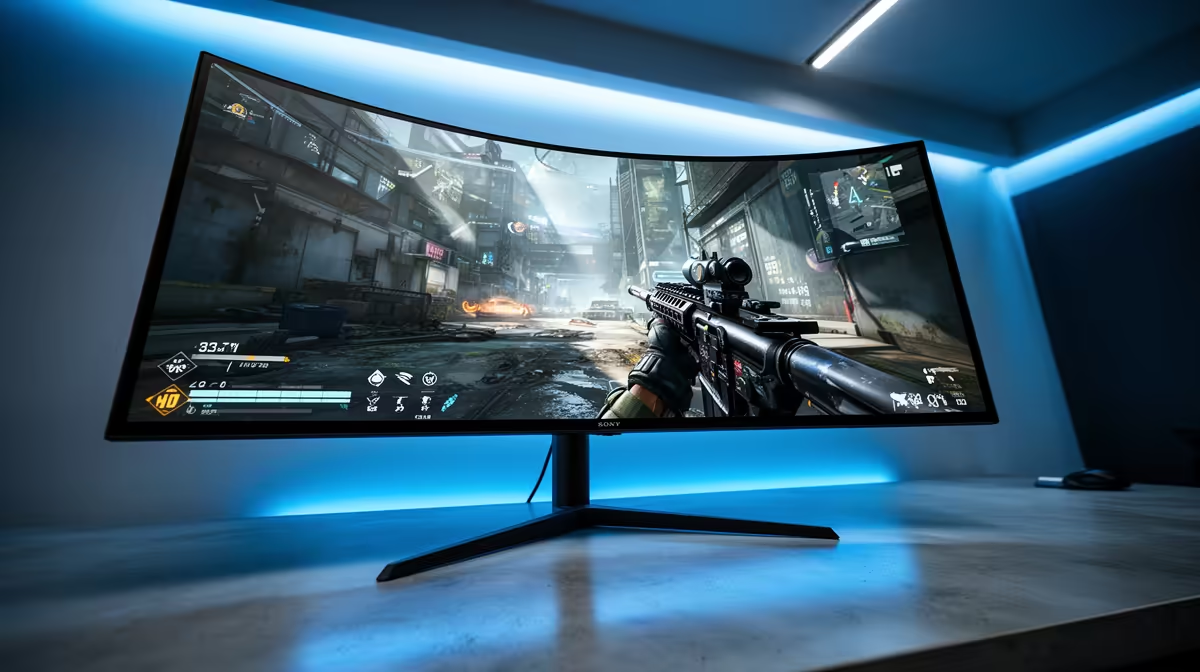
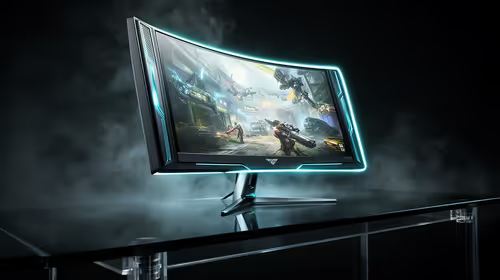
Yes, for competitive FPS gaming, a 0.03ms OLED gaming monitor provides a measurable competitive advantage over even the fastest 1ms IPS panels. The elimination of pixel trailing during rapid crosshair movement is tangible in CS2, Valorant, and Apex Legends, and pairs perfectly with the high refresh rates (240Hz and above) that competitive play demands.
Why 0.03ms Changes the FPS Experience 🎮
Response time in monitors measures how quickly a pixel transitions between colours. At 0.03ms GtG (grey-to-grey), OLED panels are approximately 33 times faster than a 1ms IPS panel, and over 160 times faster than a typical 6ms VA panel.
IPS panels at 1ms can still exhibit overdrive artefacts (inverse ghosting), where the pixel overshoots its target colour and creates a bright halo around fast-moving elements.
Refresh Rate Pairing for Competitive FPS 🔧
A 0.03ms OLED monitor is available in 240Hz, 360Hz, and in some panels even higher refresh rate variants. For South African competitive players, the relevant tiers are 240Hz (R18,000 to R30,000 for 4K or 1440p models) and 360Hz (available at 1440p, typically at a lower price than 4K 240Hz OLED).
For CS2 specifically, 360Hz at 1440p delivers tighter frame-to-frame consistency that experienced players notice during spray control.
For Apex Legends and Valorant, where frame rates above 240 fps are achievable at 1440p on an RTX 5070 or RTX 5080, a 240Hz or 360Hz 1440p OLED represents better value than a 4K 240Hz panel that your GPU cannot fully drive in those titles.
Is OLED Overkill for Your Current SA Setup? 💰
If you are currently on a 144Hz 1ms IPS panel and your GPU is an RTX 3070 or RX 6700 XT class, the most impactful upgrade is the GPU first. A 0.03ms OLED at 240Hz fed by a GPU that cannot sustain above 144 fps delivers the same experience as a 144Hz display. The OLED advantage is fully realised only when your GPU can push frame rates near or above the panel's refresh ceiling.
For SA competitive players, an RTX 5070 Ti at approximately R22,000 to R26,000 paired with a 1440p 240Hz or 360Hz OLED at R12,000 to R20,000 is the highest-impact competitive upgrade combination available under R50,000 total.
Match Refresh Rate to Your Game's Typical FPS ⚡
Before choosing between 240Hz and 360Hz OLED, benchmark your current game at 1440p or 4K and record your 99th percentile fps. Buy a monitor whose refresh rate sits at or just above that number. Paying for 360Hz when your GPU delivers 180 fps in your primary game wastes both the panel and money.
FAQ
Does the 0.03ms response time matter more than refresh rate for competitive FPS?
Both matter. Response time determines how clean fast-moving images appear, while refresh rate determines how frequently new frames are displayed. At 240Hz and above with 0.03ms response, OLED delivers the best combination of both for competitive play. Prioritising one at the expense of the other misses the point.
Do professional FPS esports players use OLED monitors in SA?
Top tier professional players typically use whatever panel their team sponsor provides, which historically has been high-refresh IPS or TN panels for their cost advantages in team kit. However, OLED adoption at the professional level is growing internationally, and SA semi-pro and amateur competitive players increasingly choose OLED for home practice setups.
Is the burn-in risk real for a dedicated FPS gaming OLED?
For pure gaming use where the content is constantly changing, burn-in risk is very low. Static HUD elements like health bars and maps can contribute to image retention over years of daily use. Enabling the monitor's pixel refresh cycle weekly and using the proximity auto-sleep feature significantly reduces this risk.
Ready to upgrade your competitive FPS setup with a 0.03ms OLED monitor?
Evetech stocks high-refresh OLED gaming monitors suited to CS2, Valorant, and Apex Legends, all with local stock and warranty support across South Africa.