Valve's 2026 Steam Machine put a concrete number on a question PC gamers have argued about for years: buy the prebuilt SteamOS box, or build your own and run SteamOS yourself? The Steam Machine ships with a fixed 6-core AMD Zen 4 CPU, a semi-custom RDNA 3 GPU with 28 compute units and 8GB of GDDR6 VRAM, 16GB of DDR5 memory, and SteamOS 3, which finally gives the build-versus-buy debate a fixed benchmark to measure against. For SA buyers sourcing parts locally, matching or beating those specs while keeping the door open to upgrades is very achievable.
Quick Answer
If you want a plug-and-play living-room console with zero setup, the Steam Machine is the simpler buy. If you want upgradeable hardware, the freedom to spec around the same Zen 4 and RDNA 3 baseline, and a path to swap parts later, building your own SteamOS PC with Evetech components wins on flexibility. Both run the same SteamOS 3 experience.
What the Steam Machine actually offers
The appeal of Valve's box is that everything is decided for you. The hardware is fixed, SteamOS 3 is pre-installed and tuned to it, and it is designed to switch on and play like a console. There is no parts research, no assembly and no driver wrangling. For a buyer who values that simplicity above all, it is a clean answer.
The cost of that convenience is that the configuration is locked. The CPU and GPU are what they are, so when newer titles demand more, the whole unit is your upgrade rather than a single component. The handheld and console-style devices in the handheld gaming range at Evetech show how Valve's fixed-spec philosophy fits into the wider SteamOS hardware picture.
The Steam Machine's pricing reality
The Steam Machine launched globally at USD 1,049 for the 512GB model and USD 1,428 for the 2TB version. That pricing drew immediate scrutiny, with several hardware publications pointing out that a DIY build with comparable Zen 4 and RDNA 3 class specs could come together for considerably less. Valve's premium pays for the compact cube form factor, factory SteamOS tuning, and seamless Steam Controller wireless pairing without a USB dongle. For an SA buyer converting at the current exchange rate, imported pricing adds another layer of cost the local DIY route sidesteps entirely.
Why building your own changes the maths
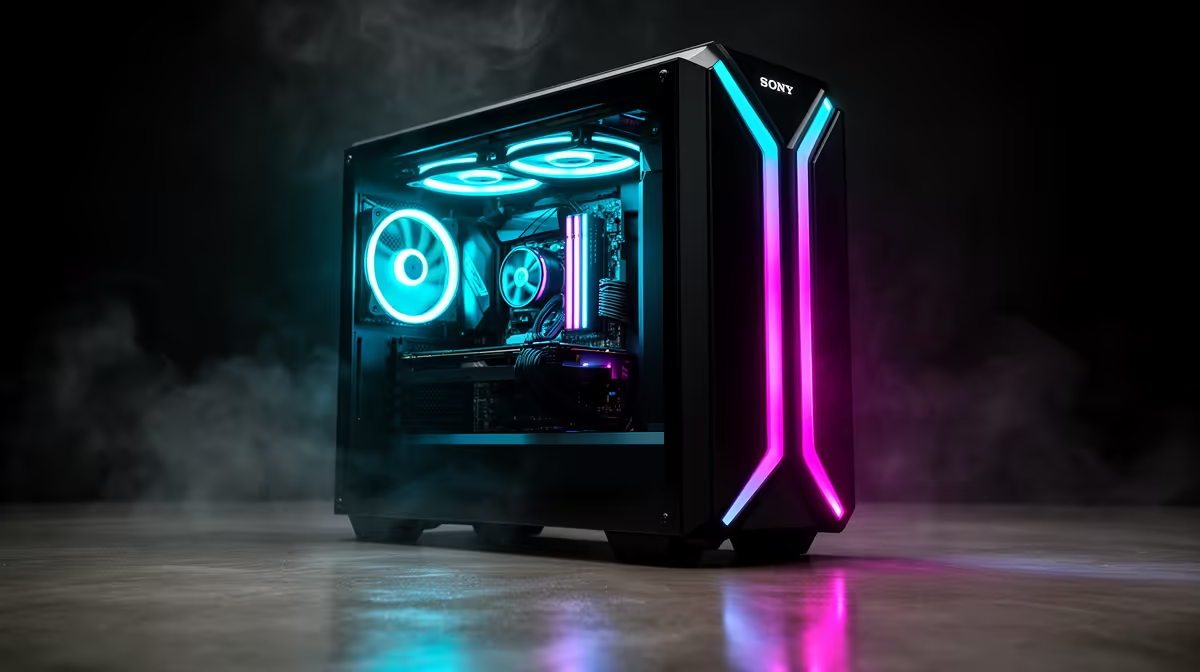
A self-built SteamOS PC starts from the same idea but keeps every decision open. You can match the Zen 4 and RDNA 3 class baseline, or push past it with a stronger GPU now while staying in budget elsewhere. More importantly, nothing is soldered into a single tier. When a future GPU or a faster CPU makes sense, you swap that one part instead of replacing an entire machine.
Running SteamOS on your own build
SteamOS is now installable on standard PC hardware, and community-supported options such as Bazzite deliver the same Steam Deck style interface on a DIY build. That means the couch-friendly, controller-first experience is no longer exclusive to Valve's box. You get the console feel with desktop flexibility underneath.
The upgrade path advantage
This is where the build pulls ahead over time. A prebuilt console ages as a sealed unit, while a self-built rig spreads its lifespan across individual upgrades. Adding storage, more memory or a newer graphics card extends the machine for years rather than forcing a full replacement. Browsing the best-selling prebuilt and gaming PCs is a useful sense-check on where current parts and prices sit before you commit.
Anti-cheat: the same caveat applies to both
One area where the Steam Machine versus DIY question does not change the outcome is anti-cheat. Both platforms run SteamOS, so both face the same limitation: kernel-level anti-cheat systems like Riot's Vanguard and Activision's RICOCHET refuse to run under Linux regardless of whether the hardware is a Valve box or a custom build. If your main game relies on kernel-level anti-cheat, neither option resolves that, and a Windows machine remains the only path for those specific titles. For the majority of the Steam catalogue, however, both options cover you equally well through Proton. Dual-booting SteamOS and Windows on separate drives is also a workable middle path if you need both.
Performance per rand: the SA-specific calculation
The Steam Machine launched at USD 1,049 for the 512GB model, and the ZAR equivalent at current rates is substantial. Hardware analysis published at launch found that a custom build using a Radeon RX 7600 (32 compute units versus the Steam Machine's 28) plus a 1TB NVMe drive came in around USD 970, undercutting the Steam Machine while offering more storage and slightly stronger GPU hardware. For South African buyers sourcing through a local retailer, that gap can be wider still, because grey-market import costs add margin the local build route avoids entirely.
The Steam Machine's premium buys a compact 156mm cube form factor, the factory SteamOS configuration, and seamless Steam Controller 2 pairing. Those are real conveniences. But for a buyer who has priced components locally and run the maths, the DIY option typically lands you more machine for the same outlay.
How SA buyers should decide
For a South African buyer, local pricing and stock weigh heavily. A self-build lets you allocate rand exactly where it matters and source parts you can replace later through a local retailer. The Steam Machine is the right call if you genuinely want a console you never tinker with. If you see yourself upgrading even once, the DIY route almost always serves you better.
Frequently Asked Questions
Can I run SteamOS on a PC I build myself?
Yes. SteamOS is installable on standard PC hardware, and community distributions like Bazzite provide the same Steam Deck style interface. A self-built machine can deliver the full SteamOS experience.
What are the Steam Machine's core specs?
Valve's 2026 Steam Machine pairs a fixed 6-core AMD Zen 4 CPU with a semi-custom RDNA 3 GPU featuring 28 compute units and 8GB of GDDR6 VRAM, 16GB of DDR5 memory, and ships with SteamOS 3 pre-installed.
Is building cheaper than buying the Steam Machine?
In most cases, yes. The Steam Machine launched at USD 1,049 and above, and hardware publications noted that comparable DIY specs could be assembled for considerably less. For SA buyers sourcing locally, the gap can be even wider when import costs are factored in.
Will my own build get the console-style interface?
Yes. SteamOS and Bazzite both boot into a controller-first, big-screen interface, so a self-built PC can feel just like a console in the living room.
Which is better for upgrading later?
The self-built PC, clearly. You can swap individual components such as the GPU or storage over time, whereas the Steam Machine is a sealed unit you replace as a whole.
If you never want to touch the hardware, the Steam Machine is the easy buy. If you value upgrades and local value, build your own with parts from the gaming and component range at Evetech and keep your upgrade path open.