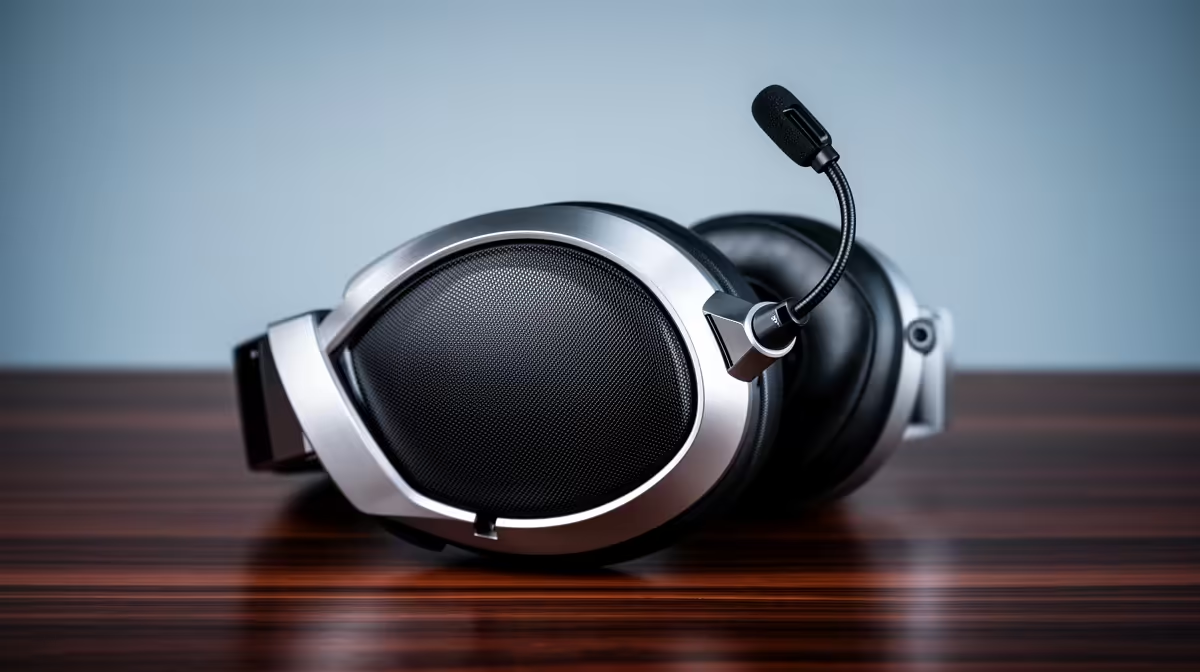
More virtual speakers do not guarantee a clearer footstep direction. Choosing stereo vs 7.1 for FPS means testing the same scene, volume and game audio settings to learn which presentation preserves location cues for you.
Quick Answer
Stereo gives an FPS two output channels, while virtual 7.1 processes those channels to create directional cues around your head. Either can work. A game with its own headphone spatial audio may already convert the 3D scene for stereo headphones, and adding a second surround layer can blur direction or distance. Claims about what most professional players use need current, player-level evidence, because settings change by title and event. Start with one spatial system, compare it against clean stereo at matched volume, and keep the mode that helps you place sounds with fewer mistakes.
Stereo headphones can carry 3D cues
Humans locate sound through timing, level and frequency differences between the ears. Games can encode those clues into two headphone channels. That is why stereo does not mean every sound sits on a flat line from left to right.
A game's headphone mix may use head-related transfer functions, often described as HRTF, to suggest height, front and rear position. The quality varies by game, and the result interacts with your ears and head shape. One profile may place a sound behind you with ease while another makes front and rear harder to separate.
Plain stereo can also mean the game sends a basic two-channel mix without a binaural spatial stage. Check the audio menu instead of assuming the word "headphones" tells you the whole path.
What virtual 7.1 does
Virtual surround software takes multichannel or positional information and processes it for two physical earcups. It may add timing, frequency and room cues that make the scene feel wider. The processing can live in the game, operating system, headset app or USB sound device.
That flexibility creates a trap. If the game applies headphone spatial audio and the headset app then virtualises the result again, you have stacked two processors. Direction can become diffuse, reverb can grow, and distance may feel wrong. Use one spatial stage at a time unless the game or hardware maker documents a combined setup.
Virtual 7.1 can be enjoyable in a cinematic campaign where space and atmosphere matter. For competitive play, the question is narrower: can you identify the direction and distance of a useful sound faster and with fewer errors?
Why a professional-player claim needs care
Player settings are snapshots. A professional may change headset, game version, event computer or team setup. Published profiles can also omit software processing outside the game. A count drawn from one title cannot represent every competitive FPS.
Tournament rules vary. An organiser may provide a communication headset, require noise isolation or control the PC image. Some players wear in-ear monitors under event ear protection. Those conditions are far removed from a home headset comparison.
If you want to copy a specific player's setup, use a dated primary source from that player or team and match the whole chain. Even then, treat it as a starting point. Their hearing, training and role in the team are different from yours.
Run a useful stereo-versus-surround test
Choose a repeatable training map, replay or private match. Reset the game's audio to a known state and note every active spatial option. Turn off operating-system and headset surround for the stereo pass. Keep the same headset, equaliser and master volume.
Run a fixed route and record four things: front-versus-rear errors, vertical errors, distance judgement and how quickly you identify a cue. Repeat the route with one virtual surround mode enabled. Match perceived volume, because a louder mode often seems clearer during a quick comparison.
Use several cue types. Footsteps test movement tracking, reloads test fine detail, and gunfire tests distance and reflections. A mode can help one cue while making another harder to place. Give each setting more than one round, since your brain needs time to adapt to a new spatial filter.
Then test a busy fight. Positional clarity can change when music, team chat and explosions arrive together. If surround gives you a broad sense of space but loses the exact doorway, stereo may suit ranked play. If the game's stereo mix makes rear cues collapse and one spatial mode fixes that, keep the processor.
EQ and ear pads can change the result
Virtual surround gets much of the attention, yet the headset's base tuning may be the larger issue. Strong low frequencies can cover quieter midrange detail. A modest, model-specific EQ can help, though extreme boosts can cause distortion or make other cues harsh.
Ear-pad seal changes bass and channel balance. Glasses, worn pads or hair under one side can alter what reaches each ear. Seat the headset the same way for both tests and replace damaged pads with parts suited to the model.
Avoid chasing a universal "footstep frequency." Games use different samples, surfaces and mixes. A narrow boost that exposes one floor texture can make gunfire tiring and reduce awareness elsewhere.
Check the complete signal path
On Windows, confirm the selected output format and spatial-sound setting. In the headset app, check surround, EQ and game profiles. Inside the game, choose the intended headphone or speaker mix. Change one layer, save it, and restart the game if its audio system requires that.
Wireless headsets can expose different functions through USB receiver, Bluetooth and cable. Console support may differ from PC support. If surround is part of your buying decision, confirm where the processing runs and which connection modes support it.
Browse popular PC peripherals to place the headset in the rest of your setup. The gaming accessory range is useful when you also need the USB audio, stand or control hardware around it.
Keep the setting that produces repeatable location calls in your game. The best spatial mode is the one you can verify with your own mistakes and successes.
FAQ
Do professional FPS players all use stereo?
No dependable rule covers every player, title and event. Use current primary evidence for a named player and test the setting yourself.
Can virtual surround make footsteps harder to place?
It can when processing smears cues or stacks on top of the game's spatial audio. Run one spatial system at a time.
Is virtual 7.1 useful outside ranked play?
It can add space and atmosphere to a campaign or film. Choose it by listening rather than assuming the mode is more accurate.
Compare gaming audio gear and test one spatial mode at a time on your own FPS setup.