Quick Answer
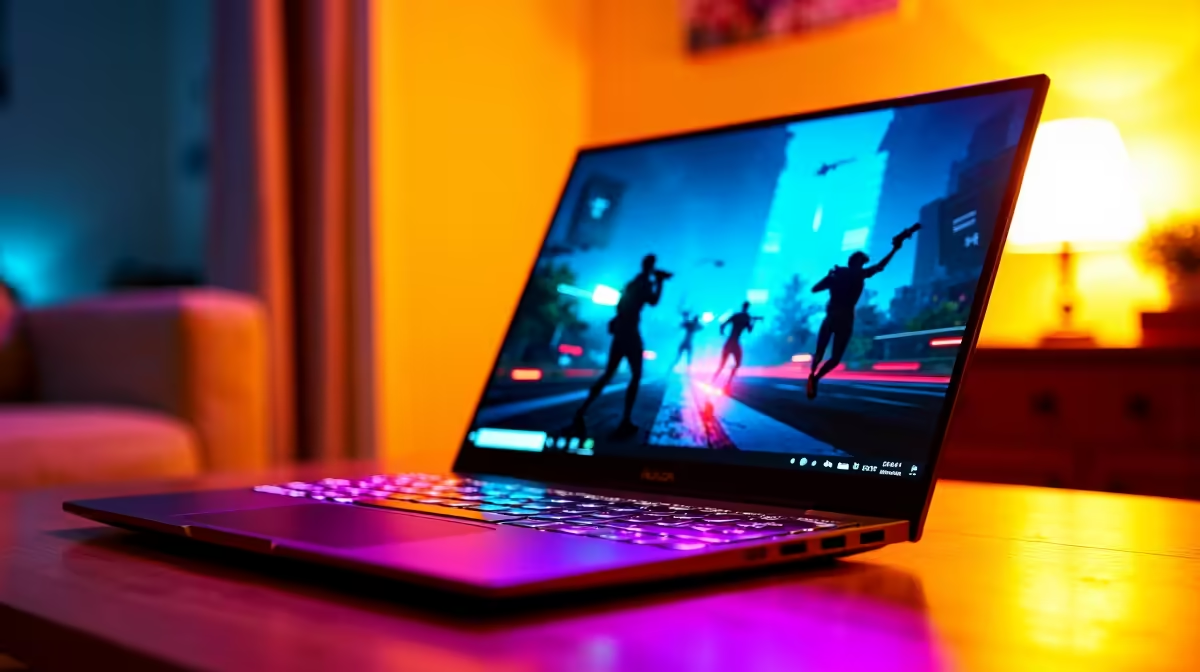
For SA students, a laptop for cinematic story games should prioritise RTX 4050-class graphics, 16 GB RAM, quiet cooling, and a good 1080p IPS screen. Budget around R15,000 to R30,000 for a practical new machine, with the cheapest useful study laptop starting near R8,000 rather than below R5,000. Buy for the software and campus routine first, then tune weight, battery life, and screen size.
Minimum Spec That Makes Sense
The baseline is not the same for every course. For controller-friendly adventure and story games, 8 GB RAM is already tight; 16 GB is the safer floor, while 32 GB matters when scenes, samples, or AI models grow. A 512 GB SSD is workable for first year, but 1 TB is cleaner when projects, games, or media libraries stay on the same machine.
SA Campus Fit And Daily Carry
A student moving between residence, lecture halls, and libraries at UJ, Wits, UCT, Stellenbosch, or UP needs more than a benchmark score. Aim for Wi-Fi 6, a charger that is not oversized, and a screen bright enough for shared study spaces. For heavier cinematic story games builds, accept a 2 kg class chassis if the cooling keeps performance stable under 30 minute workloads.
What To Compare At Evetech
Use named families such as ASUS VivoBook for coursework, Lenovo LOQ for balanced gaming and creation, MSI Katana for GPU-heavy value, and ASUS TUF Gaming where cooling and ports matter. Treat those as comparison families, not fixed live-price promises. If the workload needs GPU acceleration, an RTX 4050 or RTX 4060 Laptop GPU is a more useful signal than a cosmetic chassis upgrade.
FAQ
Is 8 GB RAM enough for cinematic story games?
No for most serious cinematic story games use. It can handle browser notes and documents, but 16 GB gives a much better margin for controller-friendly adventure and story games.
Should a first-year buyer spend more on CPU or GPU?
Spend on CPU, RAM, and SSD first unless the course or gaming need clearly uses the GPU. For rendering, VR, and AI, the GPU becomes a primary buying factor.
What price band should SA students plan for?
Plan from about R15,000 to R30,000, depending on GPU and screen quality. NSFAS-style allowance amounts do not cover a full new laptop on their own, so compare realistic entry-level options.
Student check
Match the laptop to the heaviest app you will open in week one, then choose the lightest model that still meets the RAM, SSD, and GPU requirement.