The complete guide to adjustable actuation and Rapid Trigger begins by separating two controls that are often bundled together. Actuation determines when a press starts. Rapid Trigger determines how the key resets as it rises. Together they can improve repeated movement, but only when each is tuned deliberately instead of set to maximum sensitivity.
Quick Answer
Adjustable actuation sets registration depth; Rapid Trigger changes when a pressed key resets as it rises. Together they can sharpen repeated movement, but safe tuning starts with one stable profile and measured 0.1mm changes rather than maximum sensitivity. At R4,199, the Razer Huntsman V3 Tenkeyless uses Gen-2 analogue optical switches with Rapid Trigger and a stated 0.1mm precision actuation range.
🎯 Learn the two decisions separately
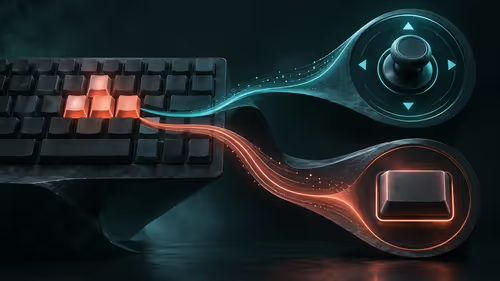
Actuation answers: "How far should this key travel before the computer sees it as a press?" A shallow point can make a movement feel immediate. A deeper point can reduce accidental presses from resting pressure. Neither is universally correct because hands, games and key jobs differ.
Rapid Trigger answers a different question: "When does a key stop being held as it comes back up?" A conventional fixed release point can feel familiar and predictable. Rapid Trigger responds to the upward movement of the key, which can help when you need to stop and reverse direction repeatedly. It can also become over-responsive if tiny natural finger motion begins changing your input.
The practical rule is to set the press before testing the reset. If a key starts unwanted movement before you deliberately press it, Rapid Trigger cannot solve that. First establish a stable actuation point. Then evaluate reset behaviour on the movement keys that actually need it.
Review gaming keyboards and keyboard switches when deciding whether configurability is a tool you will use or a feature you would rather leave fixed.
🧪 Build a baseline you can repeat
Choose one familiar game practice area and one simple typing passage. Connect the keyboard directly to a motherboard USB port and keep polling at 1000Hz for the first profile. The goal is to reduce variables, not to decide that 1000Hz is inferior. If the system feels inconsistent before tuning, you need a stable baseline before any setting can be judged.
Start with a comfortable mid-range actuation point. Run a left-right movement drill for ten minutes. Write down accidental movements, missed inputs and the point at which your hand starts feeling tense. Then change only one key by 0.1mm. Repeat exactly the same drill. A small paper note is enough: setting, accidental inputs, missed inputs and comfort.
This measured approach reveals the point where more responsiveness turns into more errors. It also prevents a tempting mistake: adjusting the whole board at once and then being unable to explain why typing, menus or one game became worse.
⚙️ Give movement and typing different roles
WASD and similar movement keys may benefit from a responsive profile because rapid stopping and reversing are part of the task. Chat, menus, password entry and ordinary writing usually have a different priority. A deeper point can reduce unwanted characters and make a board more pleasant during a work session.
Where profiles are available, keep one for movement and one for typing. Name them clearly. Do not rely on memory after several weeks, because a future troubleshooting session should begin with a known state rather than a guess. The best profile is often a pair of sensible compromises, not one extreme setting forced onto every key.
The Razer board's 0.1mm adjustment is useful here precisely because the changes can remain small. Use the same deliberate step size for the key that needs help, rather than chasing a universally celebrated number.
🔄 Introduce Rapid Trigger carefully
Once a movement key has a predictable press point, enable Rapid Trigger for that key and repeat the drill. Pay attention to whether you can release and reverse more cleanly. Also notice whether a slight lift from a resting finger creates an action you did not mean to take. If that happens, return to the prior configuration or make the relevant setting less sensitive.
Do not assume Rapid Trigger belongs on every key. It has the clearest case on keys used for repeated movement. A typing key can become more difficult to trust when reset sensitivity responds to ordinary finger motion. The control is valuable because it can be targeted, not because it must be spread across the layout.
🖥️ Test polling rate afterward
The Huntsman V3 Tenkeyless has 8000Hz HyperPolling. At a nominal level, 8000Hz reports at 0.125ms intervals compared with 1ms at 1000Hz. That is a separate PC setting. Test it only after actuation and reset behaviour are settled.
Use the same game scene, graphics options and background applications. If the higher rate preserves stable frames and feels useful, keep it. If it coincides with stutter or CPU pressure, return to 1000Hz. A high polling rate does not compensate for a profile that causes accidental presses, and a stable lower rate is a strong result.
🧭 A five-step tuning order
- Establish direct USB and a 1000Hz baseline.
- Identify one key and one specific input error.
- Change actuation by 0.1mm and repeat the same drill.
- Add Rapid Trigger only after the press is predictable.
- Compare polling rates separately, retaining the smoothest whole-system result.
This order gives every setting a reason. It turns configuration from an endless menu into a sequence of reversible decisions.
Keep the settings reversible
Write down the profile name and baseline before trying a more responsive option. If a game, update or tired hands make the new setting feel wrong, returning to a known stable profile is faster than rebuilding the keyboard from memory.
Frequently Asked Questions
Is adjustable actuation the same as Rapid Trigger?
No. Adjustable actuation controls when a press begins. Rapid Trigger changes reset behaviour as a pressed key rises.
Should I choose the shallowest setting for gaming?
Not automatically. The right point is the shortest press that remains predictable and does not create accidental input under normal hand pressure.
Can I use one profile for games and typing?
You can, but separate profiles are often more comfortable. Movement keys may benefit from a more responsive setting while typing needs fewer accidental characters.
Why test 8000Hz last?
It is a separate report-rate setting. Testing it after switch behaviour is stable makes any result easier to identify and repeat.
Ready to make keyboard tuning a controlled experiment rather than a guessing game?
Explore Evetech gaming keyboards and build a profile one repeatable decision at a time.