Quick Answer
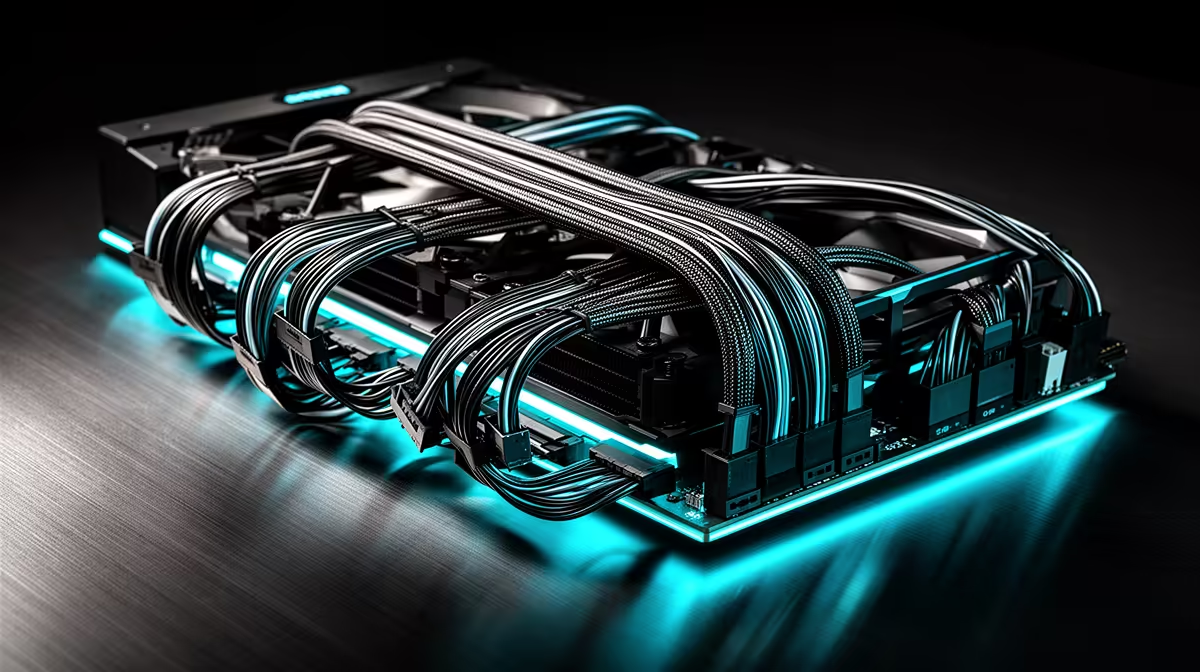
Fully modular cabling means every cable, including the 24-pin ATX and EPS CPU cables, detaches from the PSU entirely. You only plug in the cables your build actually needs, which dramatically reduces cable clutter and improves airflow compared to semi-modular or non-modular units.
What Separates Fully Modular from Semi-Modular 🔧
A non-modular PSU comes with every cable permanently attached, whether your build uses them or not. Semi-modular units fix the 24-pin ATX and at least one EPS cable, detaching only the PCIe and peripheral connectors. Fully modular PSUs detach everything. For a clean build this matters enormously. A mid-tower with a glass side panel and only one GPU, one SSD and no optical drive has no use for three spare SATA daisy chains or a second EPS cable. Tucking those unused bundles behind the motherboard tray is frustrating and restricts rear-panel airflow. A fully modular unit lets you route exactly what you need and store the rest in the box. PSUs of this type at Evetech typically start around R2,000 for 650W Gold and scale to R5,500 for 1,200W Platinum fully modular models.
Cable Quality and Sleeving Matter as Much as Modularity 🖥️
Not all modular cables are equal. Budget PSUs sometimes ship with thin, tightly braided cables that resist bending and make routing awkward. Premium units from established brands use individually sleeved cables with longer reaches, often 650mm or more on the EPS lead, critical for full-tower cases where the PSU mounts at the bottom and the CPU socket is near the top. Some flagship PSUs also offer flat ribbon-style cables that bend at precise angles without kinking. When building a white or tempered glass showcase rig, white sleeved modular cables from matching brands make a visible aesthetic difference.
Airflow and Thermal Benefits Inside the Case 🌬️
Cable management is not purely cosmetic. A bundle of unused cables wedged above the PSU intake fan partially blocks airflow to the fan itself, raising PSU operating temperatures over time. Thermal cycling stresses capacitors and shortens component lifespan. South African summer ambient temperatures can push case internals 5°C to 8°C higher than in temperate climates, making internal airflow optimisation more important here than in cooler regions. A fully modular build with only the necessary cables routed typically drops GPU intake temperatures by 2°C to 4°C compared to an equivalent non-modular build in the same case.
Label Your Modular Cables at Storage ⚡
When you pull your PC apart for upgrades, modular cables from different PSU brands are often not cross-compatible, even if the plug looks identical. Store each PSU's cables in a labelled zip-lock bag to avoid accidentally mixing them, which can short circuits or damage components on reassembly.
FAQ
Are fully modular PSUs worth the extra cost over semi-modular?
For most builds the price difference is R200 to R400. If you value clean cable routing or have a glass-panel case, fully modular is worth it. For a budget build hidden in a corner, semi-modular is a reasonable compromise.
Can I use modular cables from a different brand with my PSU?
No. Modular PSU connectors are not standardised at the PSU end. Using cables from a different brand risks incorrect pinout and can permanently damage your components. Always use the cables supplied with the specific unit.
Does modular cabling affect PSU efficiency or performance?
No, the electrical performance is identical. Modularity is purely a cabling convenience feature and does not change the power delivery or efficiency rating of the unit.
Want a cleaner build with zero cable clutter?
Evetech stocks fully modular power supplies across wattage ranges from 650W to 1,200W, ready for your next build or upgrade.