Quick Answer
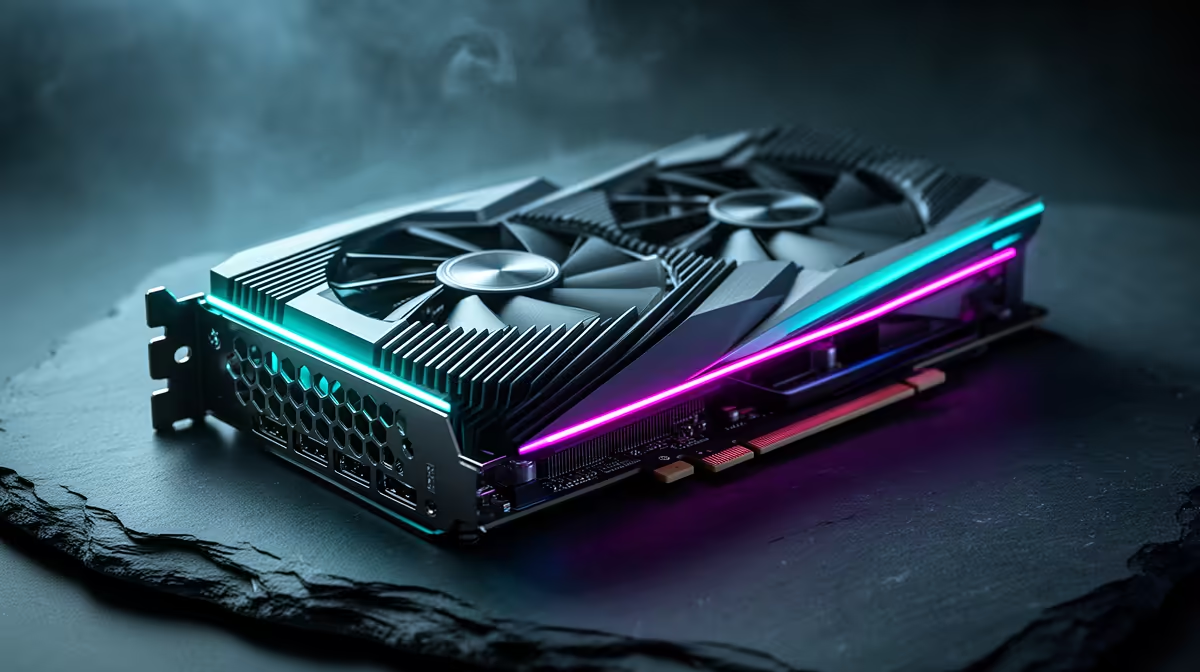
8GB GDDR7 graphics cards represent the best entry point into current-gen GPU performance in 2026. For 1080p gaming, 8GB GDDR7 covers all mainstream titles at High settings comfortably. For creative workloads at 1080p and 1440p output, 8GB GDDR7 handles most common tasks well. The GDDR7 bandwidth advantage extends the practical usefulness of the frame buffer compared to same-size GDDR6 on older cards.
8GB GDDR7 for Gaming: Resolution and Settings Mapping 🎮
At 1080p, 8GB GDDR7 is the right amount of VRAM for virtually all current mainstream games at High settings. VRAM usage at 1080p High sits between 5GB and 7.5GB in demanding open-world titles. Esports games sit well under 4GB at any quality level. Games with optional high-resolution texture packs can push closer to 8GB at Ultra settings, but the standard High preset stays comfortably within the limit.
At 1440p, 8GB GDDR7 is workable but tighter. The frame buffer is larger and the GPU loads higher-detail LOD textures. Some demanding titles approach 8GB at 1440p High with ray tracing enabled. Enabling DLSS Quality mode reduces internal render resolution and VRAM pressure simultaneously, making 8GB GDDR7 more practical at 1440p than 8GB GDDR6 was two generations ago.
8GB GDDR7 for Creative Workloads 🖥️
In DaVinci Resolve, 8GB GDDR7 handles 1080p and 1440p H.264 and H.265 timelines with colour grading and noise reduction without saturating VRAM. For 4K H.265 timelines with heavy effects stacks, proxy media is recommended for smooth playback. Resolve's neural engine AI tools including Magic Mask and scene detection run on 8GB GDDR7 without issue.
In Blender's Cycles GPU renderer, simple to medium complexity scenes at up to 2K render output run within 8GB. Heavy architectural renders with 4K texture maps can exceed 8GB and may need CPU render or Blender's tiling fallback. For most SA video editors and 3D artists working at standard complexity, 8GB GDDR7 handles the workload well.
Comparing 8GB GDDR7 Against Other Current-Gen Configurations 💡
The main alternatives are 12GB GDDR6X on RTX 4070-tier cards and 16GB GDDR6 on some RX 9070 variants. 8GB GDDR7 has lower capacity than both but matches or exceeds 12GB GDDR6X in bandwidth in some configurations. For pure 1080p gaming, 8GB GDDR7 is competitive. For creative workloads with very large scene complexity or 4K video projects, 12GB or 16GB becomes more valuable.
Monitor VRAM in Resolve Before Long Renders ⚡
Enable the Performance panel in DaVinci Resolve under the Playback menu to watch GPU VRAM usage in real time while editing. Catching VRAM saturation early lets you switch to proxy media before starting a long render rather than discovering the limit midway through.
FAQ
Is 8GB GDDR7 enough for AI-assisted features in creative apps?
Yes for most mainstream creative AI tools. Adobe Premiere's AI features including auto reframe and noise reduction run on 8GB GDDR7 without issue. DaVinci Resolve's neural engine features also run comfortably at typical project sizes.
Will 8GB GDDR7 feel limiting in two years?
At 1080p gaming, unlikely. For creative workloads, it depends on whether your project complexity grows. A creator working with increasingly complex 4K projects may find 8GB limiting sooner than a gamer using the same card.
Are 8GB GDDR7 cards available at Evetech under R12,000?
RTX 5060 8GB GDDR7 cards are currently stocked at Evetech. Check the graphics card category listings for current pricing and availability across Palit, ASUS, and Gigabyte variants.
Ready to bring GDDR7 speed to your gaming and creative setup?
Evetech stocks 8GB GDDR7 graphics cards from the RTX 50-series range with local SA warranty. Browse the graphics card category to compare models and find the right card for your workload.