Quick Answer
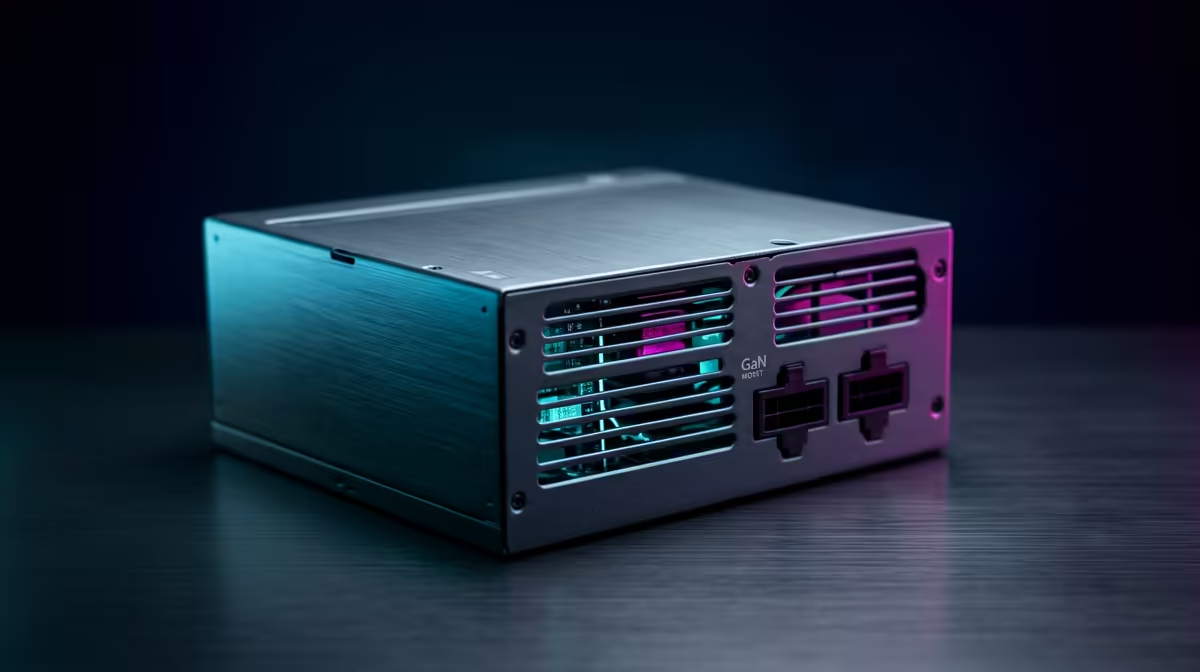
GaN (gallium nitride) MOSFETs are a newer transistor technology used in premium PSU switching stages that switch faster and waste less energy as heat compared to traditional silicon MOSFETs. In gaming PCs, GaN MOSFET PSUs deliver higher efficiency at high switching frequencies, enabling smaller transformer designs, faster transient response and lower operating temperatures without sacrificing output stability.
Silicon vs GaN MOSFETs: The Core Difference 🔬
Traditional PSU switching stages use silicon MOSFETs, which have been the industry standard for decades. Silicon MOSFETs switch adequately at frequencies up to around 100 to 300 kHz, but their switching losses, the energy lost as heat each time the transistor transitions between on and off states, limit how fast you can run them before efficiency collapses. GaN MOSFETs switch at frequencies of 500 kHz to over 1 MHz with dramatically lower switching losses because gallium nitride has a wider bandgap than silicon, allowing faster, lower-resistance transitions.
How GaN Translates to Real Gaming Benefits 🎮
The improved transient response of GaN MOSFETs means the PSU reacts faster to sudden GPU current demand changes, reducing 12V rail voltage droop during transient spikes. This results in fewer GPU driver crashes during demanding scenes and more stable overclocking headroom. The higher switching frequency also translates to lower output ripple: a well-designed GaN PSU may achieve below 20mV ripple on the 12V rail at full load, versus 40 to 50mV for a conventional design. Lower ripple means cleaner power to your GPU's VRAM and processor, which is beneficial for memory overclocking stability. GaN PSUs also run cooler internally, which extends the lifespan of electrolytic capacitors that are sensitive to heat. A capacitor operating at 45 degrees Celsius lasts roughly twice as long as one running at 65 degrees Celsius according to Arrhenius degradation models.
Which PSUs Use GaN MOSFETs and What They Cost in South Africa 💰
GaN MOSFET technology has moved from ultra-premium to mainstream-premium PSU pricing over the past two years. Notable GaN-based units include the Seasonic Prime TX-1000 (Titanium), select Corsair AX series models, and certain ASUS ROG Thor variants. In South Africa, GaN-equipped units in the 1000W to 1200W range are priced from approximately R6,000 to R10,000 at Evetech. They sit above conventional Platinum designs but deliver engineering quality that justifies the premium for a flagship RTX 5090 or multi-GPU compute build. For gaming builds using an RTX 5080 or lower, a conventional Platinum ATX 3.1 unit in the R3,500 to R6,000 range delivers excellent results without the GaN premium.
GaN PSUs and Fan Noise: A Genuine Benefit ⚡
Because GaN switching stages generate significantly less heat than silicon equivalents, GaN PSUs can run their internal fans at lower speeds or even enter fanless mode at moderate loads. A GaN unit in fanless mode at a 400W gaming load contributes zero PSU fan noise to your overall system acoustic profile. If building a near-silent gaming or streaming setup, a GaN-based PSU is one of the most effective individual noise reduction upgrades available.
FAQ
Is a GaN MOSFET PSU necessary for an RTX 5090 build?
No.
Do GaN PSUs require special cables or connectors?
No.
How long do GaN MOSFETs last compared to silicon?
GaN semiconductors themselves are highly durable, but PSU longevity is still primarily determined by capacitor quality and operating temperature.
Building a flagship gaming or workstation PC and want the best power foundation?
Evetech stocks premium GaN MOSFET power supplies alongside the full range of ATX 3.1 Platinum units, with local stock and knowledgeable support for South African builders.