Quick Answer
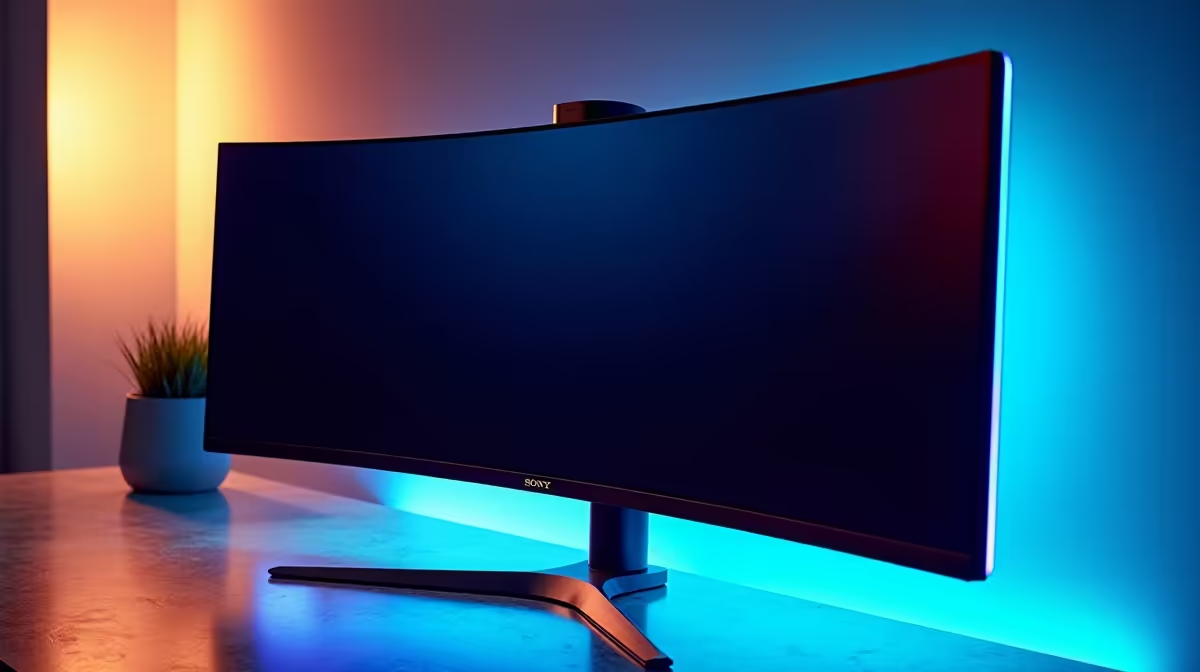
Bedfordview residents buying an ultrawide monitor should focus on two tiers: a 34-inch IPS 3440×1440 144 Hz panel at R5,000–R7,000 (LG 34WP65C, Dell U3423WE class) for productivity and casual gaming, or a 34-inch OLED/VA 3440×1440 165–175 Hz at R14,000–R16,000 (LG 34GS95QE, Samsung Odyssey OLED G8) for serious gaming. An RTX 4070 or RX 7800 XT is the minimum GPU for comfortable 100+ fps at 3440×1440 in modern games.
IPS vs VA vs OLED at Ultrawide: What Each Delivers
IPS 3440×1440 144 Hz (R5,000–R7,000): Best all-round for Bedfordview home offices. Wide viewing angles, accurate colour, good for Excel, PowerPoint, coding, and casual gaming. 1 ms GTG response, 1,000:1 contrast. Main limitation: grey blacks in dark games.
VA 3440×1440 165 Hz (R7,000–R10,000): Higher contrast (3,000–5,000:1) than IPS — dark scenes in games look better. Slightly slower response (4 ms GTG typical) can cause motion blur at 165 Hz versus IPS. Good middle ground between IPS productivity and OLED gaming.
OLED 3440×1440 165–175 Hz (R14,000–R18,000): Best gaming quality. 0.03 ms response, 1,000,000:1 contrast, HDR True Black. Transforms open-world and RPG titles. Bedfordview gaming setups with RTX 4080 class GPUs make full use of it.
GPU Requirements for 3440×1440 Gaming
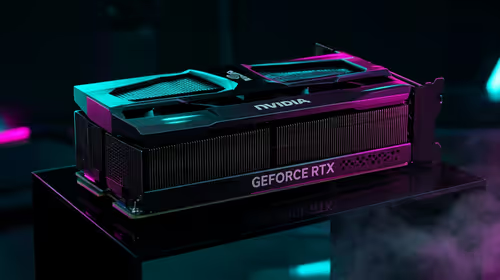
Ultrawide 3440×1440 demands more GPU headroom than 2560×1440 (about 30% more pixels). Minimum for 60 fps AAA: RTX 4070 (R11,500 at Evetech). Recommended for 100+ fps AAA: RTX 4080 (R22,000). For competitive esports at 144+ fps: RTX 4080 or RX 7900 XTX class. Pair your ultrawide choice to your GPU before buying — an IPS 144 Hz panel at R6,000 with an RTX 4070 is a better combo than an OLED at R15,000 that your GPU can't push above 60 fps.
FAQ
Is a 34-inch ultrawide better than a 27-inch 1440p for a Bedfordview home office?
For productivity — yes. The 21:9 aspect ratio gives 33% more horizontal screen space, which transforms multi-window workflows: two A4-width documents side by side with room to spare, or a spreadsheet and reference window open simultaneously. For competitive gaming, a 27-inch 2560×1440 144 Hz IPS is better value — less GPU demand and better frames-per-rand than ultrawide.
What desk depth do I need for a 34-inch ultrawide monitor?
A 34-inch ultrawide needs a minimum 60–70 cm viewing distance — any shallower and the periphery falls outside comfortable head movement range. Standard desks (60–65 cm deep) are borderline; a monitor arm that pushes the screen 5–10 cm forward of the stand is often the solution. A 65 cm deep Bedfordview home office desk with a monitor arm comfortably fits a 34-inch ultrawide at the right distance.
Can a PS5 or Xbox Series X use an ultrawide monitor properly?
No — PS5 and Xbox Series X do not natively support 21:9 ultrawide resolutions. They output at 16:9 (1920×1080 or 3840×2160), and most ultrawide monitors display this with black bars or stretched depending on settings. Ultrawide monitors are primarily a PC gaming and productivity display format. For console gaming, a standard 27-inch or 32-inch 16:9 panel is more appropriate.
1440p (2560×1440) scaling mode on your ultrawide monitor for competitive games — many ultrawide panels render a centred 1440p 16:9 image with black side bars, boosting fps by 25–30% versus native 3440×1440 for the same GPU.