Quick Answer
Vertical GPU mounting eliminates sag completely because the card's weight is distributed across its own support plate rather than cantilevered from the PCIe slot. Case-mounted brackets prevent sag effectively when correctly adjusted. Vertical mounting is the better engineering solution but costs R400 to R900 more for a PCIe riser cable and requires compatible case support.
How Vertical Mounting Prevents Sag Mechanically 🔩
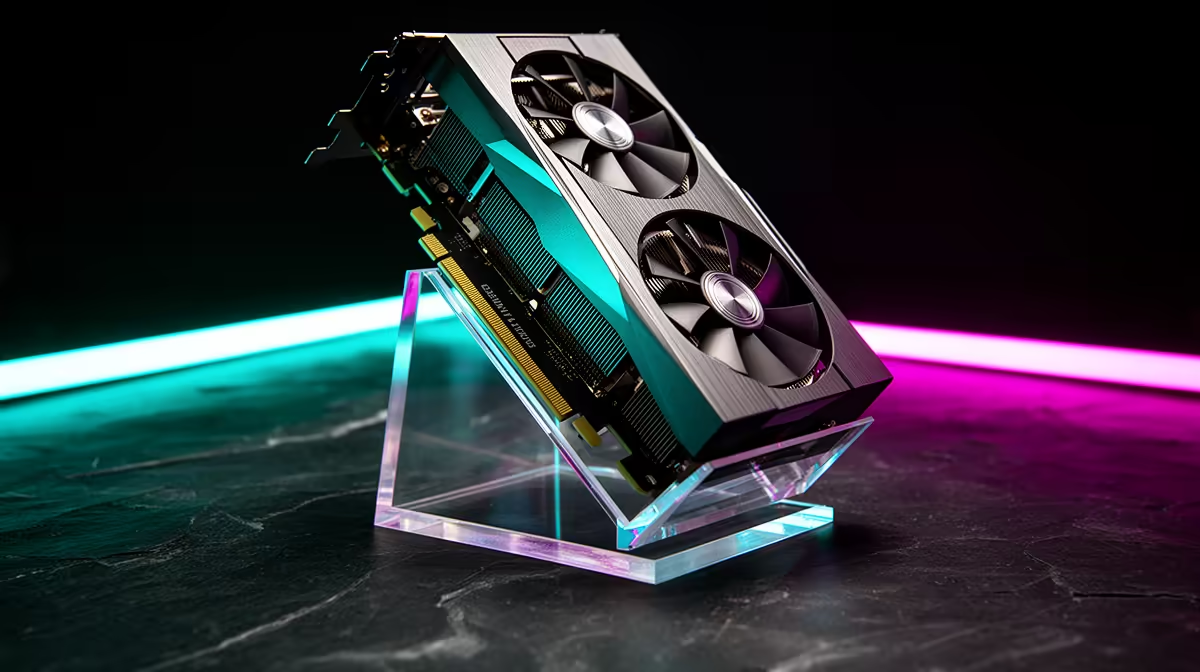
In a standard horizontal PCIe installation, the GPU's mass is supported at one end by the PCIe x16 slot and the expansion bracket screw at the rear, with the other 300mm to 400mm of card length unsupported. Vertical mounting rotates the GPU 90 degrees so it faces the tempered glass side panel. In this orientation, the card's weight is distributed vertically along the riser bracket's length rather than horizontally via the PCIe slot. There is no gravitational lever arm pulling the front of the card downward, so sag is physically eliminated.
Case-Mounted Bracket Performance and Limitations 📌
Case-mounted GPU support brackets are effective when correctly adjusted and maintained. A quality adjustable bracket prevents sag to within 1mm to 2mm of level, eliminating all meaningful mechanical stress on the PCIe slot. The limitation is that bracket adjustment screws can loosen over 6 to 12 months of vibration exposure, gradually allowing the card to resag unless periodically checked. Bracket tips also compress over time, reducing effective contact height by 1mm to 3mm. A quarterly check of bracket tightness and contact takes under 5 minutes. For a build that will not be opened regularly, vertical mounting removes this maintenance requirement entirely.
Cost and Complexity Trade-offs 💰
Vertical GPU mounting requires: a case with native vertical PCIe slot positions, a PCIe 4.0 or 5.0 riser cable to avoid bandwidth penalties, and usually a separate purchase of R400 to R900 for the riser cable and bracket assembly if not included with the case. The cost of a plain GPU support bracket is R250 to R400, delivering 95 percent of the sag-prevention benefit at a fraction of the investment. For SA builders prioritising GPU and case budget, a quality adjustable bracket is the pragmatic choice. Vertical mounting is most justified in showcase builds where the GPU display orientation facing the glass panel is part of the aesthetic goal, not purely a sag-prevention measure.
Always Use PCIe 4.0 Riser Cable Minimum for Vertical Mounting ⚡
Older PCIe 3.0 riser cables limit bandwidth to 16 GB s versus 32 GB s for PCIe 4.0, which can reduce GPU performance by 5 to 15 percent in bandwidth-sensitive titles at 4K resolution. Before purchasing a vertical mounting kit, confirm the included riser cable is rated for PCIe 4.0 or 5.0. A R50 to R100 saving on a lower-generation cable is not worth the performance penalty on a R20,000 GPU.
FAQ
Does vertical GPU mounting affect GPU cooling performance?
Yes, sometimes negatively. In vertical orientation, the GPU intake fans face the tempered glass side panel. If the gap between the fans and the glass is less than 30mm, the fans recirculate hot exhaust air, raising GPU temperatures by 5°C to 15°C.
Can I vertically mount a GPU in any case using a riser cable?
Only if the case has PCIe expansion slots positioned in the vertical orientation near the side panel. Most standard cases do not. Some cases sell optional vertical GPU mounting kits as accessories.
Is a vertical-mounted GPU more vulnerable to damage during transport?
Potentially. In vertical orientation, the GPU's mass presses laterally against the riser bracket during transport vibrations rather than against the PCIe slot.
Exploring vertical mounting or standard GPU bracket support for your build?
Browse Evetech's range of GPU support brackets and cases with vertical mount compatibility to find the right sag prevention solution for your setup.