



Marvel Rivals launch in South Africa
Marvel Rivals launch needs a balanced parts plan, not a random basket. Map the CPU, GPU, RAM, SSD, cooling, and monitor target to the budget so SA builders know where to spend first.
Read moreForget the marketing fluff: game stutter on a ddr5 nvme gaming matters only when GPU length, radiator size, and noise targets align with your SA build plan. Built for SA gaming PC buyers. Compare picks.
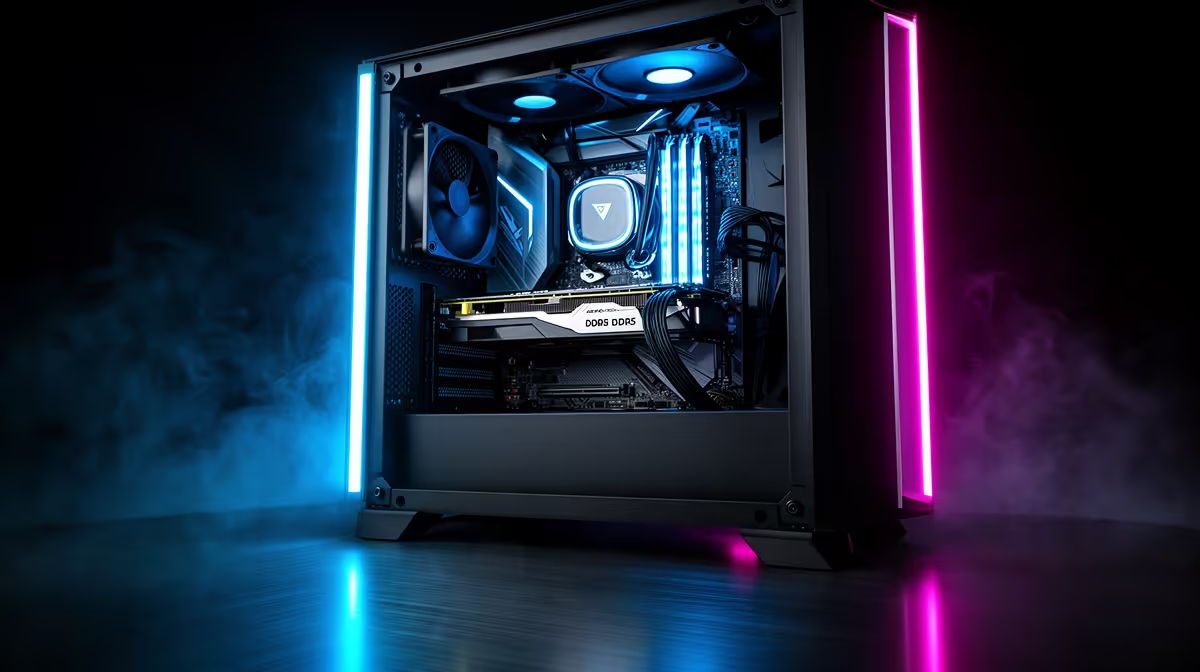
Game stutter on a DDR5 NVMe system is most often caused by shader compilation hitches, Windows background processes interrupting the CPU, or a mismatch between the GPU's frame output and the monitor's refresh rate. DDR5 and NVMe eliminate old bottlenecks, so persistent stutter on modern hardware is almost always a software or synchronisation problem rather than a hardware deficiency.
DirectX 12 and Vulkan titles compile shaders on the fly the first time you encounter them in a session, producing the freeze-and-recover stutter many players mistake for a hardware fault. Titles like Hogwarts Legacy, Elden Ring, and the Unreal Engine 5 catalogue are well-known offenders. Let the game run a full shader pre-compilation pass on first launch, usually triggered automatically or available in the graphics menu. After pre-compilation, revisiting the same areas produces no stutter. A PCIe 4.0 or 5.0 NVMe drive speeds up this step, which is one of its practical gaming advantages beyond load times.
Windows Defender real-time scanning triggers mid-game CPU spikes when game files are written to disk during auto-saves or live-service updates. Add your game library folder to Defender's exclusion list to remove this without disabling protection globally. Xbox Game Bar consumes CPU cycles even when its overlay is hidden, so disable it via Windows Settings under Gaming. On AM5 or LGA1851 platforms, confirm XMP or EXPO is enabled in the BIOS. Running DDR5 at 4800MHz base instead of 6000MHz to 6400MHz rated speed introduces micro-stutter in bandwidth-sensitive titles and is one of the most common overlooked settings on new builds.
Stutter is often not about average FPS but inconsistent frame delivery. A game averaging 90fps but delivering frames every 8ms to 22ms alternately feels worse than a steady 72fps. Enable G-Sync or FreeSync on a compatible monitor to synchronise the display's refresh to each delivered frame. Cap your frame rate 3fps below your monitor's maximum refresh using the in-game limiter. This keeps the GPU behind full throttle and smooths frame delivery variance that causes perceived stutter even when the FPS counter looks fine.
Disabling the High Precision Event Timer via an elevated command prompt (bcdedit set useplatformclock false) reduces timer resolution overhead on Ryzen platforms and smooths micro-stutter in CPU-sensitive games. Revert with bcdedit deletevalue useplatformclock if any instability appears.
Yes, particularly on Ryzen 7000 and 9000 series platforms where the memory controller is sensitive to clock speed and timings. Running DDR5 at 6000MHz CL30 versus 4800MHz CL40 can reduce 1% low frame times by 10% to 18% in open-world titles, which directly translates to less felt stutter.
In open-world games that stream assets continuously, a PCIe 3.0 NVMe can bottleneck during traversal, producing pop-in and micro-freezes. Upgrading to a PCIe 4.0 drive with sequential reads above 5,000MB/s resolves this in titles built around DirectStorage.
Rarely. Most stutter on new high-end systems traces back to default Windows settings or shader compilation on first play. Work through software fixes before an RMA, as hardware defects causing stutter are far less common than configuration issues.
Stutter ruining your gaming sessions? Evetech stocks DDR5 gaming PCs and PCIe 4.0 and 5.0 NVMe upgrades that give modern titles the storage bandwidth they need. Browse gaming desktops and NVMe drives at Evetech.
Marvel Rivals launch needs a balanced parts plan, not a random basket. Map the CPU, GPU, RAM, SSD, cooling, and monitor target to the budget so SA builders know where to spend first.
Read more
Path of Exile 2 launch needs a balanced parts plan, not a random basket. Map the CPU, GPU, RAM, SSD, cooling, and monitor target to the budget so SA builders know where to spend first.
Read more
Black Myth Wukong launch needs a balanced parts plan, not a random basket. Map the CPU, GPU, RAM, SSD, cooling, and monitor target to the budget so SA builders know where to spend first.
Read more
Hollow Knight PC requirements should be mapped to resolution, settings and upgrade budget before choosing a tier. Verify current requirements, then balance GPU, CPU, RAM and SSD around SA pricing.
Read more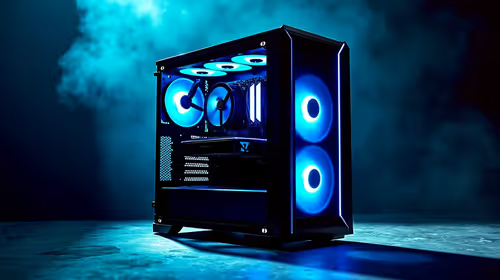
Hollow Knight build planning should focus on the target resolution, settings and total system balance. Treat launch wording as time-sensitive, then verify requirements before choosing SA PC parts.
Read more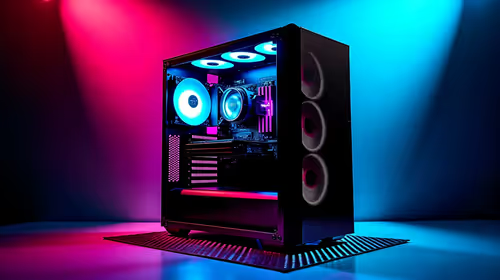
Fallout 4 PC requirements should be mapped to resolution, settings and upgrade budget before choosing a tier. Verify current requirements, then balance GPU, CPU, RAM and SSD around SA pricing.
Read more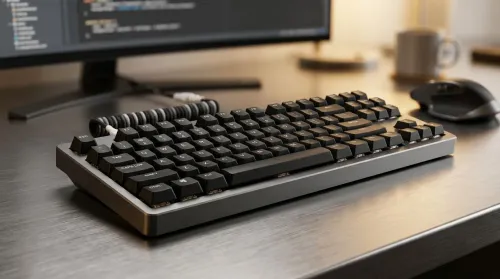
Wondering if a TKL wireless mechanical keyboard is worth it for everyday productivity? We break down latency, battery life, comfort, and workflow gains for real work. ⚡⌨️

Maximise battery life on a fanless 15-inch laptop using efficiency core architecture. Cut idle drain, tune power profiles, and improve thermals for longer runtime. 🔋⚙️
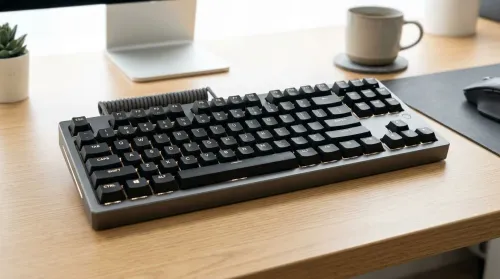
Learn how to reduce desk clutter with a TKL wireless keyboard using fewer cables, smart placement, and tidy essentials. Get a faster, calmer workspace with better ergonomics. ✅🧼
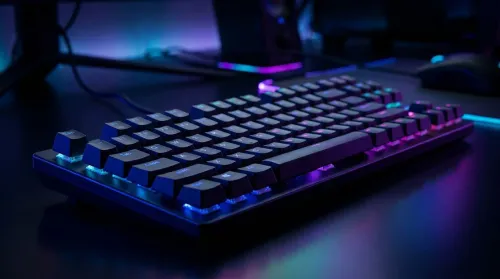
RGB keyboard lighting too distracting? Learn how to manage backlight modes, set brightness, and reduce distraction for focus and productivity 😌🖱️
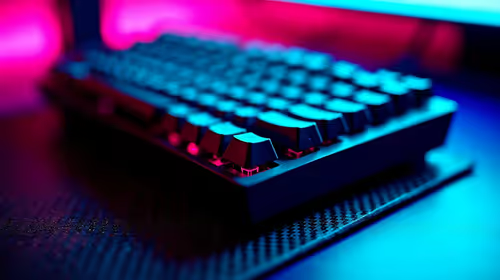
Are themed gaming keyboards worth the extra cost? Compare build quality, switch options, features, and resale value to find the best fit for your setup 🎮⌨️
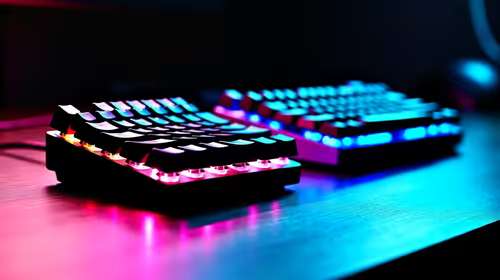
Full-Size vs Tenkeyless mechanical keyboards for gaming: find out if a smaller layout truly improves aim, speed, and comfort. We break down layout, desk space, latency-feel, and keybinds 🎮⌨️

Dedicated media rollers vs function key shortcuts: learn which setup gives you better workflow control, faster media access, and fewer mistakes. 🖱️🎧
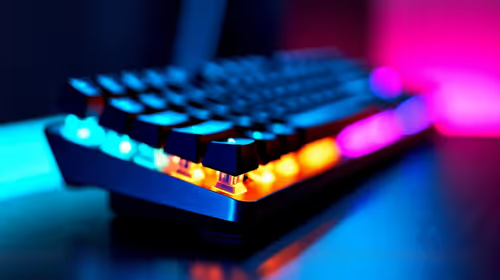
Best Mechanical Switch Type for Gaming: Clicky vs Linear vs Tactile. Find your feel, speed, and noise balance with practical guidance for FPS, MOBA, and productivity 😄🎮
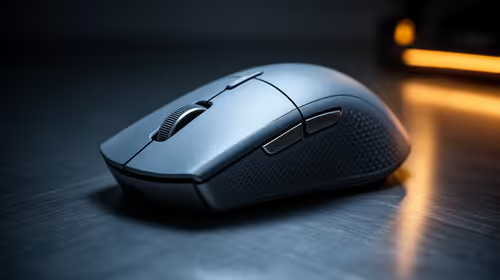
Direct mouse answer: Mouse not keeping up with your work? Everything that matters about dual-mode 2.4GHz + BT 5.0: DPI behaviour, channel switching, battery curves and per-app button mapping. Covers when 2.4GHz USB wins (low-latency desk) and when BT 5.0 wins (laptop, d
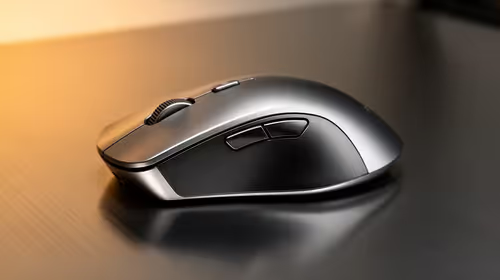
Plain wireless mouse guide: Mouse not keeping up with your work? Everything that matters about wireless productivity mouse: DPI behaviour, channel switching, battery curves and per-app button mapping. Includes DPI tuning tips, channel switch shortcuts, and ZAR-aware fea
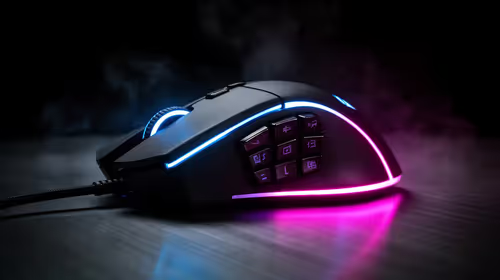
Real productivity numbers: Set up your wireless mouse in this order: everything that matters about wireless productivity mouse: DPI behaviour, channel switching, battery curves and per-app button mapping. Includes DPI tuning tips, channel switch shortcuts, and ZAR-aware
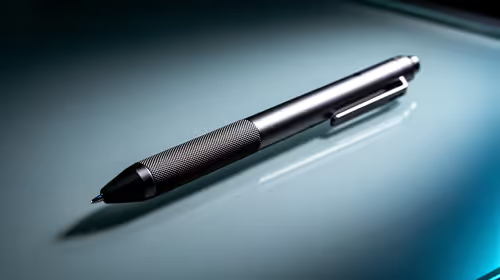
Pen not feeling like paper? Stylus lag and skipping usually trace to old drivers, dirty nibs, or display refresh mismatches, not the pen itself. Covers pressure curve tuning, tilt thresholds, nib swap timing, and SA pricing brackets.